While leaning toward the United States, President Javier Milei has been adjusting ties with China. Given the U.S. strategic narrative of “Western Hemisphere First,” his approach to balancing relations with Beijing and Washington may serve as a bellwether for the foreign policy strategies of other countries across the region.
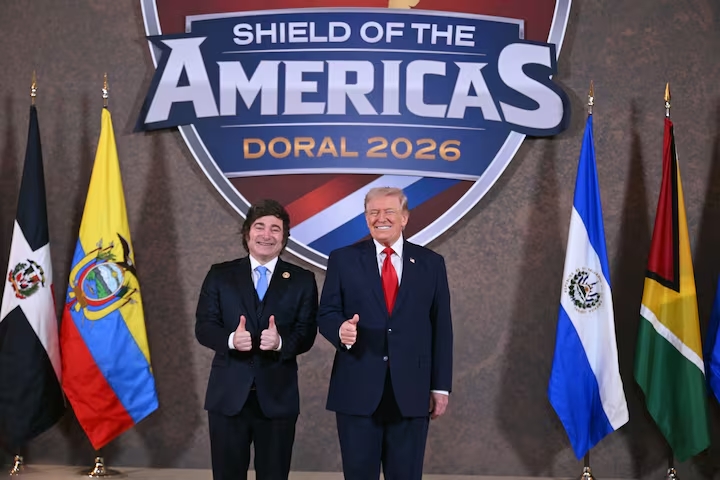
Argentine President Javier Milei recently attended the inaugural “Shield of the Americas” gathering hosted by Donald Trump. Its purpose was forging a shield in a high-profile way. Touted as an initiative to promote regional freedom, security and prosperity, the summit was primarily designed to counter the “spear of extra-regional major powers” extending into Latin America.
Meanwhile, Argentina announced the resumption, after a suspension of nearly two years, of the country’s largest hydropower project. It is being built by the Chinese-funded China Gezhouba Group. The move indicates that while leaning toward the United States, Milei has been adjusting ties with China. Against the backdrop of the U.S. strategic narrative— “Western Hemisphere first”— his approach to balancing relations with Beijing and Washington may serve as a bellwether for the foreign policy strategies of other countries in the region.
Though widely considered an Argentine version of Trump, Milei is by no means a carbon copy of the U.S. president, though a staunch supporter. He has been hailed by Trump as his “favorite president.” The two share striking personality traits: Both are outspoken and prone to making provocative remarks. Both govern with an iron fist and favor radical measures. Ideologically and in terms of values, they belong to the traditional conservative political camp, opposing abortion and homosexuality and joining hands to expand the influence of the Conservative Political Action Conference (CPAC) on a global scale.
But their political and economic propositions are not identical. On immigration, despite publicly endorsing Trump, Milei has not enforced extreme deportation measures against undocumented immigrants since taking office. Instead, he only tightened immigration controls after winning in the midterm election. On climate change, while he has echoed Trump’s skepticism, his country has not followed Washington in withdrawing from the Paris Agreement; rather, it remains somewhat detached from global climate cooperation.
The more fundamental differences between the two presidents lie in their economic thinking and philosophy. As an adherent and practitioner of the Austrian school of neoliberal economics, Milei advocates liberalization, marketization and privatization. He champions the virtues of small government and firmly opposes state intervention in economic activities. Therefore, the core of what might be called Milei Economics is a laissez-faire market system combined with an open economy based on trade liberalization. This sets him apart from Trump, who pursues tariffs-based unilateralism and protectionism and a mercantilism that advocates state intervention in trade and industrial policies. As The Economist once observed, radical right-wing forces in Latin America are similar yet distinct— “more cousins than brothers.” The metaphor is even more apt when describing the relationship between Milei and Trump.
It should be noted that as the United States seeks to reshape the geopolitical landscape of the Western Hemisphere through the summit, the Milei administration is likely to deepen its ties with Washington. Trump’s decision to convene the summit amid intense tensions with Iran demonstrates his resolve to pursue the so-called Donroe Doctrine and highlights the unique position of the Western Hemisphere and its interests in his global strategic readjustment.
The moves to oust Nicolas Maduro and bring Venezuela to heel, together with the operation to eliminate Iran’s Ebrahim Raisi, brought an exceptionally charged geopolitical atmosphere to the summit. Trump’s declaration that “Cuba is the next target" signaled his readiness to wield a “big stick” against any Latin American country he deems defiant. While brandishing the big stick, the summit also offered incentives to participating countries. For instance, Washington pledged to boost public and private capital investment in “like-minded” regional countries and to sign initiatives, such as the American Energy Agreement and the American Infrastructure Agreement.
These initiatives span numerous fields, including mineral resources, ports, digital networks, immigration and counter-narcotics cooperation. They are expected to involve investment levels far exceeding those of the Growth in the Americas Initiative launched during Trump’s first term.
U.S. hegemonic moves in its backyard have reinforced Milei's belief in the political correctness of his initial alignment with Washington. Trump’s intervention to help Milei secure a come-from-behind victory at the critical juncture of the midterm elections further strengthened his resolve to follow Trump’s lead.
As Argentina enters its peak debt repayment period in the middle of the year, the country’s strained foreign exchange reserves have become a vulnerability that could determine the success or failure of Milei’s reforms. Whether Washington will provide further financial support for the country has emerged as a crucial variable. With the reforms entering increasingly difficult territory, “seeking U.S. financial support has become Milei’s last lifeline,” the Latin American financial media company El Financiero proclaimed. Thus, U.S. efforts to reshape the Western Hemisphere's geopolitical order and the specific needs of Milei's “shock therapy” point to the same conclusion: his administration is likely to continue deepening its alignment with the United States.
At the same time, driven by economic and financial interests, Milei has also been constantly adjusting relations with Beijing, making his China policy increasingly pragmatic. Faced with the dilemma of choosing between China and the U.S., he did not adopt a middle-ground strategy, as have many middle powers, during his campaign or in the early days of his presidency. Instead, he leaned largely toward Washington. His campaign rhetoric criticizing China as “an assassin” foreshadowed a chill in China-Argentina relations. After taking office, the suspension of several projects in Argentina undertaken by Chinese-funded enterprises cast a shadow over bilateral ties.
However, as Argentina’s “chainsaw” reforms move deeper, Milei, who won the election by playing the economic card, has increasingly recognized that Argentina cannot extricate itself from its economic predicament without China, its second-largest trading partner. The country’s economic pillars, such as the soybean and beef industries, are heavily reliant on China as a major market. In particular, the renewal of the currency swap agreement with Beijing, valued at RMB 35 billion, in June last year provided crucial support for Argentina to repay its international debts and stabilize its exchange rate.
Acknowledging China’s irreplaceable role in his country’s economic and financial stability, Milei has adopted a more rational and pragmatic approach toward Beijing. Early this year, he said in an interview that he hoped to visit China within the year. Similarly, the appointment of Diana Mondino, a seasoned hand in China affairs, to his core decision-making circle is regarded as part of an effort to recalibrate relations with China.
Despite Milei’s claim that geopolitics and trade cooperation are separate matters, pressures from both Washington and within Argentina have riddled this adjustment with uncertainties. Peter Romero, Trump’s designated ambassador to Argentina, said bluntly before taking office that his mission would be to contain China’s influence in Argentina. After Trump launched Shield of the Americas—which is designed to prevent external forces from gaining a foothold in Latin America—balancing geopolitical and economic considerations with both China and the U.S. has become an unavoidable dilemma for Milei, who has largely chosen to dance to Washington's tune.
At the same time, divisions within the government have complicated the adjustment of his China policy. Vice President Victoria Villarruel said that a complete free market opening in Argentina would risk result in even more dependency on China, exposing the nation’s political rifts over China policy.
In the history of modern international relations, third-party countries are often swept into trouble when they take sides amid competition between major powers. In contrast, a non-aligned foreign policy that maintains equal distance from major powers and seeks to benefit from cooperation with both sides can sometimes achieve the optimal outcome of maximizing national interests. For Argentina, the key to balancing relations with China and the U.S. lies in its ability to transcend political dependence and maintain strategic autonomy. Latin America is not an arena for China-U.S. rivalry. If Argentina can break free from the shackles of the Trump Doctrine and adopt a long-term strategic vision, it may serve as a lever to drive win-win cooperation between China, the U.S. and Latin America.
