
It’s no secret that the relationship between Asia’s two largest states is far from friendly, but the present window of opportunity for new global leaders to take center-stage could turn things around if both play to their strengths.
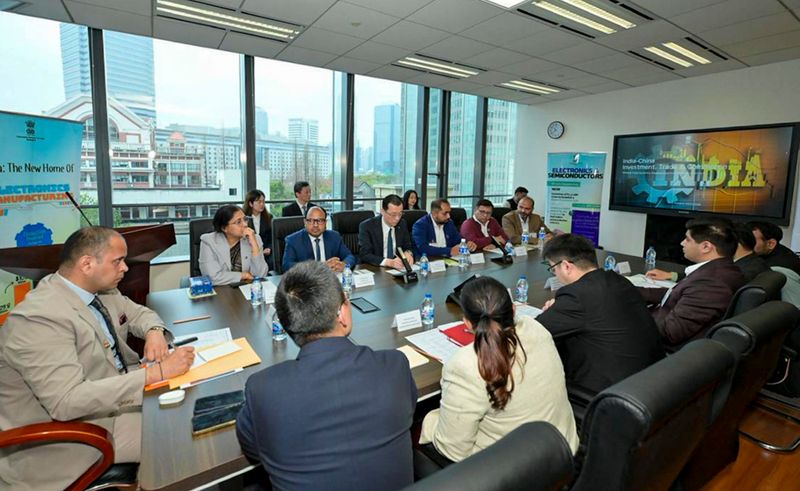
A business roundtable between the PHDCCI and Chinese companies. After 5-year hiatus, Indian biz delegation visits China from March 29 to April 4, 2026.
Winds of change are taking to the Sino-Indian relationship.
On March 11th, the Indian cabinet announced that it would be easing the Press Note 3 rules on investment from neighbouring countries, thereby allowing for limited Chinese investments in the manufacturing of electronic parts, solar panels, and other capital goods.
From March 29th to April 4th, a delegation of the Punjab, Haryana, and Delhi Chamber of Commerce and Industry visited Shanghai and Jiangsu, with Chinese state media lauding the visit as “add[ing] to [the] warming trend of China-India economic ties”, an indication of the wider, shifting tone from the very top.
The détente between China and India, which had found themselves actively at loggerheads after the 2020 border clashes, had first begun with the preparatory meetings in the run-up to the key leadership summit between Indian Prime Minister Narendra Modi and Chinese President Xi Jinping at Kazan in 2024, and was followed by both the meeting itself, as well as the Modi-Xi-Putin rendezvous at the SCO summit in Tianjin in 2025.
Existing commentaries have tended to frame such improvements as induced by Trump’s brusque and vulgar treatment of India. Indeed, the second Trump administration’s treatment of India has left many keen observers of the India-U.S. engagement during Trump I and Biden incredibly puzzled. Senior American officials have repeatedly accused the most populous economy in the world of “unfair trade”, with the President himself dubbing India and Russia, on one of his petulant rants, “dead economies”.
More recently, U.S. Deputy Secretary of State Chris Landau addressed a packed room at India’s flagship annual Raisina Dialogue, noting that the U.S. is “not going to make the same mistakes with India that [the U.S.] made with China 20 years ago”, in enabling India to become a peer rival to the U.S. With such refreshingly candid allies, who needs enemies?
Two Tropes in Existing Discourses on Sino-Indian Relationship
I had the pleasure of attending Raisina this year. Indeed, my five days in New Delhi proved to be a thoroughly transformative and mesmerising experience – one that left me with deeper insights into Indian foreign policy, but also the realisation that I had only scratched the surface of a very complex body of thought.
The visit has also alerted me to the following observation: discourses about the Sino-Indian relationship today – especially in the two countries – are shaped by two common perceptual tropes.
The first is what I term the “Third Power Fixation”. The second can be termed the “Negative Frame”.
The former is a view espoused especially by various commentators in Chinese foreign policy circles, which posits that to the extent Delhi appears interested in pursuing a warmer relationship with Beijing, such interest can only be attributed to the haughtiness of Washington, and the desire of Indian political elite to signal disapproval and – perhaps – costs over the U.S. elite’s foolhardiness.
Indeed, in this era of Trumpian duplicity and capriciousness, however, many in Delhi – but also regional hubs such as Mumbai, Bengalaru, Hyderabad, and Ahmedabad – are rightly having second thoughts about their engagements with the U.S. Former Foreign Secretary Shyam Saran recently noted, “We should seek new partners who are also being targeted by America – some perhaps in worse shape than we are.”
This view also asserts that India is fundamentally subservient to the U.S., and that any and all attempted improvements to Sino-Indian relations could well be (successfully) throttled by American pressure.
The latter view comprises the assessment that attempts to strengthen Sino-Indian relations must be oriented around managing the ‘negatives’ between the two – the territorial disputes along the Line of Actual Control, the military skirmishes, the vicious nationalism on display across media in both countries, or indeed, the existential thorn (for Indians), of Sino-Pakistan friendship.
There is some grain of truth to both claims – namely, that Delhi does take very seriously (albeit non-determinatively) Washington’s attitudes towards Beijing as one amongst many signals concerning its policy space on China, or that the Sino-Indian dynamic is riddled with pitfalls and prospective traps. Yet the effects of these considerations also tend to be exaggerated.
To the first, many in the Indian foreign policy establishment in fact position themselves as pursuing policies that are aligned firmly with their national (if not state-based) strategic, military, and economic interests. What the Ministry of External Affairs S. Jaishankar terms to be “multi-alignment or multi-vector” policies is the bread and butter of a state apparatus that keeps all parties equally engaged and maintains equal distance from competing powers.
An emerging China, with its rapidly ascending economic, security, and technological capabilities, has indubitably prompted Delhi to take on – for the past ten years – more military and strategic partnerships with the U.S., through initiatives including the Quad and other bilateral trade and investment agreements established during President Joe Biden’s tenure. Yet this need not imply a dynamic of subservience; instead, the Indian elite are keen to leverage the U.S.’ enduring military-intelligence-security strengths to counterbalance against a drastically evolving and increasingly strategically confident China, and China’s industrial successes as a way of systemically upgrading the country’s developmental trajectory. Geopolitical diversification is thus an imperative strategy for India’s underlying streak of strategic autonomy, which cannot be strictly attributed to the deterioration in US-India relations.
To the second, it may be tempting to advocate issue compartmentalisation – that China and India should park aside, without settling or pressing for the settling of, their territorial and security disputes, or, indeed, the Sino-Indo-Pakistani triangle; that they should instead focus on the positive fruits to be reaped from more knowledge and technology transfer and investments into India, as well as possible synergy between India’s labour dividend and vibrant service sectors, and China’s cutting-edge manufacturing.
Yet compartmentalisation is easier said than done. Both governments value national pride as key tenets of their claims to legitimacy. In any case, compartmentalisation can only yield fruits insofar as the “positive” compartments render setting aside the “negative” compartments worth it. What therefore remains sorely missing is a positive narrative – one that bestows upon the bilateral dynamic the same kind of gravitas as the Sino-American relationship has long been given in popular discourse, e.g. the “G2” vision proposed by C. Fred Bergsten or the “new type of great power relations” espoused by Xi Jinping.
Setting aside the lukewarm governmental reception these coined concepts have received from the other, they and the interest they piqued in the regional and wider policy communities point to a far more ambitious undertaking on the part of their architects – namely, a positive vision for the bilateral dynamic.
The Case for A “South-South” (S2) Partnership: Co-leadership without Dominance
Here is a new pitch. China and India alike are portentous players amongst developing economies – China a manufacturing powerhouse, and India a digital service hub with incredible soft power. Both have extensive diasporic networks throughout the world.
A logical way forward rests with China and India’s spearheading a South-South partnership (S2) – in which they co-lead the Global South, a loosely defined “blob” of states that have previously been subject to colonialism or imperialist conquest, and that lag behind more mature markets in GDP per capita and development levels.
Such leadership does not take the form of hegemonic dominance, or unilateral dictating of interests and agenda. Instead, it takes the form of provision of key public goods, ranging from medical goods, such as drugs, vaccines, masks, and medical equipment, and renewable energy, e.g. solar panels or electric vehicles, through to more abstract domains such as security, e.g. peacekeeping and safeguarding of regional order, and intellectual thought, e.g. more research and intellectualisation surrounding how emerging economies ought to grapple with the opportunities and challenges of AI.
On manufactured goods, whilst Chinese firms will continually specialise in higher-end manufacturing through robotics and automation, they could well benefit from the rich surplus of expertise from a more opened-up Indian economy – especially in relations to information and communication technologies (ICT), marketing, and communication in the Anglosphere – as means of enhancing their global outreach and brand appeal. On the other hand, Indian companies would benefit from technology partnerships with their Chinese counterparts, through opening up their manufacturing ecosystem to foreign investment.
The net result would be one where many of the increasingly necessary goods in the renewable transition can be produced and sold at large across the Sino-Indian-ASEAN corridor.
It goes without saying that concerns pertaining to domestic producers’ being outcompeted in India are valid. Yet to molly-cuddle and preclude external competition is not a sustainable solution. Indian companies would benefit from – within reason – an increase in level of competition within their ecosystem, which could also spur state and local governments to undertake long-overdue reforms to market barriers. Efficiency can thus be improved across the board, to the benefit of many more Indian citizens.
As for the question of security, it is apparent that Beijing and Delhi can no longer count upon the renegade Trumpian administration for the maintenance of global stability. A modicum of security in the Gulf should and can come through heightened South-South cooperation, with China and India leveraging mechanisms such as the BRICS+ or even SCO to convene envoys that can – for instance – secure the safe passage of most oil ships through the Strait of Hormuz.
Both China and India would do well to remember that they should not take the support from the many irrepressibly autonomous and leverage-seeking members of the Global South as a given. As great powers in the making, pursuing the same path as many of their predecessors have done elsewhere (qua “empires”), would be a most fatal mistake. A “win-win” solution is not merely a political slogan – it is a more tenable and less costly way of winning.
