
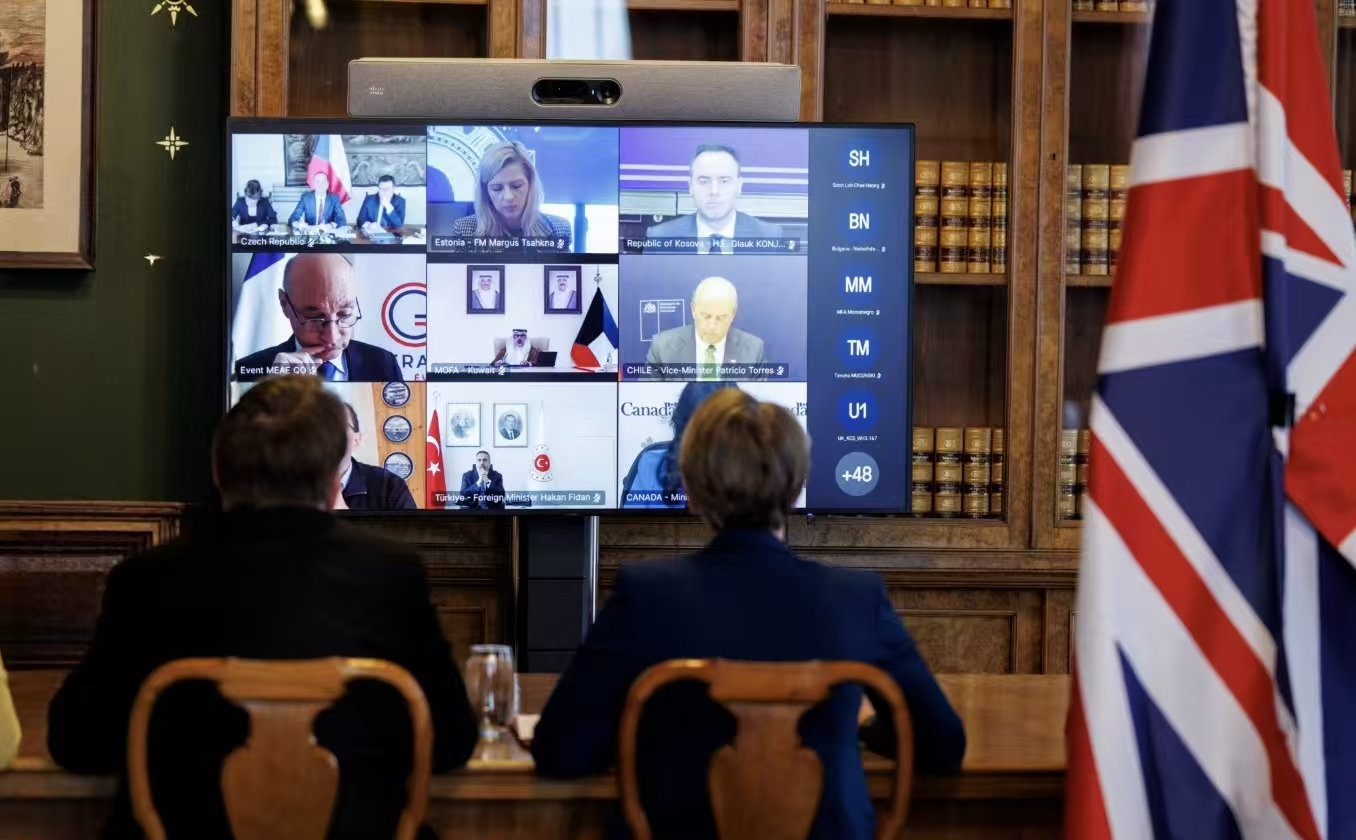
Britain’s Foreign Secretary Yvette Cooper, right, attends a virtual summit at the Foreign and Commonwealth Office in London on April 2 with more than 40 countries to discuss ways of reopening the Strait of Hormuz.
Even as Israeli bombs rained down on Lebanon, most of the world breathed a cautious sigh of relief when news broke that Pakistan had mediated a ceasefire between the United States and Iran, with the goal of reopening the Strait of Hormuz.
The reprieve, however, was not the product of sudden restraint by US President Donald Trump. Behind the scenes, American officials had pressed Pakistan to broker an agreement that would allow Trump to step back from his threats to destroy Iran’s “whole civilization” if it did not relent. The ceasefire, in other words, came about not because the world’s most powerful military imposed order, but because it was forced to contain a crisis of its own making.
While the ceasefire Pakistan negotiated is tenuous, and Iran continues to control the Strait of Hormuz (which Trump now plans to blockade after negotiations stalled), this dynamic points to a deeper shift. As the era of American hegemony comes to an end, the outlines of what may come next—with countries of the Global South exercising their leadership to shape an emerging world order—are coming into view.
The war against Iran highlights the unsustainability of a global order built on ultimatums and military might. While the system’s fragility has become unmistakable under Trump, this moment has been long in the making. Trump’s extrajudicial killings of suspected drug traffickers in the Caribbean, for example, echo the practices of his predecessors who refined drone warfare as a central instrument of American power. Likewise, hostility toward China, the isolation of Cuba, unconditional support for Israel, and a hardline stance on Iran were all pillars of both Democratic and Republican administrations’ foreign policy.
Undeniably, US unilateralism has intensified over the past year. Trump’s tariffs and severe foreign-aid cuts, his menacing of Greenland, the kidnapping of former Venezuelan President Nicolás Maduro, and the illegal, ill-conceived war on Iran, whose aftershocks have been felt across the global economy, are all evidence of this escalation.
The closure of the Strait of Hormuz poses what the International Energy Agency has described as the “greatest threat to global energy security in history,” but the economic fallout is likely to be uneven. A close historical parallel is the oil shock that followed the 1970s embargo, which recast wars in the region as threats to energy flows and helped plunge many developing countries into the debt crises that defined the 1980s.
Yet the Hormuz crisis better recalls Egypt’s closure of the Suez Canal in 1956, which followed a joint British, French, and Israeli invasion aimed at seizing the waterway and removing President Gamal Abdel Nasser. The failure of that intervention exposed the terminal decline of Europe’s imperial power and contributed to the emergence of the Non-Aligned Movement in the early 1960s.
Iran’s decision to follow in Nasser’s footsteps could create an impetus for a similar realignment. The closure of the Strait of Hormuz has led to fuel rationing, surging food prices, and higher borrowing costs worldwide. And in the scramble for limited supplies of fuel and fertilizers, Global South economies will inevitably be outbid by their more affluent counterparts.
However, these uneven effects have also revealed who has geopolitical leverage, and it is not the G7. At last month’s meeting of the group’s foreign ministers, there were faint stirrings of criticism of US Secretary of State Marco Rubio. Yet the official communiqué merely called for a “cessation of attacks against civilians and civilian infrastructure,” without acknowledging America’s responsibility for the bombing of an Iranian school that killed more than 100 children. It also cited discussions about mitigating “global economic shocks,” but offered no meaningful solutions.
Under pressure from the Trump administration, the United Kingdom convened more than 40 countries to push Iran to reopen the Strait of Hormuz. Neither the US nor Israel attended, and key mediators like Pakistan, Egypt, and China were notably absent. One of the only concrete policies the group floated was new sanctions against Iran—a failure to recognize how years of “maximum pressure” had contributed to the current crisis. More striking still, it did not reckon with the strategic implications of Iran’s move, including the likelihood that it will seek to retain selective control over the Strait even after a ceasefire.
What was needed was something akin to the Black Sea Grain Initiative, brokered by Turkey and the United Nations, which enabled grain shipments to leave Ukrainian ports despite Russia’s ongoing war of aggression. It was a practical arrangement rather than a political one, built on inspections, continuous vessel tracking, and coordination between Russia and Ukraine. By stabilizing global food prices, it showed that cooperation among adversaries is possible when the costs of disruption become too high.
Replicating the Black Sea model in the Strait of Hormuz would require leadership less constrained by Western hostility toward Iran, as underlined by the fact that Iran has never fully closed the waterway to vessels from non-hostile countries. The Trump administration recognized this, which may explain why it privately encouraged Pakistan to broker a ceasefire even while publicly threatening Iran with civilizational destruction.
Pakistan was well positioned to play that role. Despite close ties between ceasefire architect Army Chief Asim Munir and Trump—and Pakistan’s defense pact with Saudi Arabia—the country immediately condemned the US-Israeli strikes. As divisions emerged among the Gulf states, with some pushing for escalation and others urging restraint, Pakistan was able to serve as a bridge between them. Pakistan also brought China on board, persuaded the US to rein in Israeli airstrikes on Iran, and moderated Saudi Arabia’s fury at an Iranian strike that threatened to derail weeks of back-channel diplomacy only hours before Trump’s war-crime-laden ultimatum.
Still, the fog of war remains dangerously thick. The fragile ceasefire is already showing cracks as Israel devastates Lebanon. Hundreds of ships remain stranded in the Strait of Hormuz, while oil prices and financial markets oscillate with each contradictory statement by Trump.
The international response has been relatively muted, despite the immense economic consequences. Wary of an administration willing to use economic coercion to advance its agenda, many (but not all) governments have restrained their criticism, failing not only to condemn the war as a violation of international law, but also to cite the cause of the crisis as the American-Israeli attack rather than Iranian retaliation.
And yet, the fact remains that the US had to rely on the Global South to contain the fallout of its own irresponsibility. Whereas ceasefires were once brokered in European capitals, Islamabad hosted the most senior in-person talks between Iran and the US since 1979. States may still hesitate to confront a declining and vengeful hegemon, but the ceasefire offers a glimpse of a different future, one in which the countries of the Global South have both the political will and the means to navigate crises on their own terms.
Copyright: Project Syndicate, 2026.
www.project-syndicate.org
