
Timor-Leste’s accession to ASEAN underscores its expanding but still limited relationship with China, marked by significant infrastructure and trade cooperation alongside ongoing institutional and investment challenges. Deeper and more coordinated Chinese engagement would enable Timor-Leste to play a meaningful role in strengthening Sino-ASEAN cooperation.
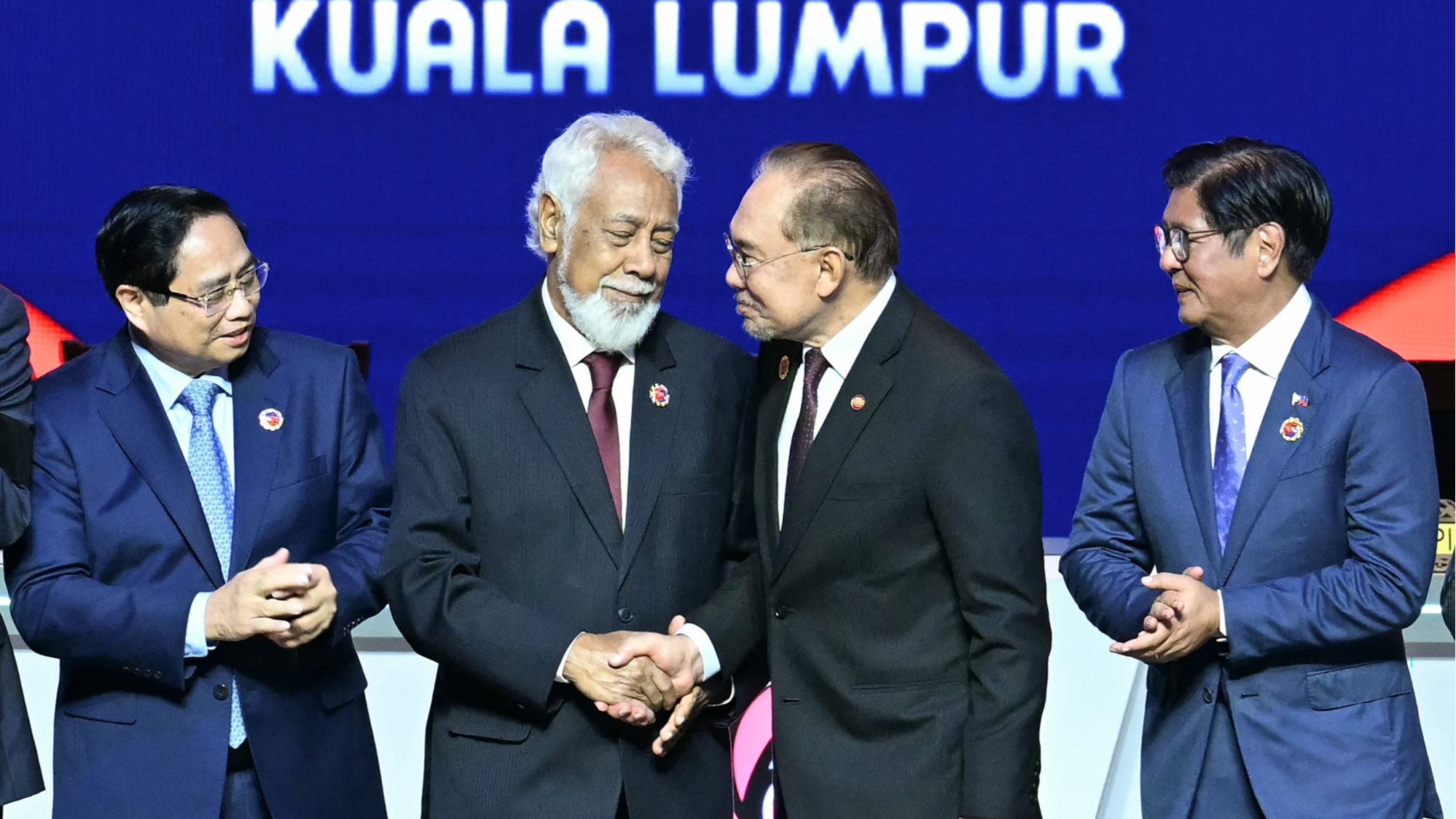
Timor-Leste's Prime Minister Xanana Gusmao (second left) shakes hands with Malaysia's Prime Minister Anwar Ibrahim (second right) as Philippines' President Ferdinand Marcos Jr (right) and Vietnam's Prime Minister Pham Minh Chinh look on after Timor-Leste joined the the Association of Southeast Asian Nations (ASEAN) during the ASEAN Summit in Kuala Lumpur on Oct 26, 2025. (Photo: AFP)
At the 47th ASEAN Summit held this October at Kuala Lumpur, Timor-Leste was formally admitted into the regional bloc as its eleventh member – the culmination of a twenty-three-year-old struggle that began upon the country’s declaration of independence.
Beyond its most proximate neighbours, Timor-Leste has long enjoyed trade and investment ties with China – yet the jury is still out over the extent to which such bonds can translate into meaningful contributions towards Sino-ASEAN relations, going forward.
The Complex and Caveated Ties between China and Timor-Leste
For over a millennium, Timor-Leste had held an important place in the maritime trade of East Asia, as the source of the vibrant sandalwood and spice traded extensively between the Chinese and various “mandala” powers throughout Southeast Asia.
In 1975, FRETILIN, a key Timorese rebel group, declared independence from Portugal – the island nation’s outgoing colonial power. Beijing fervently backed the declaration. This move in turn played into the vociferous anti-Communist rhetoric adopted by Indonesian President Suharto. Under the pre-text that Chinese agents were instigating pro-independence sentiments, the strongman proceeded to occupy Timor-Leste, in which Indonesia remained for over two decades.
Throughout the rest of the 1970s, the Chinese government maintained close contacts with the group, advocating internationally – at the UN and in regional bodies – that the government-in-exile in Mozambique be granted representation and the right to govern a post-independence Timor-Leste. Whilst the relationship cooled in the 1980s – in part due to Beijing’s warming ties with Jakarta, and in part given the worry that its perceived involvement in the precarious situation would be construed as signs of tolerance for intervention by external powers in the domestic affairs of others – China remained by and large a supportive player behind Timor-Leste’s campaign for independence. Indeed, Beijing was amongst the first countries to recognise the country in 2002.
Today, the promise in the bilateral relationship can be seen in three dimensions:
Firstly, Chinese state-owned enterprises (and a handful of private conglomerates) have been present and increasingly pivotal in the construction of vital infrastructure – from irrigation and hydraulics through to roads, bridges, and public healthcare. With only a population of 1.4 million, Dili has long struggled to attract foreign direct investment from countries beyond its most immediate neighbours. Such infrastructural undertakings have created new employment whilst fostering heightened connectivity in one of the least logistically integrated countries in the world. These investments are also increasingly geared towards strengthen Timor-Leste’s ability to partake in and contribute towards regional supply chains, with the Tibar Bay Port – opened in 2022 – a landmark joint venture between the Bolloré Group and China Harbour Engineering Company.
Secondly, in 2024, China was the second largest trading partner to Timor-Leste (behind Indonesia) in 2024 – though the island nation imports more from the powerhouse than the other way round. With its USD $17.4 billion petroleum fund due to be depleted within the next two decades, Timor-Leste is in significant need of industrial upgrading, economic diversification, and human capital intensification. Such amelioration of its urgent needs could well come through the opening-up of the Chinese market for Timorese exporters, as well as the establishment of genuine joint ventures between Chinese and Timorese firms.
Yet the prerequisite for this appears to be a modicum of trust and perception of commercial viability in Timor-Leste on the part of Chinese investors, neither of which can be taken for granted, given the country’s highly fledgling and underdeveloped industrial capacity, which has also hampered its ability to diversify away from long-standing pillars in crude and petroleum exporting and coffee production.
Thirdly, the two countries have deepened the level of strategic and diplomatic contact in recent years, with Timorese President José Ramos-Horta visiting China in the summer of 2024 to cement the bilateral relationship and elevate the “Global Strategic Partnership” between the two countries. The meeting also paved the way for Timor-Leste’s prospective participation in a wider range of collaborative ventures advanced by China under the banner of the Belt and Road Initiative, and in relation to multilateral institutions and forums.
With that said, such ties certainly come with caveats. The most senior Chinese official to visit the island nation – since its founding – was Wang Yi, in his role as State Councilor and Foreign Minister in June 2022. Beijing’s presence as an aid provider to Timor-Leste is also considerably less visible than others such as Australia, Portugal, or the US.
How Timor-Leste Could Play A Part in Sino-ASEAN Synergy
With the accession, there are at least three distinctive ways in which China’s presence in Timor-Leste – should it increase in both volume and quality, as well as the range of encompassed domains – can positively shape the synergy between itself and ASEAN.
The first concerns the immense value of Timor-Leste’s being a successful proof-of-concept and exemplar of the Chinese approach to developmental trade and aid. Internationally, China had long been riddled with perceptions and discursive tropes portraying it as partaking in ostensible “debt trap diplomacy”.
Such narratives, despite resting on dubious empirical grounds (as observed by Deborah Brautigam), have gained growing salience amongst many recipients of Chinese aid and its trade partners. Should China successfully work constructively with regional stakeholders – including but not limited to Indonesia and the ASEAN Secretariat – in advancing the quality of life for the average Timorese civilian, this could go some way in assuaging skepticism concerning the intentions and implications of China’s overseas economic presence – amongst the ASEAN population.
Indeed, from education opportunities (scholarships) through to technology transfer and innovation, from hardware to software in infrastructural design, there is much that Beijing can do in demonstrating its significant value-add for Timor-Leste – with such fruits now all the more visible to other ASEAN members given the country’s gaining access to all the institutions, privileges, and conferences attached to full membership.
The second concerns the natural intellectual resonance and symbolic alignment between the political leaderships of China and Timor-Leste. Despite his country’s relatively diminutive economic power, the incumbent President José Ramos-Horta – a 1996 Nobel Peace Prize Laureate – is highly lauded in the region as a prominent advocate of human rights and the rights to self-determination for Global South populations.
Ramos-Horta is prominently featured in conversations concerning the positioning of Southeast Asia, and the role played by multilateral institutions in upholding the sovereignty and interests of small powers, including economically feeble and externally dependent island nations. His personal rapport with the Chinese leadership and affirmation of China’s constructive role in the region, could well render him an important partner to the country in a bloc where Beijing’s growing geostrategic might and leverage have drawn complex, mixed reactions from domestic populations, especially amongst policymakers.
Notably, ASEAN decision-making is not carried out through formalised membership voting but often forged through consensus – every member thus counts. At the helm of what some have dubbed the “freest democracy” in ASEAN, Ramos-Horta possesses unique cultural cache and credibility, and has made explicit his desire to position his country as an advocate of “international law [which is] not just an abstract concept. International law is the bedrock upon which [Timor-Leste] built [its] independence.”
There is evidently the worry that Timor-Leste lacks the institutional capabilities and training required for it to play a more pronounced role within the region – let alone internationally.
It is on this front that a third dimension of Sino-ASEAN synergy can be sought.
Both China and ASEAN at large have an interest in a stable, functioning Dili. States such as Indonesia, Singapore, Malaysia, and Thailand possess a wealth of seasoned, experienced civil servants, technocrats, and professionals, who can work hand-in-hand with their counterparts in China in providing the Timorese government with insights into best practices on institution-building and the paths towards economic diversification.
This should not be viewed through the lenses of paternalism or intervention by an external power; indeed, Chinese policymakers should recognise that as they seek to provide shape and concrete substance to pledges such as the Global Development or Global Governance Initiatives, it is vital that they work with – as opposed to in the exclusion of – regional partners in building up governance capabilities of their counterparts. There are few better places to begin than Southeast Asia; within the region, Timor-Leste presents a most logical choice.
It would be a mistake to reduce Timor-Leste’s geo-strategic positioning within ASEAN to simplistic binaries of “Democracy vs. Non-democracy”, or “Developed vs. Developing” – for it straddles and moves fluidly between different apparent camps and orientations. The Chinese leadership would do well to remember that support from Ramos-Horta is not to be taken for granted. If the Sino-Timorese relationship is to remain robust and deepen over time, both sides must make a conscious effort to better understand one another.
