
Unable to maintain its position of leadership, the United States is severely hindering the progress of other nations. It’s a self-isolating form of hegemony that poses real geopolitical dangers. By openly acknowledging and pursuing exclusive spheres of influence, America is effectively signaling a return to the law of the jungle.
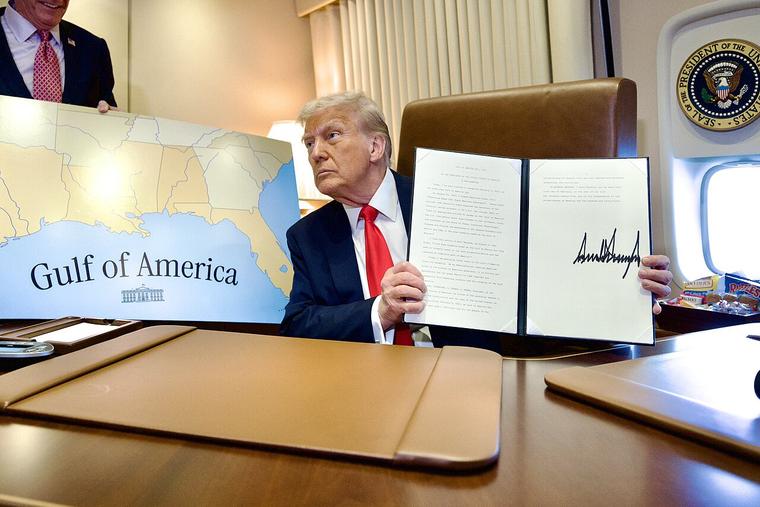
Executive Order 14172 directing U.S. federal agencies to refer to the Gulf of Mexico as the 'Gulf of America' has been highlighted as an element of the 'Monroe Doctrine.' (Photo: Executive Office of the President of the United States )
At the beginning of this year, the Trump administration arrogantly granted itself the authority to conduct cross-border military operations by designating the Venezuelan government a “foreign terrorist organization.” This move fundamentally undermines the norms governing the use of force in the UN Charter, and its logic on sovereignty could trigger dangerous chain reactions. Once the world's sole superpower begins to redefine sovereign boundaries to suit domestic needs, the certainty of the international legal system will vanish. In fact, the global order is currently facing its most serious and profound challenge since World War II.
The new Monroe Doctrine and Trump’s corollary, advanced by the U.S. administration and its core foreign policy team, signal a shift in Washington’s geopolitical logic—from liberal universal values to realistic global hegemony. Historically, the Monroe Doctrine of 1823 was defined as a defensive policy aimed at preventing Old World intervention and preservingthe political heterogeneity of the Western Hemisphere through geographical isolation.
However, the Monroe Doctrine, under Trump's interpretation, discards any pretense of non-interference, evolving into an authoritarian claim of ownership rather than the right to protect. According to this logic, the Western Hemisphere is no longer a union of sovereign states but an extension of the U.S. national interests. It is no longer America for Americans but America for the United States. This shift represents a defense-as-offense strategy adopted by Washington in the face of the challenges of global multipolarity, attempting to build an absolutely exclusive geoeconomic sphere subordinate to Washington's vertical control. It suggests that the United States has abandoned its role as a provider of global public goods, and has instead become a hegemon defending its own sphere of influence and pursuing absolute security and resource monopoly.
Trump’s new Monroe Doctrine is marked by the erosion of traditional principles of sovereignty, driven by its extreme transactional nature. Essentially, the Trump corollary redefines the sovereignty of nations in the Western Hemisphere as conditional rather than inherent, and directly links it to their contributions to U.S. national security, particularly in areas of immigration control, drug interdiction and exclusive economic commitments. This conditional view of sovereignty reflects the extreme application of Trump’s transactional realism. Within this framework, Washington effectively transforms domestic political issues, such as illegal immigration and transnational crime, into justifications for geopolitical intervention, thus blurring the legal boundaries between domestic jurisdiction and international intervention. This means that any act that introduces the influence of a major power outside the region will be seen as an infringement on U.S. strategic depth, rather than as normal sovereign diplomacy. In essence, this approach revives the old-era political legacy of spheres of influence in the Western Hemisphere, reducing complex international relations into a zero-sum dependency and forcing regional nations into a dilemma of "sovereignty downgrading".
At the implementation level, Trump's new Monroe Doctrine exhibits a high degree of militarization and judicial input. Its most profound change is the unlimited expansion of what counts as security—now encompassing trade, energy, infrastructure, and even the legal framework. For example, by designating the Venezuelan government as a terrorist organization, the Trump administration is effectively seeking legitimacy for cross-border law enforcement outside the bounds of international law and shifting its diplomatic approach from normative guidance to rule-of-law deterrence and even military intervention.
Furthermore, American nearshore outsourcing in the economic sphere undermines the basic logic of market efficiency, thus becoming a tool of geopolitical containment. This economically exclusive arrangement—ostensibly justified as a security measure—aims to sever the organic connection between Latin American countries and the global supply chain, forcing the region into high economic dependence on the United States. This hardening of methods reflects a profound strategic anxiety: When the U.S. can no longer maintain regional influence through soft power, it resorts to hegemony enforced through military deterrence and the weaponization of law.
For Latin America and the Caribbean, the return of the Monroe Doctrine signifies a structural disruption to regional integration. Under the heavy pressure of the “America first” agenda, mechanisms originally designed to promote South-South cooperation, such as CELAC and Mercosur, face the risk of paralysis as the U.S. pressures countries to take sides. Some right-wing regimes naturally opt to sacrifice sovereignty in exchange for security guarantees, while major countries, including Chile and Brazil, have a strong inclination toward strategic autonomy, thus leading to unprecedented political polarization across the Western Hemisphere. Latin American countries are confronted with a difficult choice, between integrating into globalization and submitting to Fortress America.
Trump’s strategic retreat comes at the expense of stability in other parts of the world. By shrinking its overseas military presence (such as partial withdrawals from Ukraine, NATO and East Asia) and concentrating resources on the borders and seas of the Americas, the United States is creating an unprecedented global power vacuum, directly triggering an increase in conflicts in periphery regions worldwide. As Washington pursues the Monroe Doctrine in its hemisphere, its credibility and deterrent power in Europe, the Middle East and the Indo-Pacific region are spiraling downward.
From a global order perspective, the United States, which is unable to maintain its leadership, is severely hindering global progress through a self-isolating form of hegemony. Trump’s revival of the Monroe Doctrine marks a complete departure from globalization, signifying a retreat from a rules-based order and toward power-driven fragmentation. By openly acknowledging and pursuing exclusive spheres of influence, the U.S. is effectively signaling a return to the law of the jungle. This paradigm shift implies that any country with regional influence could follow suit. It’s important to note that when trade geography is replaced by power geography, the marginal benefits of global economic growth will shrink dramatically because of frequent political interference. This will simultaneously increase global transaction costs and the risk of conflict.
