
Iran is increasingly reorienting its foreign policy and economic strategy toward China and Eurasia, using expanded overland transport and energy links through Central and South Asia to reduce its vulnerability to sanctions and maritime disruption. This shift aligns with Beijing’s push for deeper trans-Eurasian connectivity and positions Iran as a more important partner in China's efforts to integrate the Eurasian continent through infrastructure, trade, and energy networks.
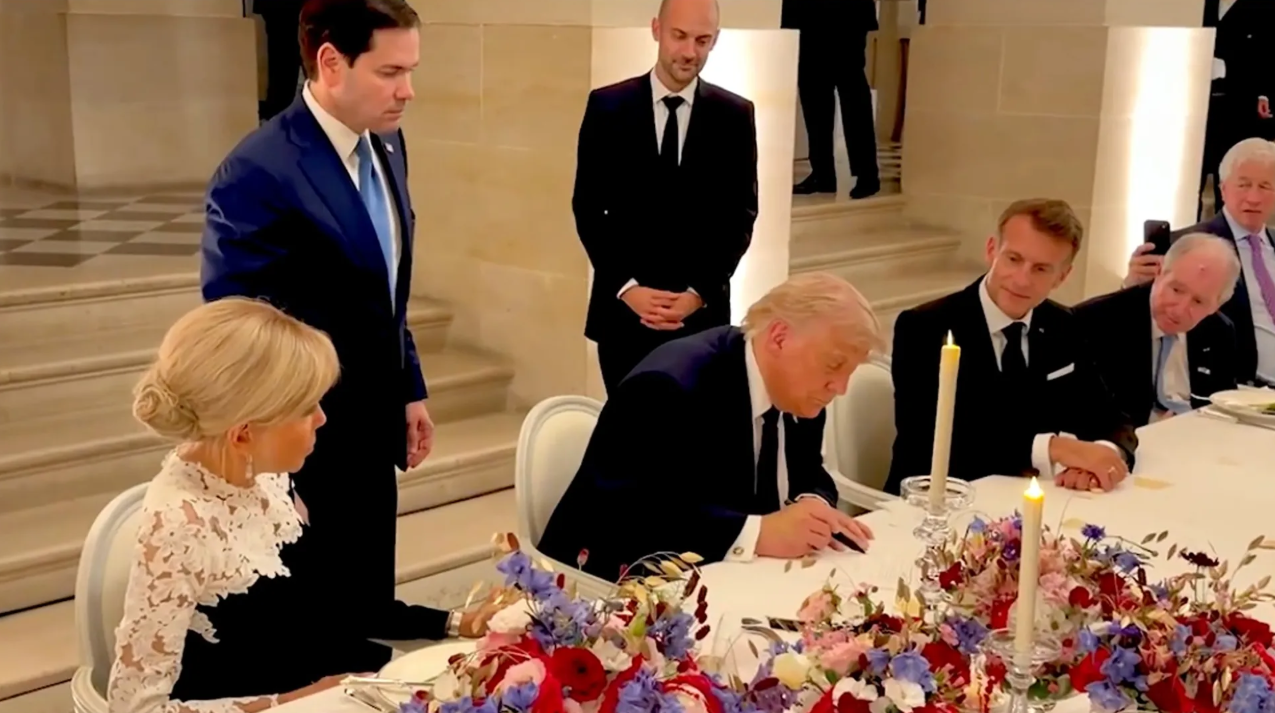
U.S. President Trump signs the memorandum of understanding to end the war and open the Strait of Hormuz at the Palace of Versailles near Paris on June 17, 2026.
Since the war in Ukraine, sanctions have made Russia more reliant on the Chinese market for its energy exports. The same may happen with Iran. Continued fighting in Lebanon may test the implementation of a fragile United States-Iran peace deal. Despite the announced reopening of the Strait of Hormuz, Iran may attach high importance in developing an overland alternative to transport its goods to China via Afghanistan, Pakistan, or Central Asia as backup. This may mitigate the effect of future U.S. naval blockade of Iranian ports and interdiction of Iran-linked ships in the high seas. Iran can shift 40% of its usual seaborne trade to land, a development that can have a profound impact on the country’s foreign policy. It may shift the locus of Tehran’s calculus from West to Central Asia and make Tehran a strong partner of Beijing in deepening trans-Eurasian connectivity. Whether it will diminish Iran’s support to its Axis of Resistance remains to be seen.
China emerged as the biggest market for Iranian oil as U.S. and European sanctions bite. The world’s second-largest economy became the top destination of Iranian crude in 2019 following U.S. reimposition of sanctions on Tehran as Washington withdrew from the Joint Comprehensive Plan of Action (JCPOA), an agreement meant to curb Iran’s nuclear program. The return of U.S. sanctions suppressed the appetite of other buyers, cementing China’s position. Over 80% of Iran’s oil is shipped to China, mostly to independent refiners. Furthermore, an uptick in rail traffic between China and Iran could blunt U.S. maritime pressure. Washington withdrew from JCPOA barely three years after signing it, so Tehran will likely cultivate a contingency plan in case the current agreement does not endure and Western sanctions resume.
The enmity and disruption brought about by the ongoing war may push Tehran to turn to the east, the way Moscow pivoted since the full-scale war with Ukraine in 2022. Battered ties with Gulf neighbors may prompt Tehran to redirect its gaze to Central and South Asian neighbors as gateways to its burgeoning commodity trade with China. Pakistan, a neighbor of both Iran and China, hosted talks between the U.S. and Iran to end the 108-day war that claimed thousands of lives and brought extensive damage across the region. China will likely play a big role in Iran’s postwar reconstruction, rebuilding civilian, energy, and military infrastructure destroyed by U.S. and Israeli air strikes. Beijing hosted a high-stakes summit between Presidents Xi Jinping and Donald Trump last month, during which the U.S.-Iran war and shipping in the Strait of Hormuz figured, though no breakthrough was reached.
Iran’s neighbors have all deepened strategic and economic relations with China, offering lessons for Tehran. The massive China-Pakistan Economic Corridor, a key piece of China’s Belt and Road Initiative, will upgrade Pakistan’s infrastructure, industry, and energy sectors and position it as a bridge linking China’s autonomous western Xinjiang region to the Arabian Sea. Turkmenistan is supplying gas to China via Uzbekistan and Kazakhstan. Kazakhstan also sends oil to China through a pipeline. Russia exports gas to China from Siberia, with plans to build another pipeline that will pass through Mongolia. A pipeline that will bring gas from the Russian Far East is expected to be operational by next year. Russian gas via pipelines may reduce demand for liquefied natural gas shipments by sea, which are exposed to disruptions or threats in global chokepoints from the Straits of Hormuz and Bab el-Mandeb to Malacca. This can enhance China’s energy security. Iran may join the fray, diversifying China’s pool of gas suppliers.
A turn to the East will make Iran an active shaper in the evolving Eurasian geopolitics fueled by new transcontinental pipelines, railways, and roads. Membership in BRICS+ and the Shanghai Cooperation Organization and warm ties with China and Russia can facilitate greater Iranian participation in the remaking of this vast, resource-rich, and strategic mega-region. Like Pakistan, Iran can provide sea access for western China, landlocked Afghanistan, and Central Asia. The surge in cargo traffic at Pakistan’s Gwadar port could inspire Iran to engage China to develop its ports in Bandar Abbas or Jask.
Iran’s turn to the East may manifest in more active involvement in transformative cross-border projects. This includes the Five Nations Railway Corridor linking Khaf in northwestern Iran and Kashgar in western China via Afghanistan, Tajikistan, and Kyrgyzstan. Feasibility studies on the Afghan section of the rail line were already completed, with designs and financing getting traction. Stability in Afghanistan may bode well for Tehran’s desire to grow its transit options to reach the Chinese market. Last October, Iran began exporting diesel by train to Afghanistan for the first time via the Khaf-Herat track. Iran’s rail diplomacy may focus on activating the Southern Corridor. This can serve as an alternative to Russia’s Northern Corridor, beset by disruptions due to the war in Ukraine, and the complications from the sea-rail linkages offered by the Middle Corridor via the Caspian Sea. The Southern route is a 9,000 kilometer full rail track, corresponding to the ancient Silk Road, which can reduce China-Europe logistics by three weeks compared to the longer sea voyage. U.S.-Iran negotiations brokered by Islamabad may also give fresh impetus to the stalled Iran-Pakistan gas pipeline.
The U.S.-Iran war can reshape Tehran’s foreign policy. A pivot to the East will make the country more invested in ties with Central and South Asian neighbors as conduits to reach the huge Chinese market. This shift will converge with Beijing’s growing Eurasian footprint, deepening transport and energy connectivity, to dull the effect of external maritime pressure.
