
The recent G7 and NATO summits suggest that Europe is seeking not only to retain the initiative in shaping regional security but also to play a more active role in building an improved international order. In doing so, it has absorbed elements of Donald Trump’s transactional diplomacy.
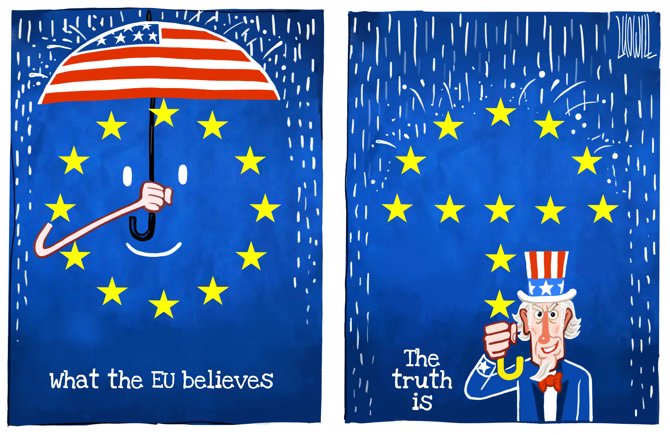
(Copyright: Luo Jie/China-US Focus)
Europe has become adept at managing the ever-self-absorbed U.S. President Donald Trump through flattery. At last year’s G7 and NATO summits, that approach had helped to stabilize transatlantic relations—at least temporarily.
By the time the two summits convened again this year, Europe’s strategy of flattery had evolved into “smart diplomacy,” a more sophisticated form of diplomacy.
On one hand, Europe has continued to treat Trump with considerable deference. At the G7 Summit in Evian-les-Bains, France, from June 15 to 17, Trump was the only leader to be personally received by French President Emmanuel Macron. At the NATO Summit in Ankara, Turkiye, on July 7-8, NATO Secretary-General Mark Rutte lavished praise on Trump’s “leadership.” At the same time, however, European leaders shifted their approach from the guarded posture they had adopted a year ago to one of growing composure.
At the NATO summit, they largely brushed aside Trump’s remarks about taking over Greenland, withdrawing U.S. troops from Europe and ending trade with Spain. They chose instead to focus on his commitment to provide Patriot missile systems to Ukraine.
After the G7 summit, Trump claimed that Italian Prime Minister Giorgia Meloni had been “eager” to be photographed with him, prompting Meloni to cancel her planned visit to the United States in protest. Yet when the two met again at the NATO summit three weeks later, they interacted in an entirely businesslike manner, at least partly because European leaders have gained a better understanding of Trump’s temperament and negotiating style.
More important, however, Europe’s own strategic position has changed. Despite what many in Europe regard as Washington’s “abandonment,” Ukraine has demonstrated remarkable resilience on the battlefield and has increasingly gained the upper hand over Russia, highlighting the growing weight of European support behind Kyiv. By contrast, Trump has become increasingly entangled in the Middle East. Even preserving Viktor Orban’s political position in Hungary has proved difficult, making Trump’s ambitions—such as taking over Greenland—appear even more remote.
Ultimately, Europe’s diplomacy of flattery is intended to buy time. On one hand, Trump has pressed Europe to open its markets to greater competition and to assume more responsibility for its own defense; on the other, he has sought to marginalize Europe in international affairs—two objectives that are fundamentally at odds.
Recent experience at the G7 and NATO summits suggests that Europe is determined not only to retain the initiative in shaping regional security but also to play a leading role in building a more stable international order. In doing so, it has not only absorbed elements of Trump’s pragmatic approach to diplomacy but consciously drawn on the strengths it possesses—strengths that Trump has often brushed off, such as rules, professionalism, institutions and soft power. It is precisely this combination that best illustrates Europe’s evolution from “diplomacy of flattery” to “smart diplomacy.”
First, by participating in and promoting a transatlantic military-technological-economic alliance, Europe seeks to better constrain the Trump administration while channeling America’s tech and military advantages to serve its own strategic interests.
At the Defense Industry Forum on the opening day of the NATO Summit, Rutte announced more than $50 billion in new procurement plans, unveiled the so-called Drone Edge initiative and launched two additional programs: the NATO Front Door for Industry and the NATO Engine. For Germany, securing approval to purchase Tomahawk cruise missiles was widely regarded as the summit’s most significant outcome.
For Trump, whose approach to diplomacy is superficial and transactional, Europe’s rapid military buildup presents an opportunity to claim a share of the benefits. According to reports, he said at the NATO summit that the United States would remain in the alliance and continue selling weapons to its allies “regardless of how those weapons are ultimately used.”
The New Washington Consensus advanced during the Biden administration is, in essence, not about severing global economic ties but reconnecting the global economy through the reconfiguration of security alliances in ways that favor particular social forces and interest groups. Both the G7 declaration on securing critical mineral supply chains and the NATO Ankara Summit Declaration clearly reflect the growing trend toward a transatlantic economic security alliance.
Between the G7 and NATO summits, the European Union also joined the U.S.-led Pax Silica, declaring its intention to "build an economic security order based on trust, technological complementarity, shared interests and a shared commitment to a more prosperous future.” This demonstrates that Trump is not synonymous with the United States. Once the transient influence of his personal style recedes, the more fundamental forces shaping transatlantic relations—and international relations more broadly—will become increasingly apparent.
Second, the thing that most clearly demonstrates Europe’s diplomatic innovation is France’s use of its G7 presidency to shape the G20 agenda by placing the issue of global economic imbalances at the center of international political discussion. The objective is to better coordinate the development strategies of the world’s three major economic powers—the United States, China and Europe—while encouraging both Washington and Beijing to adjust their domestic and external policies, thereby easing pressure on Europe’s economic transformation and reducing the burden of strategic alignment.
At the annual conference of French ambassadors at the beginning of this year, Macron argued that the root cause of global tensions lies in the fact that the United States faces twin trade and fiscal deficits; Europe suffers from underinvestment, weak innovation and sluggish growth; and China, despite its strong productive capacity, continues to face relatively weak domestic consumption.
As a practical response to China’s absence from the G7 Summit, France convened the Global Convergence for Growth Summit by video conference four days before the G7 meeting. The G7 Leaders' Statement calling for more balanced, durable and resilient growth noted that “countries with large and persistent external surpluses should strengthen domestic sources of growth”—a clear reference to China—while adding that "countries with large and persistent external deficits should undertake policies that include supporting domestic savings and fiscal consolidation”—an implicit reference to the United States. This year, the U.S. holds the G20 presidency and has agreed to continue advancing this issue within the G20 framework.
France will have a presidential election next year, and with Macron constitutionally barred from seeking a third consecutive term, his departure is all but certain. It is by no means inconceivable, however, that a right-wing populist party could come to power. Under that circumstance, the greatest challenge to the future of Europe’s smart diplomacy is unlikely to come from external forces, but rather from Europe’s own internal dynamics.
