
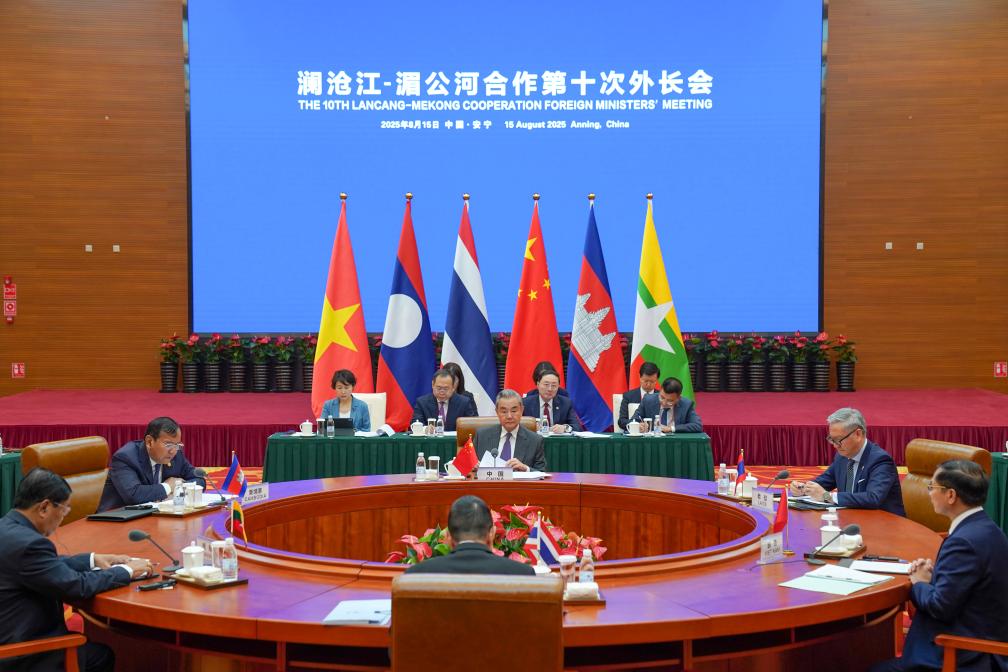
Chinese Foreign Minister Wang Yi co-chairs the 10th Lancang-Mekong Cooperation Foreign Ministers' Meeting with Thai Foreign Minister Maris Sangiampongsa in Anning, southwest China's Yunnan province, on Aug 15, 2025.
Sweeping crackdowns on online gambling and fraud activities in mainland Southeast Asia highlight the importance of regional cooperation platforms such as the Lancang-Mekong Cooperation (LMC). LMC’s Integrated Law Enforcement and Security Cooperation Center, established in Kunming in 2017, facilitates intelligence sharing and joint operations. This contributes to the ongoing campaign against transnational organized syndicates, such as the joint Myanmar-Thailand-China action against scam parks in the Myawaddy area in early February. But LMC’s value goes beyond busting cross-border crimes.
There are many initiatives launched by various dialogue partners in ASEAN’s Mekong subregion. The United States launched the Lower Mekong Initiative in 2009, which was upgraded to the Mekong-U.S. Partnership in 2020. The Japan-Mekong Connectivity Initiative was launched in 2016. The Korea-Mekong Partnership was established in 2011 and elevated in 2020. Of these, the LMC between China and the five riparian Mekong states – Cambodia, Laos, Myanmar, Thailand, and Vietnam – is one of the most dynamic.
Economics and security drive neighborhood diplomacy
Aside from the regularity of high-level and working-group-level official meetings, LMC also expanded to cover broader areas of cooperation. From transboundary water resource management, security and law enforcement to agriculture, cross-border tourism, local government twinning arrangements, innovation, and youth exchanges, LMC has come a long way from its first leaders’ meeting in Sanya in 2016. The next decade may feature a deepening of strategic and economic interaction owing to greater connectivity, redirected trade and investment, supply chain linkages, green energy transition, and industrial upgrading.
LMC shows the importance attached by China to neighborhood diplomacy. Geography, security, and economics influenced Beijing’s ties with its southern periphery. Vietnam and Thailand are among the biggest beneficiaries of the China+1 strategy, wherein Chinese and foreign firms expand production and supply chains beyond China to mitigate risks and improve resilience. Mekong countries provide China’s landlocked southwestern provinces access to the sea via road and rail, diversifying China’s energy and trade routes. The Kunming-Kyaukphyu oil and gas pipeline and railways connecting Yunnan’s capital Kunming with Vientiane and Haiphong, respectively, are key examples. The Pinglu Canal, linking Guangxi’s hinterland with the Beibu Gulf due for completion this year, is another case in point. The gulf lies between coastal southern China and northern Vietnam, so the new waterway is expected to boost cross-border commerce.
Beyond economics, China has a deep stake in the subregion’s peace and order. It shares a long contiguous border with LMC states Myanmar, Vietnam, and Laos. Hence, any instability in these countries can spill over across China’s southern provinces, such as Yunnan. Hence, it is no surprise that China has actively brokered ceasefires between Myanmar’s government and various ethnic rebel armies. It also promoted dialogue between Cambodia and Thailand. Last October, Ta-ang National Liberation Army (TNLA) rebels withdrew from several positions after negotiations with Naypyidaw in Kunming. Last December 29, the foreign ministers of Cambodia, Thailand, and China met in Yuxi, Yunnan province, to consolidate a fragile armistice, prevent a resumption of hostilities, and gradually rebuild trust. Last December 15, police from China, Myanmar, and Thailand conducted their first joint operation against transnational fraud hubs in the Thai-Myanmar border. Last month, Cambodia repatriated to China an alleged scam mastermind. Dismantling organized cross-border syndicates, repatriating trafficking victims, and extraditing crime bosses for prosecution are growing aspects of LMC cooperation.
Cooperation on green energy and inspiration for maritime ASEAN
New energy is another strong area of confluence for LMC members. Beyond the vast hydropower generated from the Lancang-Mekong River and its tributaries, the subregion also has much untapped wind and solar energy potentials. The six countries have ambitious clean energy targets. Accelerating their transition to more sustainable and locally-sourced power will reduce their reliance on imported fossil fuels, enhancing their energy security and sovereignty. This is a major contribution to achieving United Nations Sustainable Development Goals for affordable and clean energy (SDG 7) and climate action (SDG 13). Collaboration in this field also spurs regional energy interdependence, with surplus energy producers like Laos, dubbed Southeast Asia’s battery, exporting energy to neighbors with higher demand, such as Thailand and Vietnam. Laos, in fact, is emerging as one of the world’s largest exporters of hydropower per capita.
Tapping the power of the sun and wind can broaden the green energy portfolio of LMC states. This can mitigate the impact of seasonal variability of the Mekong river’s water volume on hydropower generation, especially during prolonged dry spells brought by climate change. It is no coincidence that Mekong countries host some of the region’s largest renewable power plants. Vietnam’s 2400MW Son La Hydropower Plant and 450 MW Trung Nam Solar Farm are ASEAN’s biggest. Laos’ 600MW Monsoon Wind Farm, which opened last year, is also ASEAN’s largest.
China is a major partner in LMC’s green energy transition. It is a global leader in renewables in terms of installed capacity and production of new energy technologies from solar panels and wind turbines to energy storage and batteries for electric vehicles. Some Chinese photovoltaic cell makers, such as Jinko Solar, have established factories in other LMC countries. Partnership with Chinese firms, like Hefei-based battery producer Gotion, allowed Vietnamese carmaker VinFast to leapfrog into electric vehicle production. EV giant BYD has opened a factory in Thailand, along with other Chinese automakers. The Green Silk Road and Global Development Initiative can provide broader anchors for LMC, deepening cooperation in building green energy infrastructure from solar and wind farms to grid and electric battery charging network. LMC can facilitate the flow of Chinese capital, technology, practices, and know-how to upgrade manufacturing in mainland ASEAN countries.
LMC’s significance goes beyond mainland ASEAN. Mekong River irrigation has made Thailand and Vietnam powerhouse rice producers, with fellow ASEAN members Indonesia and the Philippines among the major markets. The Laos-Thailand-Malaysia-Singapore transmission line can form the nucleus of the ASEAN Power Grid. VinFast’s EV taxi fleet is already plying the streets of Manila and other ASEAN capitals. Indeed, the steady progress of LMC can offer lessons for the other sub-regional organization in ASEAN – the Brunei-Indonesia-Malaysia-Philippines East ASEAN Growth Area. BIMP-EAGA’s first ministerial meeting was hosted in Davao City in 1994. LMC may provide valuable lessons to its maritime subregional counterpart.
*This piece draws from the author’s participation in the 8th Think Tank Forum of Global Center for Mekong Studies held in Chongqing last December 29-30, 2025. The event was organized by the China Institute of International Studies and Southwest University of Political Science and Law.
