
At the Washington summit it was more than obvious that China-U.S. cooperation is essential and must continue despite any potholes in the road. Neither country, nor the world, can afford to have the wheels come off.
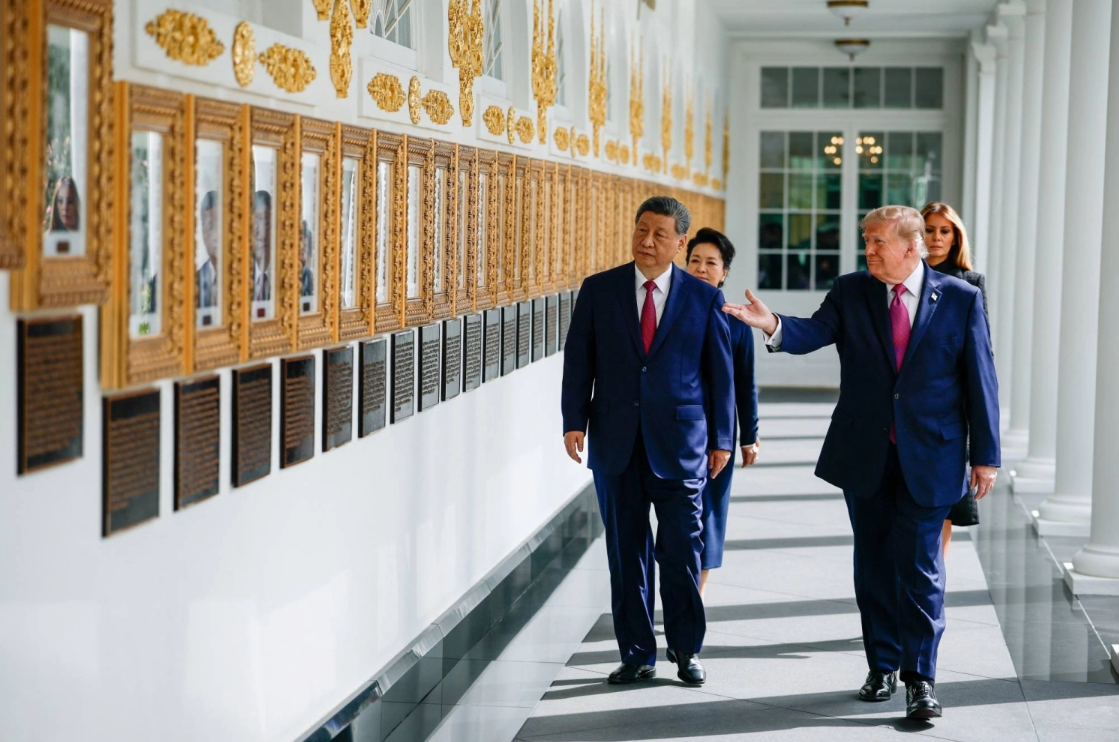
U.S. President Donald Trump, first lady Melania Trump, Chinese leader Xi Jinping and his wife, Peng Liyuan, walk along the Colonnade of the White House in Washington, Sept 24, 2026. (Photo: REUTERS)
The presidents of China and the United States have visited with one another twice in less than six months—in Beijing in May and recently in Washington. The most significant development at this latest summit is that the two countries are becoming more active in defining the relationship they want to build. In recent years, their interactions have often revolved around how to respond to the other side’s next move, leaving policy vulnerable to the disruptive energy of disputes. Now, continued economic and trade talks, discussions on artificial intelligence cooperation and joint efforts to advance strategic stability are receiving clearer political backing. Competition remains a reality, but it no longer tells the whole story. This is an important starting point for understanding the significance of the Washington summit.
The role of head-of-state diplomacy in this process extends well beyond securing any particular deal. When mutual suspicion runs deep, policymakers in both countries tend to be on their guard against risks, while frictions between government agencies can accumulate into a negative assessment of the relationship as a whole. Direct communication between top leaders allows them to take a broader view of which differences need to be managed and which opportunities for cooperation are worth pursuing, thereby providing consistent direction for engagement at every level.
Neither side needs to wait for all disputes to be resolved before resuming cooperation, or to interpret every disagreement as evidence that the other is abandoning previous understandings. This wider scope for policy action is itself an important achievement of head-of-state diplomacy.
The value of a constructive China-U.S. relationship of strategic stability based on respect, fairness, and reciprocity lies in the basis it provides for such adjustments. Respect means taking each other’s development path and core concerns seriously and recognizing both countries’ legitimate right to pursue their own development. Fairness requires that both sides have a say in shaping the rules of cooperation and equitably sharing its benefits and responsibilities. Reciprocity means matching commitments with mutually responsive actions, ensuring that cooperation works both ways.
Given the differences in the two countries’ circumstances and strengths, reciprocity can involve a balance of interests and responsibilities without requiring identical arrangements in every area. These principles provide a foundation for stability that both sides can accept and want to sustain.
Strategic competition emphasizes shifts in relative power, but strategic stability takes the question further, asking how those shifts can occur without undermining peace and cooperation. For China, stability must accommodate development. For the United States, living with a China that continues to develop is a long-term challenge. The word “constructive” gives this framework a more positive purpose: Both sides must restrain behavior that could lead to conflict while continuing to identify worthwhile opportunities for joint action. Stability that can adapt to changes in both nations’ capabilities and interests has greater staying power than an effort to preserve the balance of power at a particular moment.
Progress on economic and trade issues gives practical expression to this approach. According to U.S. Treasury Secretary Scott Bessent, the two sides agreed to extend their trade truce by two months, until Jan. 10, allowing more time to discuss a broader agreement. The extension is short, but it reflects a decision to keep negotiating despite unresolved differences. Once trade disputes descend into cycles of retaliation, businesses and consumers are the first to bear the costs. The extension preserves room to seek mutually beneficial arrangements and creates opportunities to build on the talks already held. Tariffs on non-sensitive goods, market access and trade facilitation are among the areas in which further progress could be made.
At a deeper level, China and the United States are reassessing the interdependence underlying their economic relationship. Industrial ties allow each country to influence the other, but they also mean that unilateral action can impose costs at home. After repeated confrontations, both are better placed to assess the effectiveness of pressure and the benefits of cooperation, which helps to refocus negotiations on what each can actually gain. China needs an external environment conducive to development, while American businesses and consumers also benefit from stable economic ties. These interests do not disappear with an election or a change in a political leader. They provide a practical foundation for building on the current improvement in relations.
The dialogue on artificial intelligence reveals a more novel development: Even the areas of most intense competition can generate new reasons to cooperate. At the recent summit, China proposed continuing dialogue on AI’s risks and benefits, preventing its misuse and abuse and ensuring that it remains under human control. As AI capabilities grow, both countries have a greater need to understand the potential cross-border effects. A lead in computing power does not mean a country can address safety concerns on its own; faster research and development brings more complex governance challenges. There are compelling practical reasons for the two countries to maintain communication on governing risk even as they compete to advance their technologies.
The significance of this cooperation is that it need not wait for strategic mistrust to disappear. Notification of major AI safety incidents offers a feasible starting point. If a system accesses a network in another country without authorization, the timely exchange of essential information can help distinguish a technical accident from criminal activity or state action, preventing escalation caused by mistaken attribution. The specific arrangements still need to be agreed upon, but designated points of contact, notification criteria, and verification procedures can be worked out gradually through expert dialogue. By addressing a limited set of issues first, then expanding cooperation as it proves effective, China and the United States have an opportunity to build trust through practice. AI could thus become not only a new field of competition but also an important setting in which the two countries learn to address emerging problems together.
A stable relationship also requires a more accurate understanding of each side’s deepest concerns. The Taiwan question concerns China’s sovereignty and territorial integrity. At the summit, China reiterated its position and urged the United States to handle the issue with caution. Direct communication between the presidents provides the most authoritative channel for conveying these core concerns. On an issue of such sensitivity, clearly stating a position, followed by active listening, can help avoid misinterpretations of intentions. Such issues then make valuable contributions to preserving peace. As dialogue continues, both sides should work to align their policies and actions toward a stable relationship, which provides a firmer political foundation for cooperation in other areas.
Follow-up work after the Washington summit can proceed through the channels of communication already opened. The two countries’ economic and trade teams could translate broad understandings into workable arrangements. AI dialogue requires the participation of both government officials and technical experts, while academics and business communities can help identify opportunities for cooperation that neither side has fully recognized. Head-of-state diplomacy and such day-to-day interactions as these can reinforce one another. High-level understandings provide support for cooperation, while practical cooperation gives the next high-level engagement a stronger foundation. As these connections multiply, stability can gradually become an established habit in how the two countries approach problems.
People in both countries should also be able to experience this process more directly. Businesses able to plan investments with greater confidence, universities able to sustain regular exchanges and young people able to learn about the other country firsthand would all broaden support for a stable relationship. Dialogue also helps each side recognize that the needs of the other society are far more varied than the label “strategic competitor” suggests. Economic development, technological progress, and people’s lives are connected in many ways that can yield mutual benefits. Bringing these connections back into policy discussions can broaden the bilateral agenda and build resilience against future political turbulence.
Positive changes in China-U.S. relations also have global significance. The two countries agreed to support each other in hosting this year’s APEC Economic Leaders’ Meeting and G20 Summit, linking bilateral coordination with multilateral cooperation. Finding more common ground on AI safety, the world economy and other issues can also help other countries participate in addressing shared challenges.
The Washington summit has demonstrated a possibility worth pursuing: Competition between major powers can persist while cooperation continues to grow. Competition should not have veto power over cooperation. This year’s summits have opened the way for the two countries to expand their shared interests while acknowledging their differences.
