
The May and September reciprocal state visits by U.S. President Donald Trump and China’s President Xi Jinping have seemingly succeeded in cementing warm personal ties between the two leaders while stabilizing an unstable U.S.-China relationship. Historians may look back on these twin summits as perhaps a turning point following a decade of tumult and steadily intensifying competition between the two powers. While the two summits have succeeded in warming the atmosphere, there remains much substantive and institutional work to do.
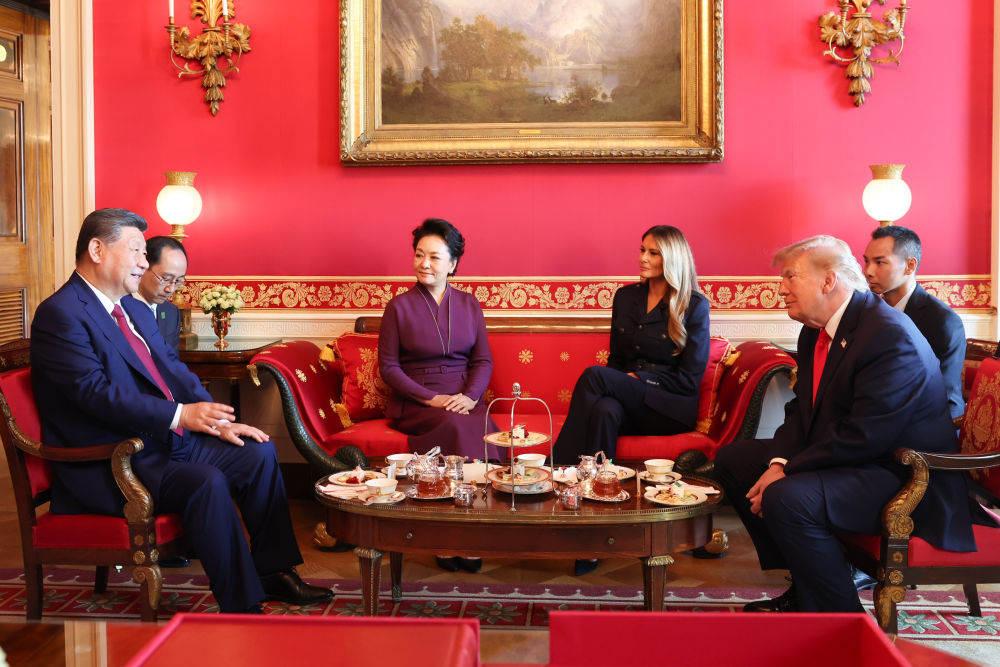
Chinese President Xi Jinping and his wife, Peng Liyuan, have a chat over tea with U.S. President Donald Trump and his wife, Melania Trump, on September 25, 2026. (Photo: Xinhua)
With their twin summits in May and September 2026, Presidents Donald Trump and Xi Jinping have now succeeded in reestablishing what can be metaphorically described as the floor and ceiling in the U.S.-China building. By a “ceiling,” I mean establishing warm personal leader-to-leader relations. The history of U.S.-China relations since the Nixon-Mao rapprochement in 1972 has repeatedly demonstrated that leaders’ personal engagement and investment in the relationship is critical to minimizing tensions and maximizing productive interactions. By establishing a “floor,” I mean that through their joint agreement to pursue a relationship of “constructive strategic stability based on mutual respect, fairness, and reciprocity,” the two leaders have put a foundation under the wildly fluctuant and steadily deteriorating relationship of the past decade.
Now, in some ways, comes the hard part: rebuilding the “walls” of the U.S.-China edifice. No structure can stand with only a floor and a ceiling. There must be walls to connect the ceiling and floor and hold the building up. This refers to the bilateral institutions and mechanisms that provide governmental channels for direct discussions, deconfliction of differences, and forging cooperation where possible—across a wide range of bureaucratic domains and issue areas. Today, regrettably, there hardly exist any meaningful and institutionalized channels between the two governments and security establishments. Thus the relationship remains intrinsically unstable.
Inter-Governmental institutionalization was previously a key part of what became known as the U.S. “engagement” policy (the other components largely consisted of non-governmental exchanges). By the end of the Obama administration the two sides had erected nearly 100 such bilateral channels (the most notable of which was the Strategic & Economic Dialogue or SAED), before the first Trump administration slashed them to two in 2017, adding two more by 2020, while the Biden administration maintained six formal mechanisms (National Security Advisor Sullivan and State Councilor Wang Yi, a financial working group, economics working group, counter-narcotics working group, AI governance and safety dialogue mechanism, and some military-to-military communication channels). The current Trump administration has been highly reluctant to reestablish any such formal institutionalized mechanisms, although Presidents Trump and Xi did agree to establish a Board of Trade and Board of Investment at their May summit in Beijing, as well as a “Super Intelligence” (SI) dialogue mechanism at the recent Washington summit.
It is indeed doubtful that the Trump administration wishes to resurrect and rebuild some of the inter-bureaucratic mechanisms of earlier administrations, since the entire administration’s foreign policy is highly transactional and centered on President Trump himself. Beyond commercial and perhaps student exchanges it is not at all evident that President Trump seeks a resurrection of the past comprehensive relationship of “engagement” with China (as I explain in my recent book Breaking the Engagement, those days are over). Both governments have now considerably “securitized” the relationship—establishing significant limits on exchanges with the other on the grounds of national security—which is going to be nearly impossible to undo.
Relatedly, over the past decade, national and sub-national bureaucracies and legal establishments in both countries have increasingly based their budgets and institutional missions on countering one another. The financial resources that allow all of these bilateral governmental bureaucracies to operate are now baked into a competitive—if not adversarial—relationship.
In this regard, the recent Xi-Trump bonhomie offers a classic example of the classic “agent-structure” paradigm in political science. That is, the two leaders have exercised their agency not only in establishing a “friendly” atmosphere in their past two summits, but President Trump has also exercised his presidential agency by ordering his administration to take certain specific steps intended to not aggravate President Xi and to deconflict relations with Beijing—specifically holding up the $14 billion arms package for Taiwan, warning Japanese Prime Minister Takaichi Sanae to provoke Beijing over the Taiwan issue, saying absolutely nothing about human rights abuses in China, and instructing his administration not to say anything publicly that might aggravate Beijing and that every issue of significance concerning China must cross his desk for approval.
Thus, rebuilding the government edifice of U.S.-China relations not only involves reconstructing (or launching new) intergovernmental bureaucratic dialogues and mechanisms between the two governments. It also includes redirecting the structural institutional missions and underlying financial resources within each government. Decades of political science research has proven that in some instances leaders can exercise their agency and impose their personal imprint on bureaucracies, usually temporarily—much more often these institutional structures prove stronger, more resilient and patient, and resist the leader’s initiatives while protecting their own core institutional missions and resources. Even if the two sides were to restart bilateral bureaucratic exchanges, the intrinsic comprehensively competitive nature of the relationship will persist indefinitely and thus there remains inherent instability and considerable fragility to the new détente. It would indeed behoove both sides to revisit, resurrect, and revise mechanisms that the United States and Soviet Union successfully forged during the détente phase of the late Cold War—such as the Helsinki Process, the Conference on Security and Cooperation in Europe (CSCE), the SALT/START nuclear arms control agreements, and a variety of diplomatic and security confidence building measures (CBMs). That U.S.-Soviet era was different, but the intrinsic logic of these mechanisms may well have positive potential in the U.S.-China case today.
Thus, after the two recent summits between Presidents Trump and Xi Jinping, an improved and warmer atmosphere has been established at the leadership level and between the two governments. This is good and the relationship is now more stable as a result. But, as described above, the hard work of re-institutionalizing the relationship, deconflicting their very real differences and ameliorating the intrinsic competition will be much harder to accomplish.
