
The summit showed that differences can be bridged on competitive issues such as AI governance, trade stability, climate change, public health and transnational crime. That that bridge can model ways of working together that can help solve other problems.
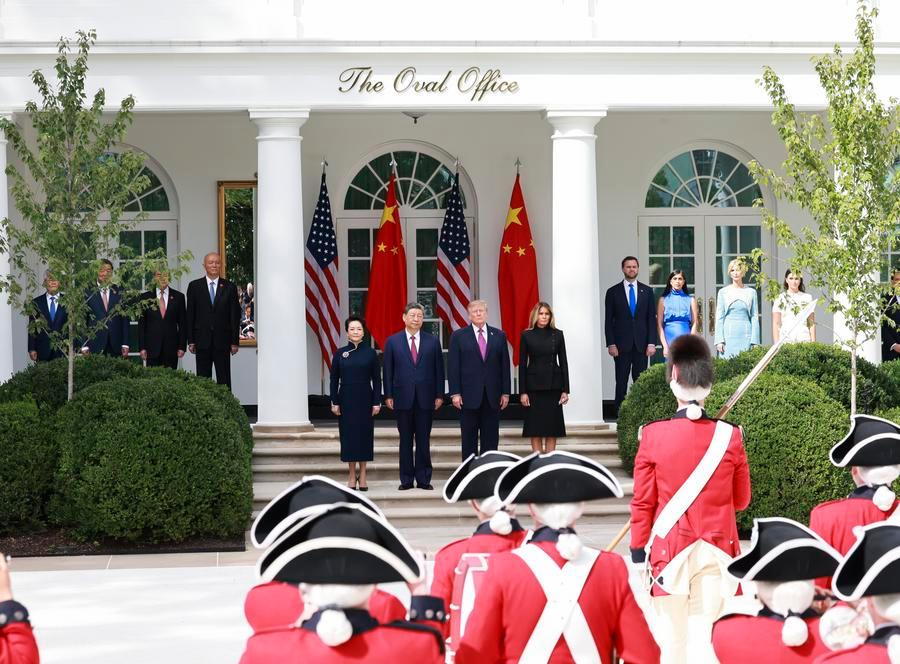
U.S. President Donald Trump holds a welcome ceremony for Chinese President Xi Jinping, who is on a state visit to the United States, at the White House in Washington, D.C., the United States, Sept. 24, 2026. (Photo: Xinhua/Wang Ye)
China-U.S. relations have become crucial in the 21st-century international system. Both are economic and technological powers, permanent members of the United Nations Security Council and strong players in Asia and beyond. They influence global trade and investment, strategic stability, international peace, global technological innovation and climate governance. In this context, President Xi Jinping’s recent state visit to Washington is more than just a formal nicety.
In fact, the visit came at a time when competition and cooperation are uneasy bedfellows in China-U.S. relations. Trade rivalry, technological challenges, Taiwan, artificial intelligence, supply-chain security and the conflict with Iran have been major challenges. Yet Donald Trump met personally with Xi at Joint Base Andrews and will also host a state reception to highlight the importance of the U.S.-China relationship. The airport welcome was symbolic and underscored the value of diplomacy and high-level interaction even amid strategic rivalry.
China-U.S. relations and cooperation will be pivotal this year. It’s uncommon for a leader to travel to the other’s country with such a brief interval. Xi’s trip to Washington follows Trump’s visit to China this year and is part of an effort to maintain strong ties between the leaders of the world’s two largest economies. The Chinese path forward is a relationship of “strategic stability” characterized by cooperation, differences that can be negotiated and competition that appears now and then.
Both China and the U.S. are great countries, and their people have made enormous contributions to science, culture, economic development and human civilization. Their relationship should not, therefore, be a zero-sum game. The success of either country should not require the failure of the other. The important thing is that major power competition does not have to be bad or unwieldy. The bigger matter is how competition plays out, what the rules and constraints are and how to avoid conflict when there are disagreements.
Competition is something neither China nor the U.S. should fear, Xi said. Rather, competition should be healthy, regulated and aimed at improvement, not confrontation. It should be more about making progress and innovating than trying to outdo the other side at any cost. It’s true that difference exist, but Beijing offers a model that could help prevent rivalries from becoming destabilizing. So, the Washington summit is not the end of an agreement to be tied down for just for now; it is the beginning of a path that can prevent bilateral flashpoints from escalating.
Analysts, however, say there are few encouraging prospects for further improvement, given the high degree of mistrust. The summit’s usefulness may therefore depend on the ability to create mechanisms for conflict resolution and ongoing communication beyond the visit’s political symbolism.
China and the U.S. don't need to reach consensus on all issues to maintain a stable relationship. Both governments need to consider the ramifications of miscalculation. When the military is involved, responses are often difficult to manage economically and politically. Strategic responsibility means keeping communication channels open, clarifying red lines, avoiding unnecessary escalation and ensuring that legitimate national security concerns are not confused with policies that intensify comprehensive confrontation. Hence, the principle of no conflict and no confrontation is important; it doesn’t mean that all conflicts will just go away. In this context, it helps ensure peaceful competition, crisis communication and diplomatic engagement. The two countries will have to learn to differ without viewing differences as threats to their respective survival.
Washington’s discussions on trade and economic relations have remained unchanged. The economies are closely intertwined in various aspects, including supply chains, consumer markets, investment, manufacturing and technological production. But the escalation of trade wars and the introduction of tariffs and restrictions on strategic goods have introduced uncertainty both within companies and in other nations that depend on international trade. This isn’t a tariff pact; it’s an economic alliance. It will be transparent, based on reliable commitments and predictable commercial rules and processes to resolve disputes. Both sides have the right to protect national security and key industries, but haphazard restrictions can further disrupt international supply chains. Fragmentation could also affect developing countries by raising costs, limiting investment options and increasing the difficulty of using technology and markets.
Artificial Intelligence has become a significant problem in the China-U.S. relationship. Both countries boast powerful technology and compete for a leading role in developing AI and high-performance computing. But AI also raises concerns about safety, privacy, autonomous systems, cybersecurity, jobs and the future of human decision-making.
President Xi has stressed the need to engage in dialogue and cooperation on the risks and opportunities of AI technology, indicating that the two countries can tackle the issue in ways that align with their respective strengths, rather than treating it only as a security threat. He also emphasized human control, a people-centered approach and preventing the misuse and abuse of AI. One of the most important areas for positive interaction and collaboration can be here. Although their politics, regulatory systems and technological agendas differ, China and the United States both face the dilemma of how to ensure that new technologies help people. Potential risks from technological innovations can be addressed through AI safety, crisis communication, risk assessment and international standards.
Meanwhile, cooperation will not be easy. Both sides want to maintain their technological leverage, and China's interest lies in becoming more self-reliant and more influential in technology worldwide. National security concerns and strategic vulnerabilities may also impede information sharing. The challenge will be to identify technically simple technologies with a global public-good impact that does not conflict with the other country's broader technological goals.
Taiwan remains one of the most contentious issues in China-U.S. relations. The situation implicates sovereignty, security, military deterrence and regional stability concerns. Serious disagreement is possible over arms sales, military operations and political declarations. Expecting the Washington summit to settle such disagreements is unrealistic. However, direct communication between the two leaders may help minimize the chance for miscommunication. A crisis is not a desirable outcome for either side and can be avoided by careful management, not by accident. Being responsible requires diplomacy and clear communication, as well as an understanding of the broader implications for East Asian security.
China-U.S. competition is also impacting the wider Indo-Pacific region. Nations in Southeast Asia, South Asia and the Pacific are striving for growth and space to maneuver while trying not to be drawn into a tit-for-tat game of great-power confrontation. While a stable China-U.S. relationship would not resolve regional disagreements, it might help to provide a better foothold for dialogue, connectivity and cooperation.
China and the United States will not be the only ones to decide the fate of the global order. Nevertheless, the interaction of these two forces will play a big role in determining the nature of the international system—whether it becomes more cooperative, more fragmented or more conflicted. The interaction impacts multilateral institutions, international economic governance, climate change discussions, public health, maritime security and global policies for emerging technologies.
No other country should be required to take sides in a constructive relationship between China and the United States. Rather, the approach should create room for a more pluralist international system in which large, medium-size and small states can fairly protect their legitimate interests. Sovereignty, peaceful coexistence, international law and dialogue remain relevant for countries that do not want to be caught up in geopolitical competition over development. Whether or not ceremonies and speeches lead to action will be the acid test of Xi’s visit to Washington. While symbolism can help set the tone, institutionalized dialogue, meaningful commitments and practical cooperation are essential to ensure sustainable stability.
China and the U.S. do not have to forego competition. They are called upon to ensure that competition stays within the bounds of responsible, mutual respect and peaceful coexistence. Differences between the strategic competitors can be bridged on issues such as AI governance, trade stability, climate change, public health and transnational crime, and that bridge can show ways of working together that can help solve other problems. The two states have not only a shared planet but responsibilities to it that go beyond their borders.
The future, however, should be founded on a policy of finding a workable compromise between competition and collaboration, not uniform opposition. Beijing and Washington are maintaining a “no conflict, no confrontation” policy, and their relationship can help create a more stable, inclusive and peaceful world order—not to mention a better world for their own citizens.
