
Four interconnected risks threaten Republican control of the U.S. Congress in November’s midterm elections. The vote will determine not only control of Congress but will also profoundly influence the future trajectory of American politics.
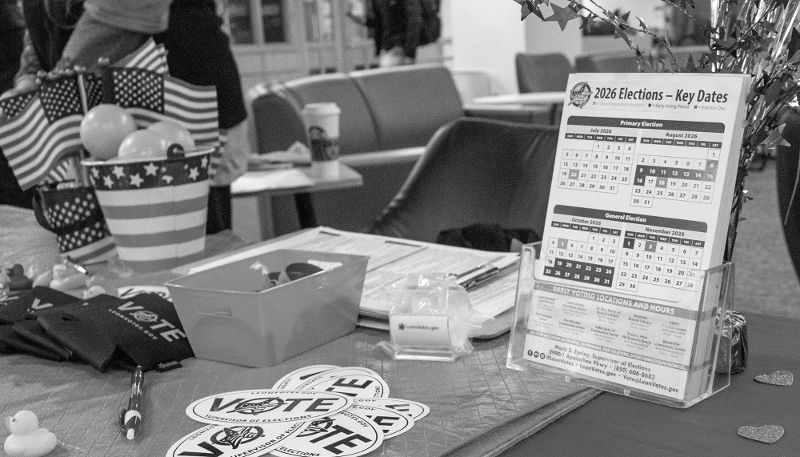
The 2026 U.S. midterm elections in November, will be a critical referendum on President Donald Trump 2.0 and the Republican Party’s governance. Historically, the president’s party tends to lose seats in midterm elections, a pattern that now looms large over the GOP. Currently holding razor-thin majorities of 218-214 in the House and 53-47 in the Senate, Republicans face a combination of four formidable challenges: a stagnant economy, Trump’s erratic foreign policy, deepening internal divisions within the MAGA movement and escalating culture war conflicts.
It’s a perfect storm that significantly elevates the possibility of Democrats reclaiming congressional control, potentially making Trump a lame-duck president for his final two years in office.
The “affordability” election
Despite outwardly positive macroeconomic data, a major concern of voters is the rising cost of living or “affordability.” Polls consistently show this as the decisive factor. While Trump claims to have created “the greatest economy in history,” public perception tells a different story. A Pew Research Center study conducted in October found that about half of Americans (53 percent) say that, since taking office, Trump’s economic policies have made economic conditions worse, about 24 percent say he’s made them better and 22 percent say his policies have not had much effect. This disconnect between government statistics and people's experience has severely damaged Trump’s reputation as an economic manager.
Trump’s net approval ratings declined throughout 2025. Currently only 41 percent approve of his handling of the economy, while 57 percent disapprove, according to the ABC News/Washington Post/Ipsos poll conducted in February. This pervasive economic anxiety directly undermines the GOP’s standing with the crucial independent and swing voters needed to defend its fragile House majority.
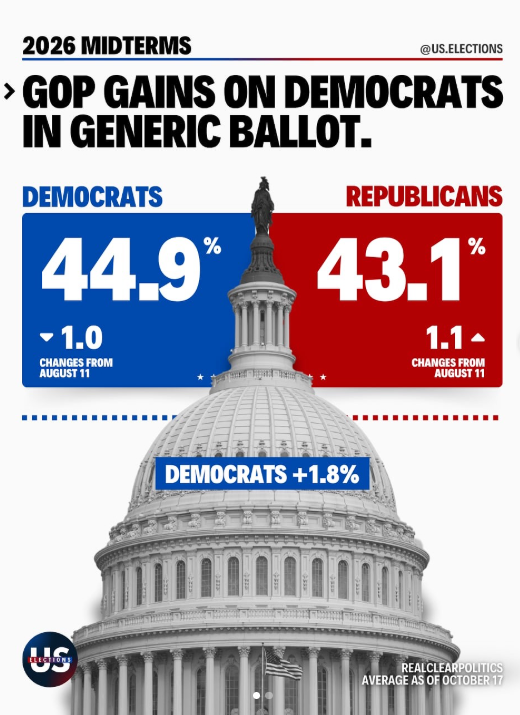
As of October 17, 2025, Democrats (@thedemocrats) hold a 44.9% to 43.1% edge over Republicans (@gop) in the 2026 midterms Generic Ballot, per the @realclearpolitics average. Since August 11, the Democratic lead has shrunk from 3.9% to 1.8%.
Impact of Iran war
Trump’s decision to launch military strikes against Iran in late February, directly contradicted his long-standing “America first” non-interventionist rhetoric and introduced a volatile “black swan” into the midterm elections. The conflict has triggered a sharp spike in global oil prices, with Brent crude exceeding $100 per barrel and U.S. gasoline prices soaring. For an electorate already suffering from inflation, higher energy costs are making matters worse. Analysts warn that sustained high oil prices could lead to a disastrous outcome for Republicans in November. Further, the war has exposed a significant rift between the administration’s narrative and public sentiment, with up to 70 percent of Americans believing congressional authorization should precede military action.
The U.S. could be enmeshed in another prolonged conflict. The war’s duration is uncertain, and Trump’s ultimate goal—the “unconditional surrender” of Iran—is deeply unpopular with a broad section of the electorate.
MAGA in turmoil
The Iran conflict has exacerbated preexisting ideological fractures within the MAGA coalition. The movement traditionally embraces “America first” isolationism but now faces a direct conflict with the interventionist stance of neoconservative hawks within the party. This internal conflict has moved from rhetorical debate to concrete action. Joe Kent, the Trump-appointed director of the National Counterterrorism Center, resigned in early March, saying that he could not “in good conscience support the current Gulf war” and accusing the administration of acting under pressure from Israel. Other MAGA-aligned figures, such as former Fox News host Tucker Carlson, have criticized the Trump administration of being dragged into war by Israel, and former Georgia Republican Representative Marjorie Taylor Greene has publicly opposed the conflict, calling it “murdering children” and departing from the “America first” agenda. Such criticism within the party could depress Republican turnout in key voting districts.
Culture war still hurts
While immigration and cultural issues were strengths for Republicans in 2024, they now carry more risks. Recent large-scale protests in many states against U.S. Immigration and Customs Enforcement (ICE) and its handling of undocumented immigrants have clearly evolved into direct dissatisfaction with Trump personally and his Department of Homeland Security’s governance style.
Additionally, the ongoing battles over abortion rights, LGBTQ+ issues, and “woke” culture continue to polarize the electorate. In a climate where economic pain is overwhelming, an overemphasis on cultural warfare may be perceived by swing voters as a distraction from their financial concerns.
Structural factors decisively favor Democrats this year. History is a powerful headwind: Since 1946, the president’s party has lost House seats in 18 out of 20 midterms. With Trump’s approval rating floated in the 36-44 percent range, well below the 50 percent critical threshold, historical models predict significant losses. The GOP’s House majority is especially vulnerable. Democrats need a net gain of just three to five seats to flip the chamber.
In addition, a retirement wave has hit Republicans, with 35 House GOP incumbents so far not seeking re-election, showing how pessimistic those politicians are with their party’s future. Meanwhile, the chance of a Democratic victory in both chambers has surged to around 50 percent; and since the Iran war began that figure has risen significantly. For Republicans, the Senate map is more favorable, but Democrats have a narrow path. They need a net gain of only four seats.
The 2026 midterm elections present the Republicans with a multidimensional crisis. Trapped by historical trends, a thin majority and internal dissent, the GOP's control of Congress is at high risk. If Democrats retake the House, they will likely launch corruption and criminal investigations against Trump, or even another impeachment, and obstruct passage of major legislation. In that scenario, if Trump wants to solidify his political legacy, he might persistently challenge constitutional boundaries and test the bottom line of American-style democracy.
This election will not only determine control of Congress but will also profoundly influence the future trajectory of American politics.
