The Trump administration has merged state authority with private interests, treating political power as a monetizable platform rather than a system of public governance. From Beijing’s perspective, this validates China’s pragmatic approach to legitimacy and positions the U.S. as a conglomerate of private interests rather than a traditional state.
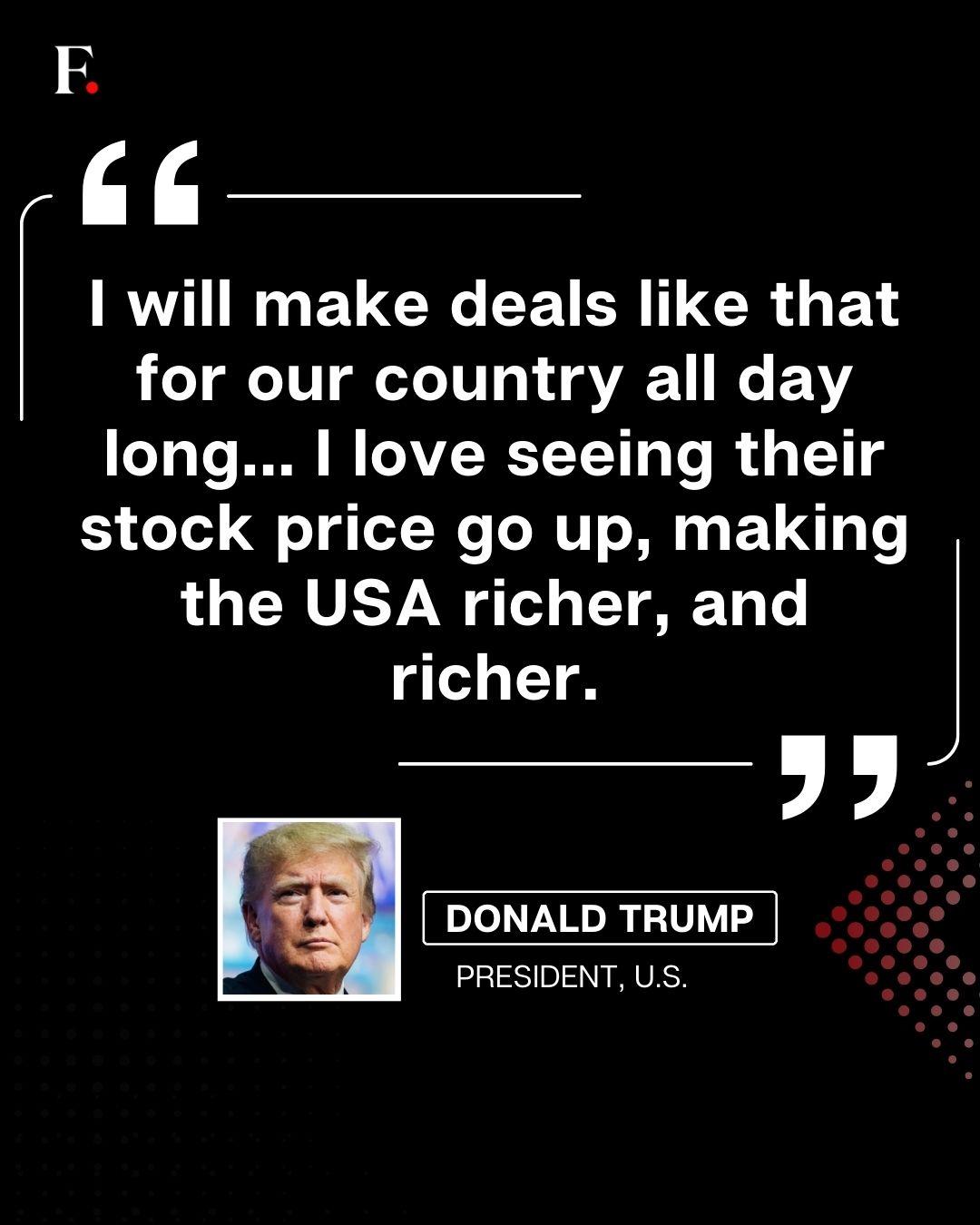
(Graphic:Firstpost)
The most revealing moment of Donald Trump’s second inauguration was not the oath, but the front row. Tech bros occupied center stage while elected representatives sat in the cheap seats. While Elon Musk, Jeff Bezos, and Mark Zuckerberg were smiling for the cameras, the merger of political power, tech oligopolies, and private fortunes completed its transition from backroom dealing to prime-time spectacle.
This carries some weight in Beijing because Chinese political culture reads power through symbolism and hierarchy, and what they saw was revealing: America had finally admitted what everyone already knew. For years, Washington lectured about democracy versus autocracy, rule of law versus party control, claiming moral authority from institutional restraint. That fairy tale expired somewhere between the first impeachment and the crypto grift, but January 20, 2025, made it official. Capital doesn’t pressure the state anymore; it is the state, and it’s not hiding.
One year on, this new arrangement has begun to dictate how geopolitics is exercised, traded, and understood. The China-U.S. rivalry was never really about competing values, and the issue is no longer whether American democracy is eroding. The question now is whether Beijing can do business—finally bypassing ideology—with what America has become: not a Westphalian state, but a franchise operation with nuclear weapons.
The Business Model of Foreign Policy
Trump’s inner circle operates foreign policy as deal flow. Steve Witkoff and Jared Kushner don’t negotiate peace in Ukraine; they trade reconstruction contracts and mineral rights. Kyiv finds out about American proposals the same time the rest of us do—by reading the newspaper. War termination gets repackaged as a revenue stream for people positioned to collect, and the Ukrainians dying in trenches are just externalities in someone else’s cap table.
Call it what you will, but don’t call it corruption. Corruption suggests the system still has rules being broken. This is more honest: public authority as a monetization platform, norms not violated but obsolete. Why bribe officials when you can simply be the officials?
Global wealth concentration gives this model confidence. Fewer than 80,000 people control three times more wealth than half of humanity. The top ten percent own three-quarters of everything while the bottom half fights over crumbs worth 2 percent of global wealth. At that scale, inequality stops being a policy problem and becomes an anthropological divide. The ultra-rich don’t see themselves as the same species as everyone else.
The White House absorbed this logic. Multilateral agreements, international law, even national sovereignty—all of it gets evaluated on a single metric: does it generate opportunities for people with the right phone numbers? Curtis Yarvin provides the intellectual cover, reframing democracy as inefficient overhead and governance as property management. Citizens are not participants; they’re users. Authority belongs to ownership, not participation, and if you don’t own anything, you simply do not exist.
Douglas Rushkoff’s account of elite survivalism supplies the logical endpoint: America’s ruling class does not plan to fix collapse, they plan to escape it. Private bunkers in New Zealand, floating cities, Mars colonization fantasies—this is what they discuss while the rest worry about rent and inflation. “The Event” is coming, they agree, but only some people will be around to experience it.
From Beijing’s perspective, this resolves a longstanding quest. How could Washington claim moral superiority while its elite treats statecraft as a business opportunity? Once procedure becomes indistinguishable from oligarchic management with scheduled elections, moral instruction loses vigor. The relevant question shifts again, from whether democracy with billionaire characteristics will abandon institutional norms to whether China recognizes this system as something it can work with.
The answer appears uncomfortably affirmative. The Communist Party of China has long defended to derive legitimacy through performance and stability rather than the political system. What Beijing now observes in Washington strengthens that argument: electoral systems can be captured by wealth without any institutional resistance whatsoever.
Indeed, as of late 2024, autocracies outnumber democracies globally for the first time in two decades—91 to 88. The democracy-versus-autocracy framework did not lose relevance; it lost meaning and analytical utility.
What Happens When the Trumps Go Shopping in China?
So here’s the scenario that’s gone from absurd to plausible: what if the Trump family goes into business in China, not despite geopolitical tension but because of it? Conflict creates scarcity, leverage, and premium pricing. Cooperation just produces regulations and paperwork.
The architecture practically builds itself. Trump-branded developments across Chinese cities, licensing agreements, luxury hotels, golf courses. In exchange: preferential access, regulatory advance notice, informal influence over decisions that matter to Beijing, and calibrated restraint where it counts. The conversion rate from access to profit would be generous; the conversion from profit to policy would be seamless.
Because the template already exists. Three adversaries from Trump’s first term reappeared in the second as partners, offering a tutorial in conversion. Elon Musk spent Trump’s first term calling him dangerous, then bent the knee and got a government position. Jeff Bezos discovered that owning the Washington Post matters less than owning Trump’s goodwill. Qatar concluded that presidential sons-in-law are best approached in the universal language of money.
Apply that model to China and the possibilities multiply. For Beijing, the information value alone justifies participation—mapping who actually makes decisions, learning how outcomes form outside official channels, understanding which levers move policy. That is information no intelligence network can reliably obtain, and here it arrives bundled with real estate deals and trademark approvals.
More importantly, it would validate what Beijing has long claimed: America does not function as a state with public interests anymore. It functions as a conglomerate of private interests wearing a state costume, and you can do business with conglomerates.
Whether this actually happens is beside the point. Capability is what matters. The Trump family has chased Chinese deals for decades. Ivanka secured trademarks while working in the White House. Monetizing proximity to power is not a deviation from precedent but the family business model. China represents the largest remaining market where scale, capital, and political leverage converge: the only question is price and timing.
The process would unfold incrementally. Trade tensions soften through private channels. Tariffs adjust selectively. Chinese investments receive presidential endorsements. Partnerships get framed as confidence-building measures while the real structure operates in layers. First tier: regular briefings on policy discussions before public announcement. Second tier: notice of regulatory changes affecting Chinese interests previewed in time to adjust. Third tier: input into personnel decisions—Treasury officials handling sanctions, Commerce appointments, ambassadors in Asia.
Nobody involved would call it betrayal. They’d call it realism, doing business, dropping the hypocrisy. The entire American political class has monetized access for years—Hunter Biden’s laptop proved that, the Clinton Foundation normalized it. The Trump family just stopped apologizing for it, hence the difference is presentation, not practice.
Beijing understands this arrangement well enough. In the American system, formal authority and private interest have merged. Paying for access is not subversion when the method runs on access payments; it is just how things work now. The absurdity is that Washington spent decades warning other countries about exactly this convergence, and then built the model themselves.
But here is where it gets interesting, because even the winners in this scheme face a problem: a nuclear-armed power governed through personal networks and private incentives is inherently unstable, and capital cannot hedge against real instability. Elite impunity advertised too openly invites responses that money cannot outrun.
History offers a pattern even the insulated might one day notice. Robert Darnton’s work on revolutionary France demonstrates that outrage over visible court excess mobilized guillotines faster than Enlightenment ideas ever could. People tolerate massive inequality right up until the moment elites advertise their impunity so blatantly that everyone else remembers they outnumber the ruling class.
The decisive issue, then, is not whether the Trump family will do business in China—they already have their playbook. The question is whether anyone in Washington retains both the capacity and the will to prevent the complete conversion of state authority into a private equity portfolio.
The answer will determine whether American institutional collapse stays a domestic problem or becomes contagious in an international system already cracking under pressure. In Beijing, some are likely scanning their real estate portfolios, noting which premium locations might soon acquire a very particular kind of availability.
