
America’s actions in Venezuela lay bare the lengths Trump’s administration will go to uphold American hegemony in the Western hemisphere. The rest of the world now must operate around the real potential of American military intervention until further notice.
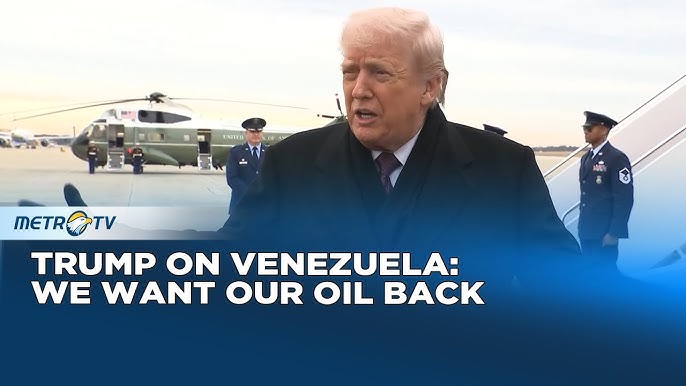
Contrary to conventional wisdom, U.S. President Donald Trump is highly predictable, at least when it comes to matters of ‘grand strategy.’ His decades-long foreign policy pronouncements, his track record in office, and, crucially, most recent National Security Strategy (NSS) show that Trump’s ultimate goal is reassertion and crystallization of American global hegemony in the 21st century. Where he is less predictable is his combustible alchemy of unorthodox geopolitical tactics and neo-imperial rhetorical brazenness.
Trump’s decision to capture Venezuelan strongman Nicholas Maduro under ‘Operation Absolute Resolve,’ and his subsequent renewal of threats to colonize Greenland (from Denmark’s de facto control) and attack Iran, are only the latest manifestation of his unabashed embrace of a vision of American global dominance with little regard for interest of even closest allies.
Far from an ‘isolationist,’ Trump has fully embraced what can be best described as “Jacksonian foreign policy,” namely an amoral and muscular approach to global affairs with no compunction with ‘shock and awe’ deployment of military force. This tradition is also profoundly populist and deeply concerned with short-term optics of power rather than substantive long-term strategic thinking.
Drenched in triumphant self-indulgence, Trump hailed America’s seamless capture of the Venezuelan strongman as an "assault like people have not seen since World War II [and one of the] most stunning, effective and powerful displays of American military might [in history]." His war chief was quick to emphasize how the operation was a display of America's operational superiority and relative ease with using force to achieve foreign policy ends. It took a more traditionalist Republican such as U.S. Secretary of State Marco Rubio to provide a more value-based spin to the operation by claiming how it supposedly marked ‘liberation’ of Venezuela from Cuban intelligence forces.
Since his return to power, however, Trump has struggled to capitalize on any of his major military operations, with patchy ‘ceasefires’ falling apart from Gaza in West Asia to Thai-Cambodia border in Indo-China. Hostile regimes in both Caracas and Tehran also remained broadly intact despite U.S. military attacks. For American allies, however, what’s even more troubling than Trump’s limited strategic follow-through bandwidth is the shattering of even a pretense to a rules-based global order.
As the U.S. president told The New York Times, “I don't need international law.” A key aide was even more blunt, openly embracing ‘machtpolitik’ as the main thrust of American foreign policy. No wonder then, as the American historian Walter Russel Mead observed, “For foreigners and for some Americans, the Jacksonian tradition is the least impressive in American politics [and] the most deplored abroad.” Instead of strategically succumbing or wallowing in despair, middle powers should step up and collectively struggle for a more rules-based international order instead of acquiescing to ‘rule of the jungle’ for the rest of the long 21st century.
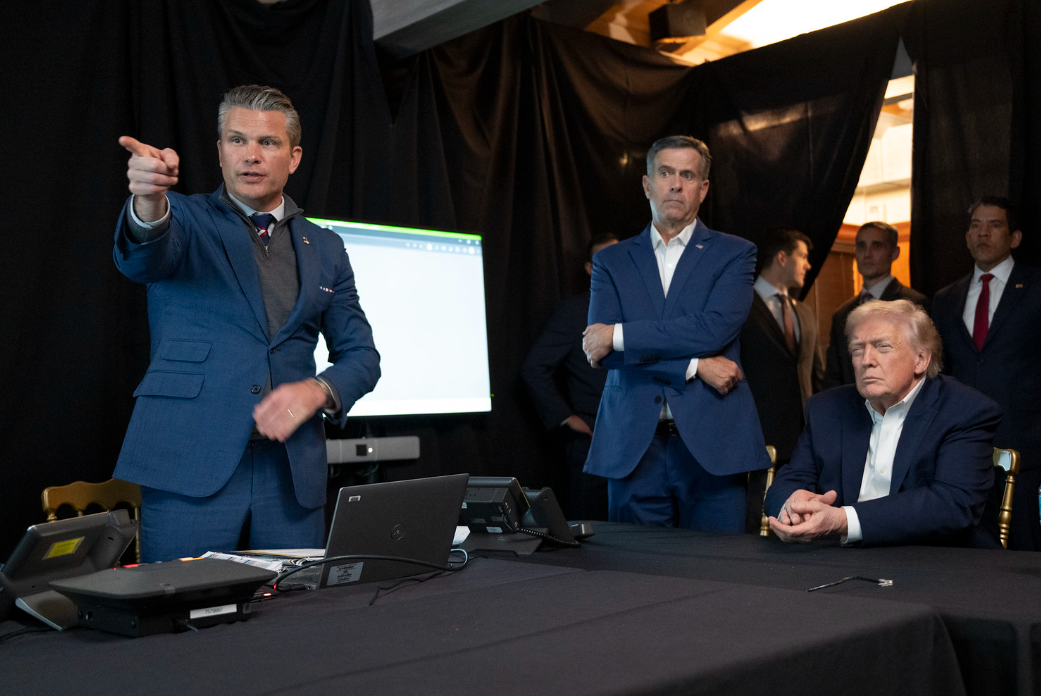
Trump monitors U.S. military operations in Venezuela, from Mar-a-Lago Club in Palm Beach, Florida, on Saturday, January 3, 2026. (Official White House Photo by Molly Riley)
Holding The Line
Sovereign states and U.S. rivals have been quick to condemn Trump’s latest military adventurism. In fact, China also openly criticized and threatened retaliation against Washington’s decision to impose new tariffs on Iran’s top trading partners in a bid to suffocate the besieged West Asian power. Crucially, even some of America’s closest partners in Latin America and Europe openly lambasted the military operation against the Maduro regime.
"These actions constitute a dangerous precedent for peace, regional security and pose a risk to the civil population," Spanish Prime Minister Pedro Sánchez and Brazilian President Luiz Inácio Lula da Silvathe said in a joint statement along with four other South American nations. "We reiterate that the situation in Venezuela must be resolved exclusively through dialogue and…without interference and adhering to international law," the six leaders continued.
In Asia, key frontline U.S. allies such as the Philippines similarly emphasized “the relevant principles of international law, including the independence and sovereign equality of states, the peaceful resolution of disputes, the prohibition against the threat or use of force, and non-interference in the domestic affairs of sovereign states.” Australia and New Zealand also subtly criticized America by invoking international law.
Leaders of France and Britain avoided direct criticism but still emphasized the need for following international law. While quietly welcoming potential demise of hostile regimes in Venezuela and Iran, however, even America’s closest allies in Europe were troubled when Trump reiterated his threat to colonize Greenland.
"I agree with the Danish prime minister that it will be the end of NATO, but also among people it will be also very, very negative," warned European Commissioner Andrius Kubilius, openly backing Danish leader Mette Frederiksen. In an unprecedented move, European powers of Germany and the United Kingdom began discussing potential troop deployment to Greenland to bolster Denmark’s tenuous hold on the resource-rich Greenland, whose residents overwhelmingly oppose American control while seeking full autonomy from Copenhagen.
Trump has tried to justify his designs on Venezuela and Greenland as part of a grand strategy of securing access to precious resources in anticipation of a showdown with rival powers of China and Russia. He has even openly embraced a so-called “Donroe Doctrine,” a new corollary to the 19th century Monroe Doctrine of American hemispheric hegemony.
Middle Power Diplomacy
As a result, even America’s closest allies fear that Trump’s brazen disregard for international law is setting a dangerous precedent that could come to haunt them down the road. Traditionally, the world has been divided into great powers and ‘the rest,’ just as societies are divided in between rulers and subjects. The Greek historian Thucydides most brutally captured this worldview when he lamented: "The strong do what they can and the weak suffer what they must.”
This binary understanding of the world, however, was simplistically misguiding. As the great ancient Chinese thinker Mencius observed, middle-sized kingdoms often played a key role in Chinese history, including constraining self-aggrandizing larger counterparts. Interestingly, numerous Greek thinkers also spoke of influential mid-sized city-states such as Syracuse and Corinth, which played a decisive role during the Peloponnesian War between superpowers of Sparta and Athens.
Renaissance era thinkers such as Italian philosopher Giovanni Botero further built on the idea by speaking of the role of mezano (middle powers) city-states such as Venice and Florence, which possessed had "sufficient strength and authority" to shape not only their own strategic destiny but also the broader Mediterranean and even Eurasian geopolitical landscape. Centuries later, modern French thinker L'Abbe de Mably forwarded the concept of “second order” powers to analyze the role of mid-sized kingdoms in shaping European geopolitics, most notably in the 1815 Paris Conference and the ensuing European ‘concert of powers’.
In the contemporary era, middle-sized nations such as Australia, Brazil, Japan, Canada, South Korea, Saudi Arabia, and Turkey have played a key role in shaping global affairs. Though they come in different sizes and levels of development, ‘middle powers’ have a common shared interest in advancing cooperation; are adept at coalition-building and multilateralism; and enjoy a sufficient degree of capability to project power and also enjoy credibility in the eyes of much of the world as a constructive player.
Many of these middle powers are deeply invested in international regimes, whether it’s the United Nations Convention on the Law of the Sea or the International Criminal Court to uphold key values and core national interests. Trump’s assault on international law, therefore, represents a direct threat to the interest of many middle powers: they fret over the return of a ‘rule of the jungle’ geopolitics, which, at the very least, forces them to prioritize military build-up at the expense of other priorities and, worse, confront potential collapse of global cooperation and post-war era of unprecedented trade and economic prosperity.
Accordingly, middle powers from Europe to the Indo-Pacific and Latin America have no choice but to step up collective efforts at preserving the foundations of a rules-based order, which prioritizes institutionalized diplomacy over confrontation and respects key principles of international law. For what it’s worth, Trump may have given sufficient impetus for rising powers of Asia and middle powers of Europe to revamp their national strategies and become more proactive and constructive players in the 21st century.
