
The question “Where is NATO heading?” has long been debated in academic circles. Under pressure from Donald Trump, the answer is gradually emerging: NATO’s trajectory mirrors that of many international institutions today, which are not collapsing abruptly but transforming themselves.
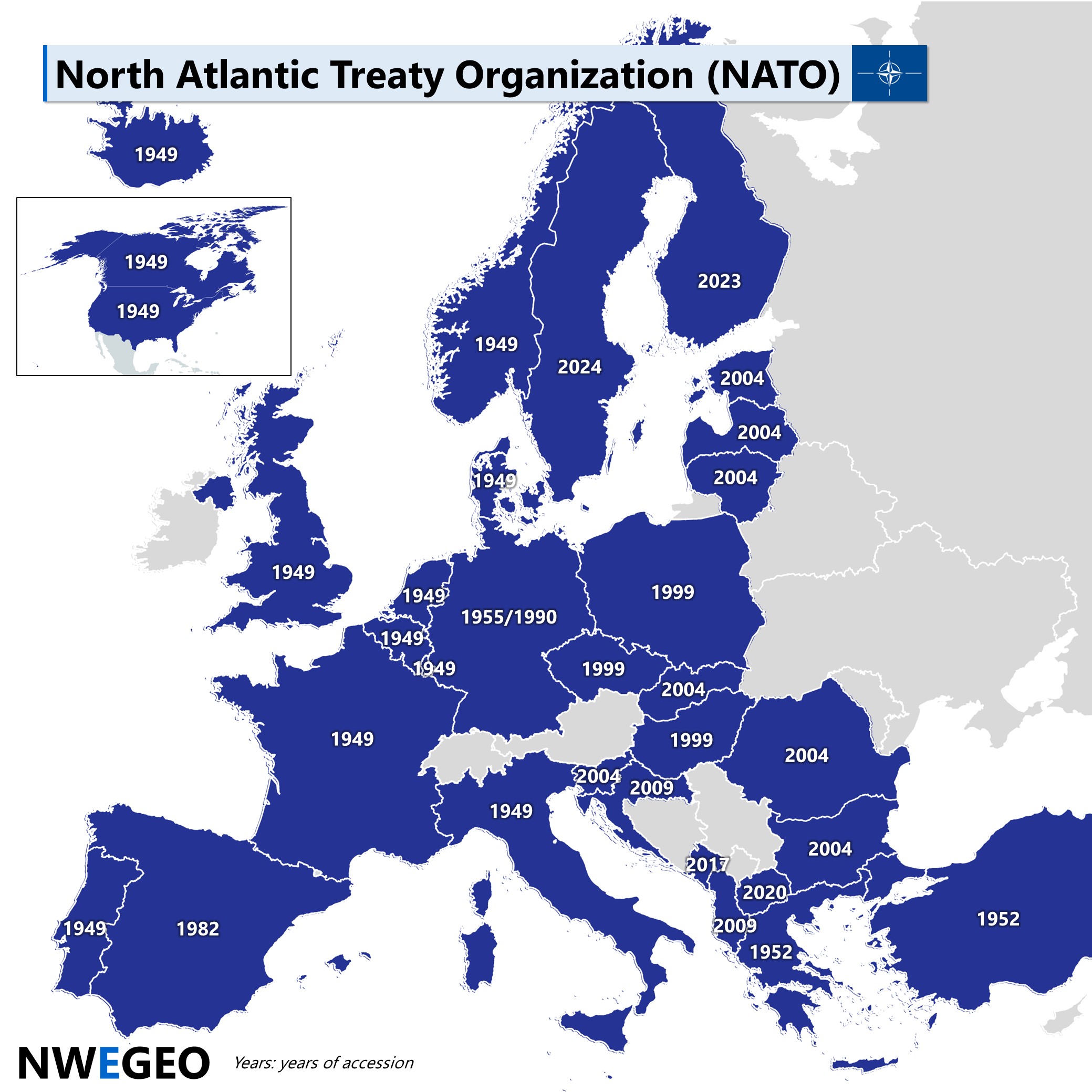
In the 1990s, with the Soviet Union—NATO’s default adversary—gone, the organization did not dissolve as the Warsaw Pact did. What distinguishes NATO from traditional alliances is its Article 5, which enshrines the principle of collective defense: An armed attack against one member is considered to be an attack against all. This principle has been fundamental to NATO’s continued existence after the Cold War.
Today, the international order has once again arrived at a turning point. U.S. President Donald Trump has expressed a more skeptical view of Article 5 and even NATO itself. Against this backdrop, a key question has emerged: Can the alliance survive another major upheaval in international politics?
Bad America
Trump may not be well-versed in international politics but, guided by business instincts, he appears to have sensed that NATO is Europe’s soft underbelly. Last year, Europe increased defense spending at Washington’s request and tacitly accepted Trump’s tariffs, largely due to its implicit desire to keep the United States within NATO. What reassured European countries was that Trump did not go so far as to threaten withdrawal. In late March and early April this year, however, he threatened to withdraw from the alliance, even dismissing it as a “paper tiger.” This shift reflects Trump’s dissatisfaction with Europe’s lack of cooperation on Iran and his effort to pressure it into further concessions.
Europe is well aware of this but shows little inclination to yield. On the surface, it has cited several reasons: concerns that the U.S.-Israel strikes on Iran may violate international law, the lack of prior consultation by Washington, and the fact that the Middle East falls outside NATO’s geographic scope. In reality, its calculations are far more complex.
First, although Iran is in Europe’s geographical neighborhood, it does not present a problem as urgent or as concerning as, say, Ukraine. Believing that Trump has no clear Middle East strategy, Europe is concerned that premature involvement could have unpredictable consequences. Major European countries, such as the United Kingdom and France, which have deep historical ties to the Middle East, are particularly wary of being left to deal with the aftermath of U.S. military actions. Therefore, they prefer to act independently of Washington and form a “coalition of the willing,” similar to the approach adopted in responding to the Ukraine conflict.
Second, the balance of power has shifted:
• As the Russia-Ukraine conflict reached a stalemate and Europe’s leadership role in Ukraine has grown, Trump’s room for maneuver has been significantly reduced.
Unlike issues related to Ukraine or Greenland, Trump depends on Europe when it comes to Iran. U.S. military bases and forces in Europe play a critical role in supporting operations against Iran, making withdrawal less likely. If the U.S.-Iran standoff drags on, Trump will have even less capacity to open another front against Europe.
Also, Trump’s domestic standing has weakened since last year, and any move to withdraw from NATO would encounter substantial constraints at home.
Finally, Europe believes that the prospect of withdrawing from NATO is largely a negotiating tactic employed by Trump. On this issue there has been no substantive discussion within Congress, the Pentagon or NATO itself. Recent developments suggest that Washington prefers to remain within the alliance and push for internal reforms. Media reports indicate that the White House plans to categorize its allies to exert more targeted pressure and may even consider expelling certain non-compliant members, though NATO has no formal mechanism for expulsion.
A new NATO
While NATO embodies collective security, its internal power structure has long been dominated by the United States. For decades after World War II, the U.S. has provided a security umbrella for Europe through NATO, while Europe has in turn supported U.S. hegemony. Yet Trump now sees this arrangement as disadvantageous. Although he is unlikely to lead the U.S. out of NATO in the short term, he seeks to extract greater benefits from it.
How can a favorable order be built or sustained when there is no dominant force within it? This is a question with which Europe, shaped by multiple power shifts, is now grappling. NATO is only one facet of this broader issue.
NATO is a vast and intricate construct involving domestic and international law, military-industrial and high-tech sectors, bureaucratic decision-making mechanisms and elite identity. Europe’s decision to maintain the alliance essentially signifies its acceptance of a certain distribution of power and interests. For now, Europe seeks to keep the U.S. within the alliance, as it remains the more advantageous option for imposing constraints on Washington.
At the same time, whether for the sake of self-preservation or autonomy, NATO members must prepare for scenarios such as a NATO not dominated by the United States, a NATO without the United States or even a NATO in opposition to the United States. Reports suggest that Europe is accelerating contingency planning for a “European NATO” to sustain defense operations in the event of U.S. disengagement.
At the EU summit in Cyprus in late April, leaders discussed how to use the little-used mutual defense clause (Article 42.7). A month earlier, the UK-led Joint Expeditionary Force, comprising Nordic and Baltic countries, held a closed-door meeting in Helsinki to assess the severe state of the transatlantic alliance. It is conceivable that even if the United States distances itself from Europe, Europe will continue to uphold the principle of collective security.
The question “Where is NATO heading?” has long been debated in academic circles. Under Trump’s repeated pressure, the answer is gradually emerging. NATO’s trajectory mirrors that of many international institutions today: They are not collapsing abruptly, but they are transforming themselves.
