
Who will shape the future of the international financial order in the 21st century? It’s a fight over rules, institutions and mechanisms. It’s not only about economic influence but a shift in global power.
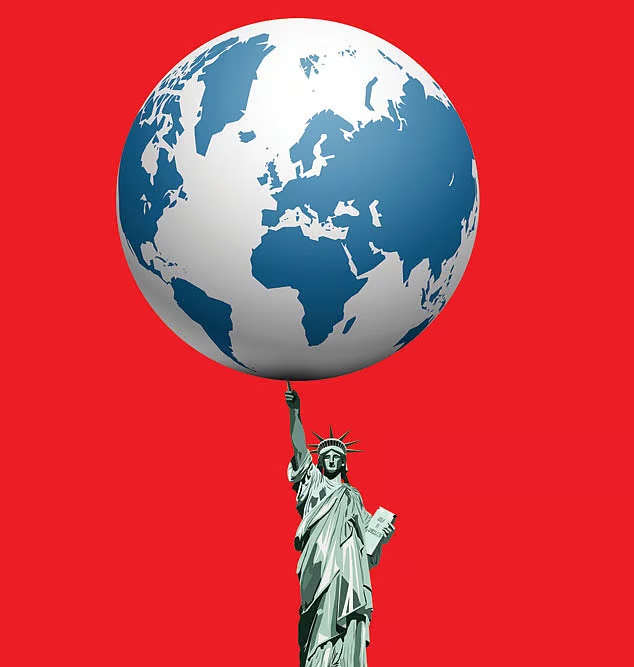
(Illustration: Saurabh Singh)
China-U.S. ties can no longer be considered a trade war, tariff war or tech war. The battlefield is increasingly the globe’s monetary system. A tit-for-tat struggle is underway between Washington and Beijing over who will shape the future of the international financial order in the 21st century. It’s a fight over rules, institutions and mechanisms. It's not only about economic influence but also about a shift in global power.
Since 1945, Pax Americana has been the international financial system, based on the Bretton Woods institutions, the supremacy of the U.S. dollar and the relevance of Wall Street in running global trade and finance. American-dominated financial structures such as correspondent banking, SWIFT messaging, maritime insurance and global financial markets enabled Washington to exert undue influence over the international economy.
As of today, around 89 percent of all foreign exchange transactions worldwide are in USD, as are 57 percent of the world’s foreign exchange reserves and 54 percent of export invoicing, reports the Atlantic Council. This control is an unprecedented advantage for the U.S. in regulating global finance.
This leverage has been increasingly mobilized in the sanctions policy. The Office of Foreign Assets Control (OFAC) is the hub of the U.S. Treasury’s regulatory and enforcement functions related to financial power. Secondary sanctions will effectively exclude a country, company or financial institution that violates Washington’s protection of the international dollar system. That’s a red line.
The level of financial exclusion in Russia, Iran, North Korea and Venezuela has varied. Financial infrastructure and geopolitics are so intertwined that Russia’s partial pullout from SWIFT after the start of the Ukraine war was an illustration of the progress it has made in that regard.
For many years, China played a large role within this American-designed system, as integration into the global economy enabled the country to undergo rapid industrialization and export-led growth. Western banking networks and worldwide maritime insurance systems were the means by which China's companies settled their debts in dollars.
However, Beijing is changing its tactics. China increasingly views America as a financial powerhouse. But it’s also a national security threat, an energy security threat and a threat to China’s long-term development.
The turning point was further seen in 2025 and so far this year. Since March 2025, OFAC has been imposing sanctions on five significant Chinese refineries for allegedly importing and refining Iranian crude oil. One of them is China’s second-largest independent refinery, Hengli Petrochemical, which was sanctioned on April 24. Companies were added to the Specially Designated Nationals (SDN) list, which means that U.S.-based assets held by these companies have been frozen and that they are barred from transactions with American entities that deal with them.
China's counter-response was unprecedented. The Ministry of Commerce of the People’s Republic of China issued a blocking order on May 2, stating that the relevant U.S. sanctions would not be recognized, enforced or complied with by China. Beijing’s most important threat was that foreign companies that cooperate with the OFAC sanctions could be held liable in China. It was the first time that China had challenged American secondary sanctions in the legal arena.
This has had an even bigger effect. But it’s not just the Iranian oil imports that are a problem. The United States established the new financial system and has increasingly come under challenge. So Beijing says it is not entirely satisfied with Washington’s dominance in international financial infrastructure. That is, China is mulling over leaving the U.S. dollar toll gate.
In the past, the financial architecture has been an effective and sensitive agent of power shifts. The Pax Britannica system started to break down in the 20th century, with the decline of the British Empire and its replacement by the dollar, and with Wall Street’s order of American colonial powers.
Most of those that remain ask themselves today: Is a transition taking place? Is a world economy emerging that is dominated by financial institutions in China, or a new “Pax Sinica”?
It’s a long-term thinking strategy that China also engages in. With dollar-clearing systems dominating international trade and finance, Beijing realizes it will not have the strategic independence it wants unless the world conducts trade and finance in other currencies. Washington’s wide-ranging use of sanctions has therefore spurred China to develop alternative financial systems to lessen its reliance on the American system.
This change has been demonstrated through several initiatives. The Cross-Border Interbank Payment System (CIPS), for example, is a yuan settlement mechanism that has been an alternative to SWIFT for some transactions since 2015. With the addition of the Chinese digital yuan, or e-CNY, cross-border transactions would be possible without passing through a dollar-clearing network. The Chinese government has also expanded bilateral currency swap agreements with dozens of central banks, offering to pay for swaps in other currencies rather than the dollar. Moreover, some projects, such as the Multiple CBDC Bridge (mBridge) led by the Bank for International Settlements and a consortium of Asian and Middle Eastern central banks, are focused on creating digital payment corridors independent of Western systems.
In addition, China’s overall economic health is crucial. China is now the biggest trading partner of more than 150 countries. This will provide opportunities for the yuan to be gradually internationalized, especially in Southeast Asia, Central Asia, Africa and the Middle East. Oil transactions in yuan with the Gulf states and Russia are both symbolic and practical indicators of non-dollarization.
But an alternative financial system is still in infancy. The U.S. financial system is a wonderful thing: it has liquidity, military strength, technological advances, institutional credibility and deep capital markets. The dollar, by itself, is the only currency today that is accepted globally, meaning free from restrictions, and that has been institutionalized. Discussions on de-dollarization will not prevent this, as American investors still hold a large stake in Chinese assets, and this dependency remains the main pillar of the global economy.
Interdependence, however, is becoming increasingly politicized. The financial world is increasingly polarized and divided, with the various geopolitical groups seeking technological, financial and institutional autonomy. Washington has increased its restrictions on semiconductors and critical technologies, while Beijing is pushing for “China for China” manufacturing and financial autonomy. And Hong Kong still plays a vital role in connecting China's financial markets to those of the world, but it’s a contentious role.
As the shattering continues, enormous dilemmas are posed to multinational companies and financial institutions. Foreign banks are caught in a dual compliance trap: To comply with U.S. laws and regulations, they risk Chinese retaliatory measures; to comply with Chinese laws and regulations, they risk being excluded from the American financial system. This is in line with the global shift of globalization from a more integrated system to geopolitical-economic spheres.
In a bizarre coincidence, the wide-ranging financial pressure being waged by Washington could be speeding up the very process it is trying to deter. The sanctions designed to stop American domination are encouraging other states to find alternatives. Russia has been boosting ruble-based trade settlements; Iran is increasingly turning to barter and local-currency transactions; and BRICS countries are exploring new payment mechanisms. China is institutionally developing a parallel payments infrastructure on an unprecedented scale.
But it’s more than all that. In truth, the political repercussions are greater: folks have lost trust that the U.S. is leading peace processes and that they are fair. Political coercion poses a threat to many countries because they are likely to be overrun by systems controlled by the United States. It’s a positive outlook fueling a push for diversification—rather than the end of dollar dominance—toward financial sovereignty alternatives.
Sino-US competition is just one example of a more general competition in which the distribution of global power and the governance of the global economy are at stake. China’s resistance to the dollar’s supremacy is not limited to the economic front but also describes a geopolitical stance aimed at making the world more multipolar.
Still, the America-centric system is not infallible, as Beijing is willing to intervene in the financial sector. The special importance of the May 2 blocking order in China, is that it elevates silent resistance to institutional resistance. This is the new era of the international monetary system, where digital currencies, alternative payment methods and geopolitical barriers are the norm.
