
Great powers have long made policy toward an imagined Iran—one that none of them had the patience to truly understand. Now, the great powers must rely on deep understanding, mutual respect and presence. But presence is precisely what Washington and Beijing lack.
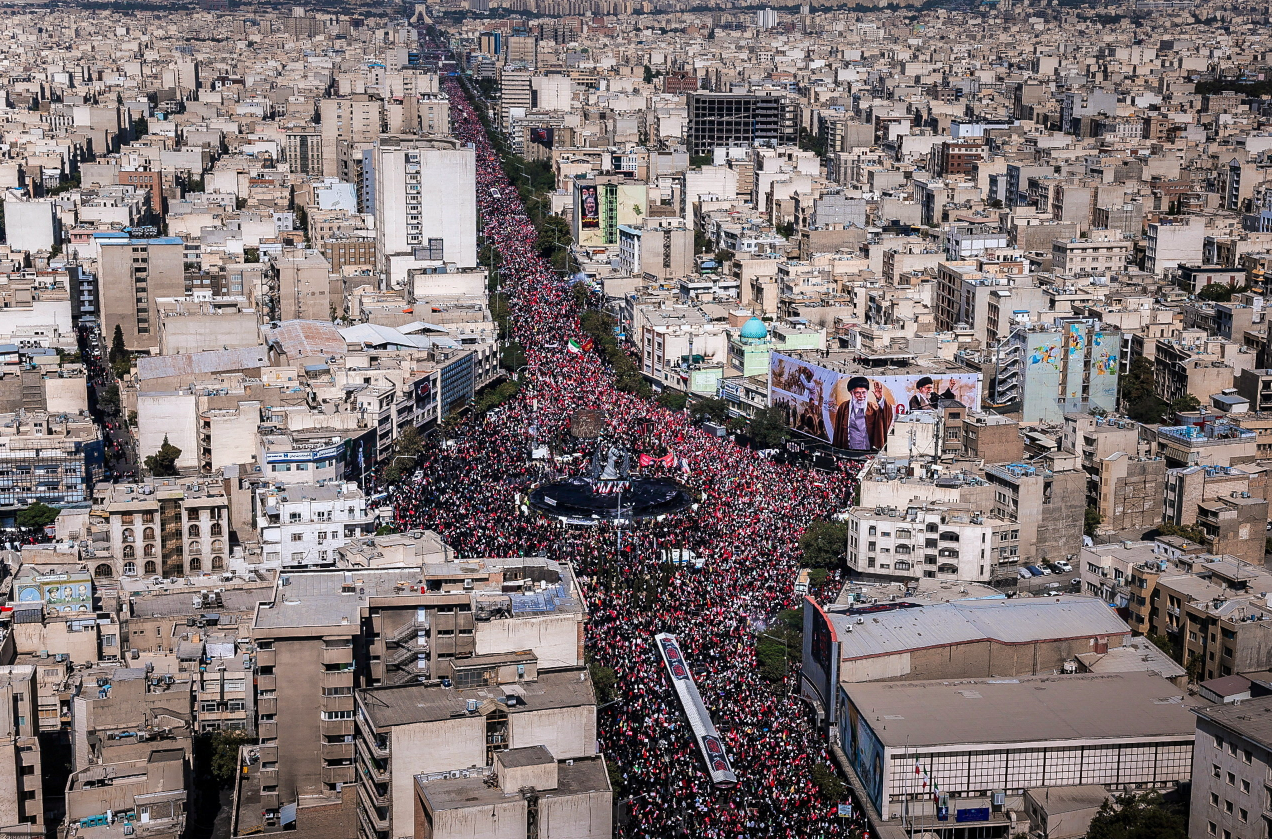
When I first traveled to Iran in early 2017, a man could marry four wives. I was asked which marriage situation I would prefer. Back then, Iran was still seen through an old set of images, as a mysterious country behind a veil.
By 2026, the Middle East had changed significantly. With Saudi Arabia opening up, Russia invading Ukraine and Israel driving into Gaza, the Mideast power structure has reshuffled against the backdrop of a larger realignment of power among the greater powers themselves. To the untrained eye, Iran may seem unchanged. But in international relations it has become one of the most consequential variables of the moment, arguably surpassing even the Israeli-Palestinian issue. On Iran, both Washington and Beijing got it wrong, each in its own way.
On June 17, the United States and Iran signed a non-binding memorandum at Versailles declaring a cease-fire. In the days that followed, Iran continued to shoot missiles at U.S. bases in Bahrain and Kuwait. Then the United States struck back and Israel continued pounding southern Lebanon. This crossfire during the so-called cease-fire is no surprise. Its course was set long ago in Iran's collective memory and in the long, repeating history of great powers on Iranian soil.
Before the cease-fire, American policy toward Iran could be captured in a single phrase—maximum pressure—although different administrations gave the same basic approach a different name. In 1979, after the seizure of the U.S. embassy in Tehran, the Carter administration issued Executive Order 12170, which froze Iranian assets as an emergency measure but formally opened the era of pressure. From the 1980s into the 1990s, the containment of Iran ran in parallel with the demonization and dual containment of Iraq.
Subsequent administrations expanded embargoes and sanctions. Under Barack Obama, the policy carried a new name— “crippling sanctions.” In 2018, the first Trump administration formally withdrew from the JCPOA nuclear agreement and defined its policy as “maximum pressure.” In 2025, the second Trump White House issued its National Security policy, NSPM-2. The decree defines Iran as a “revolutionary theocracy” that was established in 1979 and is hostile to the United States and its citizens. It is also the “world’s leading state sponsor of terrorism.” In a quiet aside, the paper named China and demanded that Iran’s crude oil exports to China be driven to zero.
Throughout NSPM-2, an ancient nation of 90 million people is reduced, again and again, to a single word: regime. The document turns on a familiar security vocabulary: nuclear weapons, terrorism, proxies. And it offers virtually no sense of Iranian society itself. The rupture between the two countries since 1979, which cut both governmental and non-governmental contact to nothing, has left a diplomatic blackout and with it an extraordinary deficit of understanding.
That deficit has fed one strategic miscalculation after another. Iran is not simply a government; it is a society with a thousand-year narrative of resistance, one that has often grown more resilient the harder it is pressed. It is no longer the Iran of 2015, waiting to be admitted into the Western order. It understands clearly that it is now a variable in the U.S.-China competition, and this year it maneuvered America’s reluctance to be drawn into another Middle Eastern war to its benefit. According to a Pentagon briefing to Congress, the U.S. has already spent $113.3 billion on its war, enriching its defense industry while, through seigniorage, spreading the cost to the next generation and to the world.
Through all of this, the world has quietly watched China move to fill the vacuum. The energy firm Kpler reports that in 2025 China purchased more than 80 percent of Iran’s oil exports—roughly 1.38 million barrels a day—at a discount of 8 to 10 dollars a barrel against the international benchmark. This arrangement may have begun in 2021, as Iran and China signed the 25-year, $400 billion China-Iran Comprehensive Cooperation Plan, which allowed China to exchange investment in Iran for discounted crude oil.
Yet the partnership has proved far thinner than the headlines suggest. For all the pledge of $400 billion over 25 years, China’s cumulative investment in Iran over the past 15 years amounts to only around $27 billion. Its flagship projects there have foundered one after another: for example, the South Pars gas field, meant to become China's largest single investment in Iran at roughly $5 billion, saw CNPC withdraw under the pressure from U.S. sanctions. Then, the Yadavaran project dragged on for nearly nine years and its second phase has been stalled since 2016. In the end, Iran announced it would develop the projects on its own.
China's interests in the Middle East have always been primarily economic. The ties between the West and the Middle East run through security, defense, political institutions and culture, while China’s are almost purely money. This is at once a strength and a weakness. The strength is that China’s dealings with the region carry no colonial wound. The weakness is that its presence is a spent arrow lacking real depth.
In contrast to the vigorous, all-fronts deepening of China’s ties with the Gulf, its cultural exchanges with Iran are thin and sparse. Last year, China and Saudi Arabia designated a “China-Saudi Cultural Year” of some 60 cultural events. They exchanged students and saw traffic between the two countries surge from 2022 onward. Chinese tourists visiting Saudi Arabia in 2025 were projected at around 500,000, a fivefold increase in three years. Chinese tourists to Iran that same year numbered only 60,000.
China’s official framework for the Middle East is the Global Security Initiative, proposed in 2022. Its language projects “common, comprehensive, cooperative and sustainable” security. In essence, it means this: Beijing has no intention of replacing Washington as the region’s security guarantor, and it will stay out of its domestic politics and changes of regime. So long as Washington maintains the regional order, Beijing is content to expand its economic ties under that security. And when Washington cannot maintain it, Beijing will still not bind itself into any alliance.
That’s why the relationship between China and Iran remains more limited than it is often assumed to be. For all the kinship two ancient civilizations may feel, and with both being targets of U.S. pressure, their cooperation is selective rather than deep. Iran’s “turn to the East” is a choice forced by sanctions and necessity, not where the heart of Iranian society lies.
As the war settled into its current phase, Iran has learned to hedge with great powers. It has made control of the Strait of Hormuz a political bargaining chip and its "turn to the East" a negotiating instrument. In this contest, Washington overestimated its pressure, and Beijing overestimated its influence. For a century, Iran has been handled by great powers, from Britain to Russia to America; and though it has been handled, it has also learned the game, finding, within the repetitions of its fate, a breath of air for its society.
From antiquity to the present, great powers have made policy toward an imagined Iran—one that none of them had the patience to truly understand. Iranians should decide their own fate. If any role is left for the great powers, it must rely on deep understanding, mutual respect and presence. But presence is precisely what Washington and Beijing lack. And the cost of that misreading is beginning to show.
