
What the U.S. president needs is not another, more intense round of airstrikes but a cease-fire formula that every side can sell at home.
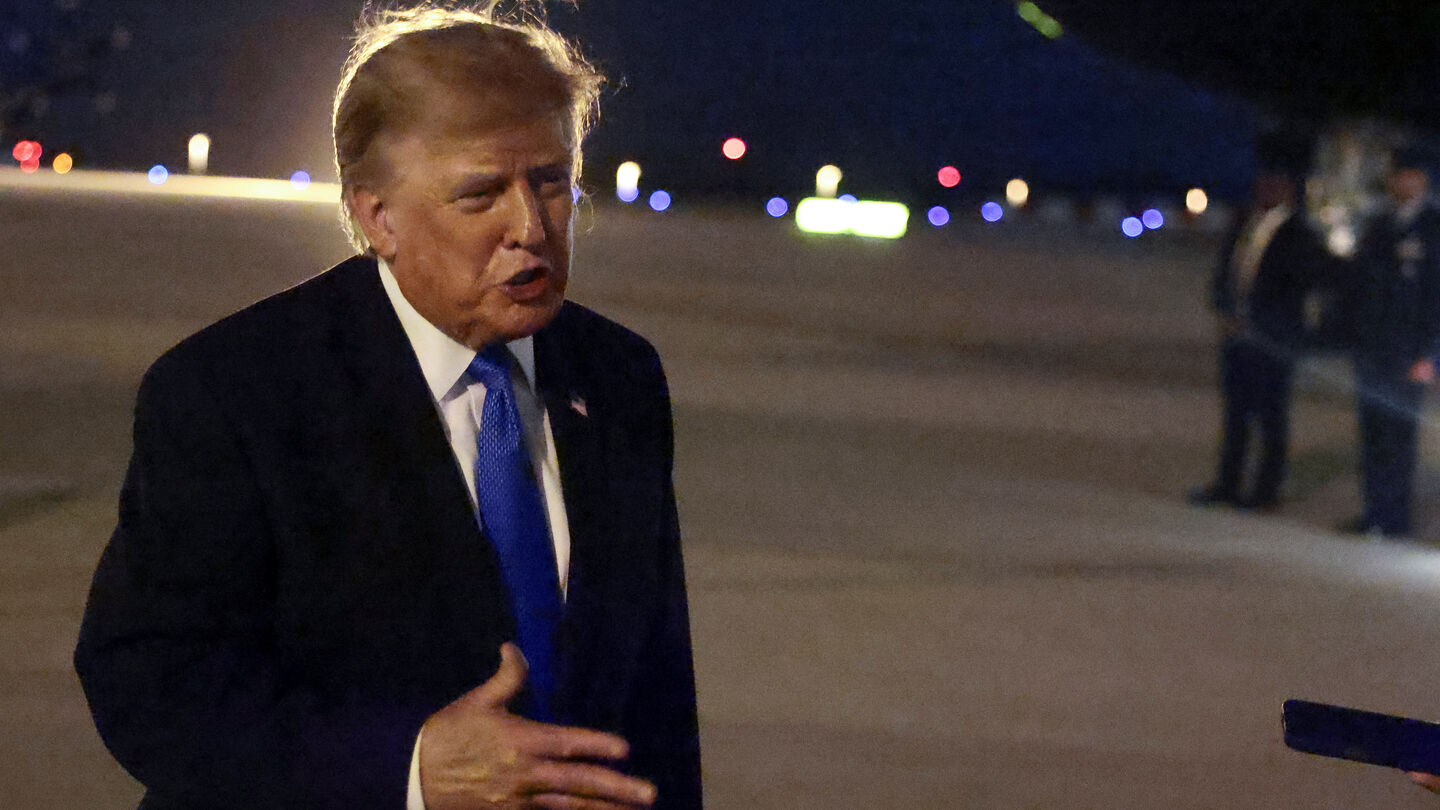
Upon arrival at Los Angeles International Airport on August 4, 2026, U.S. President Trump told the media there had been an "all-day negotiation" with Iran. (Photo: REUTERS I Evelyn Hockstein)
Five months into the U.S.-Iran war, the administration of Donald Trump has once again suspended airstrikes, claiming that “productive talks” are underway. Tehran, however, denies seeking peace, saying only that messages have been exchanged through intermediaries.
Previous cease-fires, Strait of Hormuz agreements and diplomatic openings have all collapsed more than once. The current calm appears less a genuine de-escalation than a pause to replenish munitions and reshuffle bargaining chips. The United States retains the capability to strike more targets, while Iran remains capable of generating further risks. Yet neither side has found an exit that can end the conflict without appearing to concede defeat.
Two endgames
The first obstacle to ending the war is that the two sides have fundamentally different ideas about what constitutes an acceptable endgame. Washington seeks to restore freedom of navigation through the Strait of Hormuz, roll back Iran’s nuclear capabilities and weaken its network of regional proxies. Tehran, by contrast, insists on retaining authority over the strait, securing the release of its frozen assets and sanctions relief while preventing Israel from continuing its strikes against Iran’s regional allies.
The memorandum of understanding signed in June merely put these issues on hold without resolving any of them. Its provisions on transit through the strait, shipping routes and the scope of Iran’s authority were deliberately vague, while the nuclear issue was deferred to a later stage. As a result, the negotiations became little more than a semantic contest, with each side advancing its own interpretation of the text. Washington argued that Iran should allow commercial shipping to pass unconditionally, whereas Tehran maintained that the United States had implicitly acknowledged Iran’s authority to oversee the strait. Both sides subsequently sought to use military and economic pressure to force acceptance of their respective interpretations, making a renewed outbreak of hostilities all but inevitable.
More troubling still, the conflict has long since spilled beyond the bilateral confines of the United States and Iran. Israel’s operations in Lebanon continue to provoke Tehran, while the Houthis have turned the Red Sea into a second flashpoint for global shipping. Gulf states such as Bahrain and Kuwait have likewise been drawn ever closer to the front line through successive rounds of attacks and reprisals. Under such circumstances, any cease-fire that binds only Washington and Tehran could easily be undone by a single operation carried out by Israel, the Houthis or one of the region’s many militia groups.
On this point, Chinese scholars of the Middle East broadly share the view that U.S.-Iran relations are likely to settle into a recurring cycle of confrontation followed by negotiation, with the prospect of a prolonged low-intensity conflict continuing to grow.
Can Iran hold out?
Iran has proved far more resilient than most analysts expected, but its claims that it is winning the war are misleading. The country has suffered heavy losses. Its nuclear facilities, missile sites, ports and transport infrastructure have all come under sustained attack, while years of sanctions have further fueled inflation, weakened its currency and intensified pressure on livelihoods.
Yet Iran is unlikely to be subdued by an air campaign in the near term. Its vast territory, dispersed military infrastructure and capabilities in missiles, drones and maritime harassment give it considerable strategic resilience. Tehran does not need to secure victory in the conventional sense. As long as it retains the capacity to retaliate and to keep the Strait of Hormuz shrouded in uncertainty, it can continue to impose costs on the United States, Israel and the Gulf states.
For now, time is Iran’s most valuable strategic asset. After 13 consecutive nights of airstrikes, Washington has suspended its campaign once again. U.S. officials have acknowledged that the number of viable targets is dwindling, while stocks of certain air-delivered munitions are also coming under strain. At the same time, rising oil prices and mounting U.S. military casualties are becoming increasingly salient issues in American domestic politics. A Reuters/Ipsos poll found that only about one-third of Americans support the war, while most remain unclear about what Trump ultimately hopes to achieve.
Iran’s leadership understands that the American public has little appetite for another open-ended war in the Middle East. Tehran does not need to exhaust the U.S. military. It merely needs to outlast the U.S. midterm elections. If divisions within the Republican Party continue to widen, Washington’s willingness to negotiate could increase markedly.
Trump needs to cut losses
The Trump administration’s immediate priority should be to narrow its objectives. Overthrowing the Iranian government, dismantling its military capabilities or permanently securing control of the strait would each require military and political commitments far beyond what Washington has so far been willing to bear. A more realistic course would be to focus on three more limited goals: ensuring the uninterrupted flow of shipping through the Strait of Hormuz, securing a suspension of Iran’s high-risk nuclear activities and ending attacks on each other’s territory and Gulf infrastructure. None of these objectives will be easy to achieve, but all are at least amenable to negotiation and verification.
The negotiating framework also needs to be rebuilt. Oman could once again take the lead in facilitating talks on shipping lanes, inspection mechanisms and navigation rules in the Strait of Hormuz, while Pakistan and Qatar could serve as political intermediaries. The nuclear issue should be returned to the International Atomic Energy Agency for technical oversight. Any sanctions relief should be phased in and made conditional on Iran’s cooperation with international inspections and an end to attacks on commercial shipping. Washington must also rein in Israel’s unilateral military actions and incorporate Lebanon, the Red Sea and U.S. military facilities in the Gulf into a broader cease-fire framework. Otherwise, Tehran is unlikely to believe that the United States is either willing or able to deliver on any agreement.
Trump has long excelled at using maximum pressure to force his opponents to the negotiating table. Yet he has also shown a tendency to mistake military coercion for strategy itself. The war with Iran has already demonstrated that while bombing can degrade military capabilities, it cannot necessarily break a nation’s will to resist. Escalation may destroy more targets, but it is equally likely to bring higher oil prices, a more volatile Gulf and an increasingly divided America.
The only victory that truly matters is one that reopens the Strait of Hormuz, keeps nuclear risks under control and allows the United States to extricate itself from a war that continues to erode the president’s political standing. What Trump needs is not another, more devastating, round of airstrikes, but a peace formula that every party can credibly defend before its own domestic audience.
