
President Xi Jinping’s initiative to host 50,000 American students in five years is likely to foster more firsthand understanding. The range of participants could be broad, bringing more young people from engineering, science, technology, energy, public health and other professional fields into bilateral exchange networks.
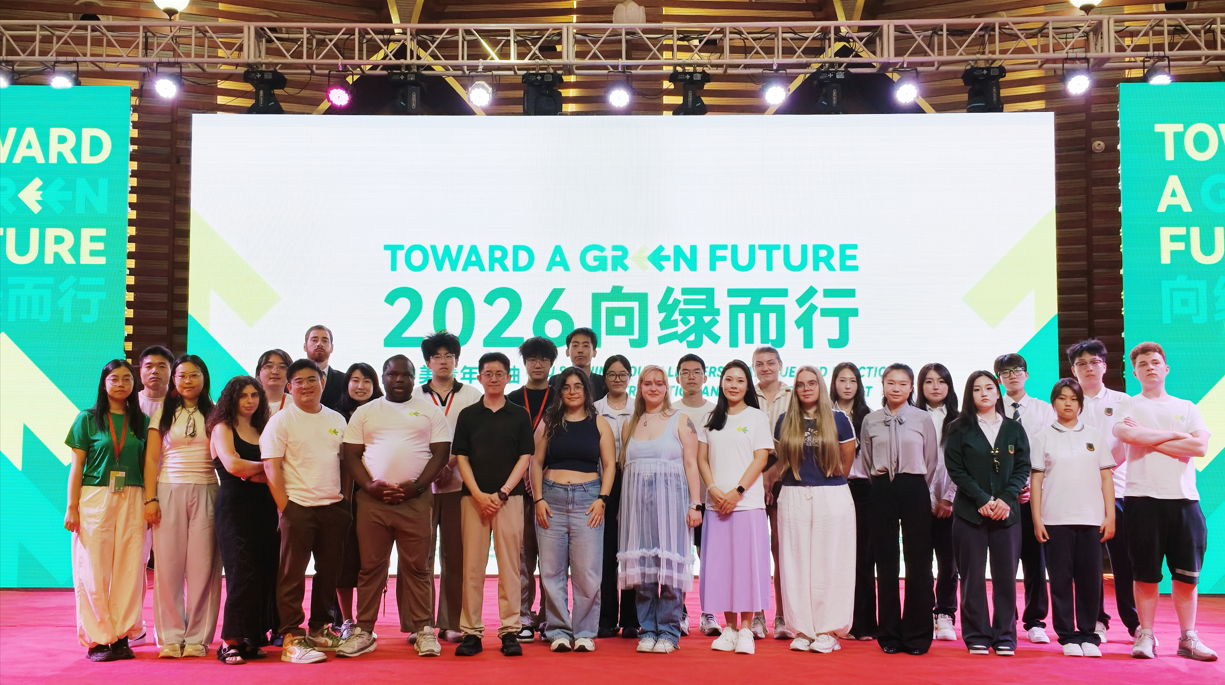
A group photo of the author Sun Chenghao (Center) with Chinese and American youth at the Tangshan-Bodhi Island China-U.S. Youth Forum.
Not long ago, I attended the Tangshan-Bodhi Island China-U.S. Youth Forum in Hebei province, where I exchanged views with young people from China, the United States and other countries on energy transition and green development. I had expected the discussion to focus largely on new-energy vehicles, clean energy and climate change. But as the conversation unfolded, some of the questions raised by the American participants quickly moved beyond green issues themselves. Some asked about differences between Chinese and American approaches to global governance, while others directly asked how we should understand the intensifying U.S. strategic competition with China in recent years.
These exchanges left a strong impression on me. Young Chinese and Americans today are living in a bilateral environment markedly different from the one experienced by the previous generation. America’s strategic competition with China has become an unavoidable backdrop to their interactions. Yet young people on both sides still want to understand how the other side sees the world and why they sometimes arrive at different conclusions.
In May, presidents Xi Jinping and Donald Trump met in Beijing. They agreed on a new vision: building “a constructive China-U.S. relationship of strategic stability” to provide strategic guidance for the development of bilateral relations in the years ahead. The vision calls for positive stability with cooperation as the mainstay, healthy stability with competition held within proper limits, constant stability with manageable differences and lasting stability with peace the expected outcome. How to make the relationship more predictable, set boundaries for competition, expand areas of cooperation and manage major risks has therefore become a challenge that both sides need to address together.
But whether strategic stability can be sustained over the long term depends also on a solid people-to-people foundation and a favorable social environment. If the two governments maintain communication while the two societies gradually drift apart, or if policymakers seek to manage competition while younger generations increasingly view each other through a geopolitical lens, strategic stability will lack the social support it needs. Seen in this light, head-of-state diplomacy, official mechanisms and people-to-people exchanges are not interchangeable; they operate at different levels of the China-U.S. relationship.
Head-of-state diplomacy sets the direction; official mechanisms manage differences and enable cooperation; and people-to-people exchanges sustain connections and mutual understanding between the two societies. Together, they provide an important foundation for resilient China-U.S. relations.
Of particular concern recently is a potential “perception deficit” between Chinese and American societies. Over the past decade or so, the number of American students undertaking long-term study in China has declined significantly. Although U.S. study abroad has recovered from the disruption caused by the COVID-19 pandemic, China remains far from the position it held a decade ago as a major destination for American students. Chinese students, meanwhile, continue to make up an important share of the international student population in the United States. According to the Open Doors 2025 report released by the Institute of International Education (IIE) in November, China remained the second-largest place of origin for international students in the United States in the 2024-25 academic year.
If this asymmetry persists, its implications will gradually extend beyond education. Young people who are around 20 today will, in 10 or 20 years, enter government, business, universities, the media and international organizations. The perceptions they form of the other country now will eventually become part of the future China-U.S. relationship.
Advances in information technology have not automatically narrowed this perception gap. Social media, short-form videos and algorithmic recommendation systems have expanded access to international information, but they can also amplify confrontational and emotionally charged content. As China-U.S. competition has extended into technology, trade, security and other areas, public discussions about the other country in both societies have increasingly been framed through the lens of strategic competition. If this trend continues, the two sides could face a paradox: There may be more information about each other, but fewer people with firsthand experience with the other society; attention to each other’s policies may increase, while understanding of the complexity of each other’s societies may decline.
Such changes will ultimately affect strategic stability. Major-country competition invariably involves conflicts of interest, and the ability to manage that competition depends to a considerable extent on whether the two sides can accurately assess each other’s strategic intentions, interests and policy boundaries. Social perceptions may not directly determine foreign policy, but they shape the domestic environment in which decisions are made. When the public becomes increasingly accustomed to seeing the other country simply as a strategic rival, the space for dialogue, cooperation and needed policy adjustment can also shrink.
For a “constructive China-U.S. relationship of strategic stability” to have genuine staying power, therefore, the two sides need not only to maintain strategic communication at the highest level and establish stable and effective mechanisms for government-to-government interaction but also, as much as possible, to prevent strategic competition from spilling over into social and people-to-people domains.
Seen from this perspective, President Xi’s November initiative to invite 50,000 young Americans to China for exchange and study programs over five years is significant. It not only would help to restore the flow of people affected by the pandemic and strained bilateral relations but also help rebuild the social connections underpinning China-U.S. relations.
With the “50,000 in five years” initiative meeting its target two and a half years ahead of schedule, the next stage could place greater emphasis on the continuity and depth of exchanges. Short-term visits can increase contact, while longer periods of study, joint research, professional experience and living together are more likely to foster stable, firsthand understanding. The range of participants could also be broadened, bringing more young people from engineering, science, technology, energy, public health and other professional fields into bilateral exchange networks.
The Bodhi Island forum’s focus on energy transition and green development illustrates the need for future China-U.S. people-to-people exchanges that engage more with issues reflecting the practical needs of both countries. In recent years, new energy, electric vehicles, batteries, critical minerals and related sectors have increasingly been shaped by industrial competition and economic security considerations. Even climate issues, once characterized by a stronger emphasis on cooperation, can no longer be entirely insulated from the broader environment of major-country competition.
Having young people discuss these issues together offers a more direct way for them to understand the complexity of China-U.S. relations. The two countries face industrial competition and policy differences but at the same time confront shared challenges such as climate change and energy transition. How to continue identifying space for cooperation in the current geopolitical environment is itself a question that the next generation will have to confront.
Future people-to-people exchanges could also move beyond reciprocal visits toward more joint research and collaborative problem-solving. Within the bounds of the laws, regulations and respective policy frameworks of both countries, sustained youth cooperation networks could be developed in areas such as energy, artificial intelligence, public health and climate adaptation. Such networks could preserve a degree of professional and social connectivity even when the broader relationship experiences periods of turbulence. These forms of cooperation are unlikely to alter the fundamental strategic landscape of China-U.S. relations in the short term, but they can help prevent competition from becoming the sole lens through which every issue in the bilateral relationship is interpreted, and create a more favorable social environment for cooperation at the official level.
People-to-people exchanges need to respect the nature of exchange itself. Young Americans who visit China may still hold different views on some Chinese policies. But when those judgments can be based more on personal observation and genuine interaction, the exchanges will have already served a valuable purpose.
At the youth forum, American participants were interested in learning about China’s practices in green development, but they also directly discussed differences in approaches to global governance and U.S. strategic competition with China. This shows that meaningful exchanges do not require that differences be avoided. What China and the United States need is not superficial agreement but a stronger ability to accurately understand each other’s policy logic and social context even when they hold different positions.
In the period ahead, China-U.S. relations are likely to continue shifting between cooperation and competition, coordination and friction. The new vision of building a constructive China-U.S. relationship of strategic stability provides an important framework for the two sides to explore how they can coexist over the long term. Future meetings between the two presidents will continue to provide strategic guidance and help add practical substance to this framework.
Yet any sustainable strategic stability requires support at multiple levels. Official mechanisms at different levels need to strengthen their capacity for policy implementation and risk management, while the two societies need to maintain sufficient people-to-people contact to nurture mutual understanding.
China and the United States especially need to prevent competition in certain areas from gradually hardening into estrangement between their societies and, ultimately, becoming embedded in the perceptions of the next generation. Youth and other people-to-people exchanges cannot substitute for head-of-state diplomacy or official mechanisms, but they can provide a more resilient social environment in which both can function effectively. Maintaining stability at the strategic level, managing competition at the policy level and preserving connections at the societal level will increasingly become three inseparable dimensions in building a stable bilateral relationship.
