

As China and the United States begin to operate within a shared framework, deeper youth-to-youth connections can help curb misunderstandings and consolidate goodwill. Young people on both sides are well-positioned to become stewards of stable bilateral relations, advocates for cooperation and supporters of peaceful development.
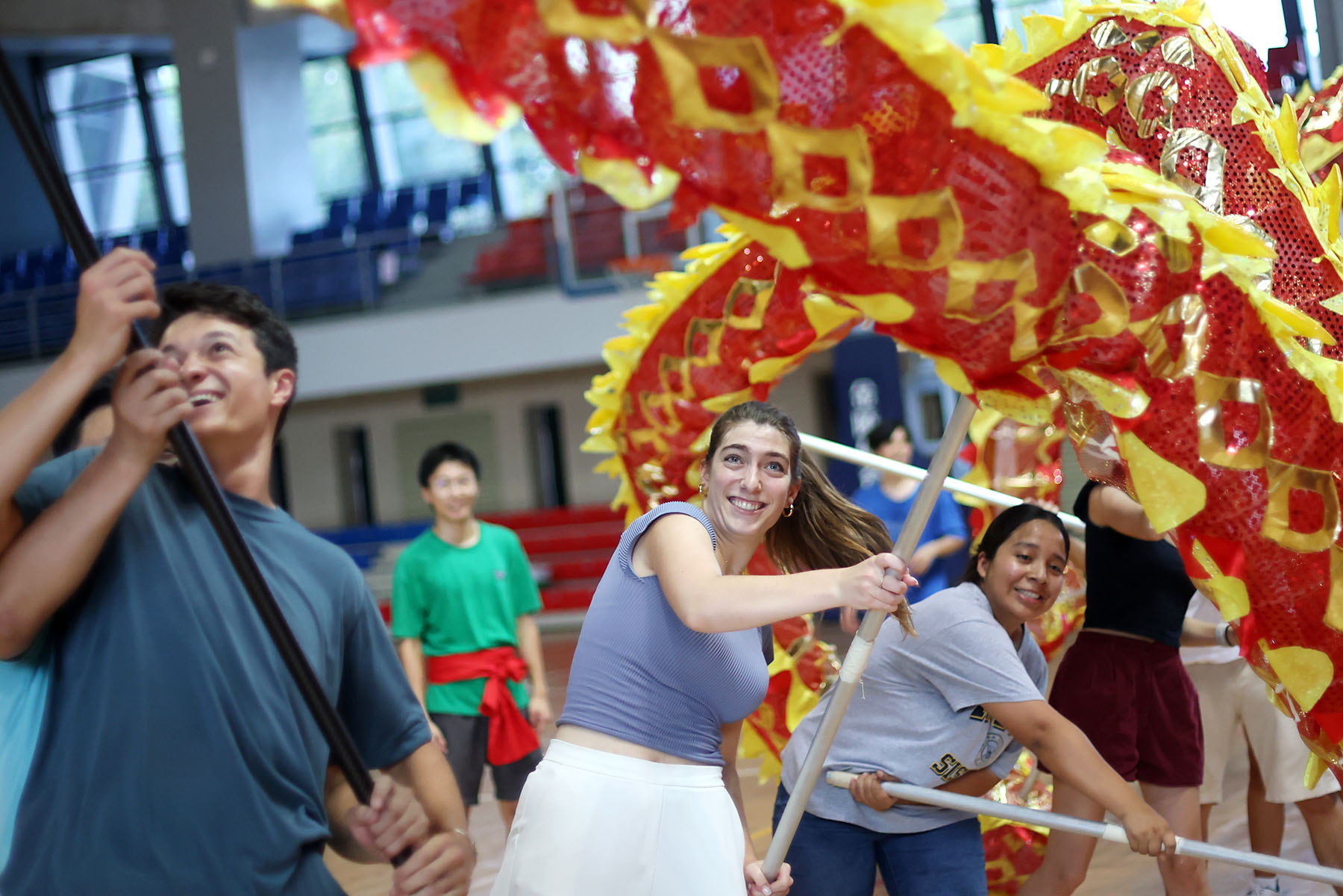
College students from the United States learn the dragon dance at Nanjing Agricultural University on Aug 7, 2024.
While high-level diplomacy charts a course for major-country relations, deep-seated societal misperceptions often stand in the way of putting that vision into practice. People-to-people exchanges, particularly by those in younger generations, play a critical role in consolidating public support for bilateral ties.
During his state visit to the United States in September, Chinese President Xi Jinping announced a landmark youth exchange initiative under which China will welcome 100,000 young Americans over the next five years for study-related visits and cross-cultural engagement. More than just a public diplomacy outreach effort, this expanded commitment seeks to build grassroots momentum for stable China-U.S. relations. Top-level agreements alone cannot sustain bilateral stability. Durable ties must draw strength from mutual understanding forged between ordinary citizens—and especially the young.
The new initiative builds upon goals agreed to at the Beijing Summit in May, when the two sides outlined a framework for a constructive China-U.S. relationship of strategic stability—an arrangement designed to manage differences, foster peaceful coexistence and expand practical cooperation. Building on China’s earlier commitment to host 50,000 young Americans, the scaled-up target of 100,000 participants expands people-to-people opportunities. It enables larger numbers of young people from both nations to learn about one another and cultivate amicable connections at the grassroots level.
Public opinion data from research institutions underscores the promise of youth-focused exchanges. Young people generally hold more open-minded views of China relative to an older population. A Pew Research Center survey this year found that 27 percent of U.S. respondents expressed favorable views toward China, a 6-point increase from 2025. Among Americans under 50, the favorable rating rose to 34 percent, compared with 19 percent of older people surveyed.
This generational pattern is not unique to the United States: France’s Institute for Marketing and Opinion Research (CSA) last year found that 82 percent of European youth have positive impressions of China. Unlike older cohorts shaped by long-running media narratives and geopolitical framing, young people tend to assess global issues with greater pragmatism.
The generation gap suggest that youth-centered engagement offers a practical path for countering oversimplified public narratives and reducing cross-societal perceptual differences. To be sure, more open attitudes among youth do not erase deep-rooted divergences, nor can they resolve long-standing frictions overnight. Nevertheless, youth exchanges can mitigate misunderstandings and help foster positive mutual perceptions over time, thereby laying a solid foundation for constructive bilateral ties going forward.
Real-world experience has demonstrated what such initiatives can accomplish. First unveiled in November 2023, the program to host 50,000 young Americans was completed two-and-a-half years ahead of schedule—by June this year. More than 32,000 young Americans have taken part in the Young Envoys Scholarship (known as YES), traveling to around 200 cities across China. Immersive on-the-ground experiences allow participants to move beyond secondhand media accounts. They can observe China’s urban transformation, campus life, local communities and everyday social realities that directly challenge persistent stereotypes.
Many returning participants carry these insights back home. They share firsthand observations with peers and foster more nuanced discussions within U.S. youth circles. The visits also create value for American communities, as returning participants bring new perspectives into U.S. classrooms and youth networks, enriching domestic conversations about China. At the same time, Chinese youth who engage with their U.S. counterparts gain greater exposure to American viewpoints. So it’s a two-way learning process.
Short-term visits can reshape individual attitudes, but lasting mutual trust depends on sustained institutional channels. Track-II platforms, including the Peking University-Georgetown University Student Dialogue, the China-U.S. Young Leaders Exchange Program, Zhi Xing China (“Understanding China on the Ground”) and the China-U.S. Young Scholars Dialogue—in which iGCU (Institute for Global Cooperation and Understanding at Peking University) has participated over the past few years—all serve as useful complements to official state-to-state diplomacy. Young leaders and scholars from both sides debate shared transnational challenges such as global governance, climate action, technological innovation and youth development.
Such forums encourage participants to look past narrow national standpoints to identify overlapping interests and practice constructive dialogue. Brief exchange experiences can refresh mutual understanding and steadily accumulate grassroots goodwill for China-U.S. relations.
It is important to note that youth-oriented Track-II and people-to-people engagement complement, but cannot replace, formal governmental strategic dialogue and policy coordination. Its purpose is not to force consensus or demand uniform opinions but instead to create spaces for mutual learning. Direct cross-border contact and immersive in-country experience bring societies psychologically closer. They foster empathy and understanding, create favorable conditions for practical collaboration and strengthen the societal resilience needed to keep bilateral relations on course. While such people-to-people work cannot fix high-level geopolitical disagreements, it can build a social context in which official dialogue functions better.
The influence of youth exchanges unfolds over time, shaping how societies perceive each other across generations. From the 2023 commitment for 50,000 young American visitors to the new expanded 2026 target of 100,000, China-U.S. youth engagement has grown both in scale and substance. As both countries operate within a shared framework for stable bilateral ties, deeper youth-to-youth connections help curb misunderstandings and consolidate goodwill across societies. Young people on both sides are well-positioned to become stewards of stable bilateral relations, advocates for mutually beneficial cooperation and supporters of peaceful development. Even though substantial bilateral challenges remain, youth exchanges can deliver consistent, generational-level energy for the long-term health of China-U.S. ties.
