
The two countries need to establish their Zeus’s Law, preventing strategic rivalry from escalating without limit and avoiding the idea that undermining the other side’s sense of security can somehow serve as a source of one’s own security.
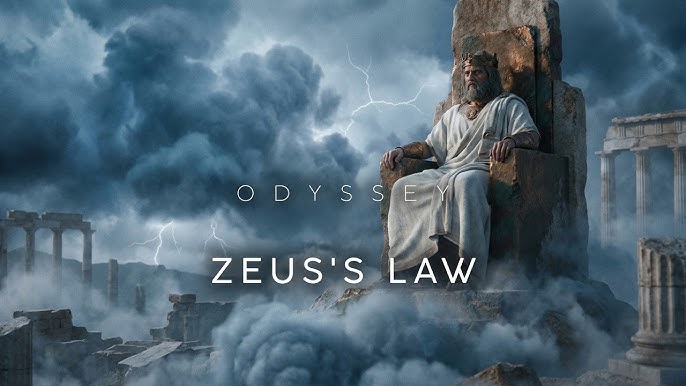
This summer, The Odyssey, a film directed by British filmmaker Christopher Nolan, became a global box office phenomenon. At a time when superhero films and established sci-fi franchises dominate the mainstream, a story based on Homer’s epic, which was written nearly 3,000 years ago, has once again captured audiences around the world. The discussion it sparked has gone far beyond the film itself. From war and peace to civilization and barbarism, people are using an ancient Greek story to revisit the problems confronting society today.
Nolan has infused the ancient Greek myth with a distinctly modern set of values. The film is not merely about a hero’s triumph over fate. It is the story of a veteran returning from war and confronting the violence, deception and collapse of trust that he himself helped create.
American media have described Odysseus as carrying something akin to modern-day war trauma, turning his 10-year odyssey not merely into a journey home but also into a reckoning with his own moral choices.
Embedded in the story are three lessons that remain highly relevant to society today:
The first concerns the erosion of traditional virtues. The film repeatedly invokes a concept that is not explicitly articulated in Homer’s original—Zeus’s Law, which refers to the ancient code of hospitality under which strangers and hosts are expected to respect and protect one another. Nolan takes this ancient custom a step further, recasting it as a rule of modern civilization. People must believe in certain shared norms, he postulates, and even when dealing with strangers or potential competitors they must not cross certain lines.
This is the foundation on which human societies form communities. Without this basic level of trust, people could neither travel, trade, negotiate nor build a stable social order. The tragedy at the heart of the film is that Odysseus himself, through his own ingenuity, violates precisely this rule. The Trojan Horse, one of the most famous stratagems in the history of warfare, becomes in Nolan’s telling something more: an original sin of a moral kind.
The second lesson concerns war itself. Traditional epics tend to celebrate how wars are won, but The Odyssey asks what happens after victory. Troy falls, and the Greeks win a glorious triumph, but the story does not end there. Agamemnon is murdered after returning home, Odysseus spends 10 years wandering, and the heroes of old are left dead, scattered or deeply scarred by what they have endured. The victors ultimately discover that conquering a city is not the same as winning a better world.
The third lesson involves the crisis of trust created by the Trojan Horse. The stratagem that became a crucial turning point in the war was once widely celebrated as a triumph of human ingenuity, but the film reveals another side of cunning. From then on, any gift might be thought to conceal an enemy, and any act of trust might be exploited. The Trojan Horse was used only once, yet it was enough to make everyone who came afterward question whether the gates should ever be opened again. The horse thus comes to represent the “weaponization of trust”: It destroys not only Troy, but also the very foundation that allows people to trust one another.
These three lessons are not unfamiliar in today’s China-U.S. relationship. The two countries, first of all, need to develop a modern understanding of Zeus’s Law in international relations. Even today, certain basic rules are needed to keep relations between major powers from breaking down: Nuclear weapons should not be used lightly; channels of communication should remain open during military crises; diplomatic commitments should not be overturned arbitrarily; economic and trade ties should not be weaponized without limit; and the other side’s core security concerns should be taken seriously.
These rules do not necessarily require the two sides to trust each other. They mean, rather, that even without trust, both sides know what must not be done. Genuine and durable stability between major powers rests on such rules. China and the United States likewise need to establish such understandings to prevent strategic rivalry from escalating without limit and to avoid the notion that undermining the other side’s sense of security can somehow serve as a source of one’s own security.
The Odyssey reminds China and the United States to guard against “competition without limits.” The problem with the Trojan War was not simply the brutality of war itself; it is that when defeating the other side becomes the sole objective, the means used to achieve it can escalate beyond established boundaries. The scope of confrontation might expand, with sanctions and countermeasures piling up without end. Military deterrence can often be just one step away from an accidental clash. Each individual escalation may appear rational and justified on its own, but taken together they can push both sides toward an outcome that is anything but rational.
The Odyssey also offers a more immediate warning: how to deal with the Trojan Horse problem. Modern states, of course, cannot afford to be complacent about security risks. Chips, communications, artificial intelligence, data, finance and critical infrastructure all have security implications, and neither China nor the United States can afford to abandon safeguards altogether. But when the logic of security expands without limit, normal interactions can be interpreted as infiltration, scientific cooperation as technology theft, people-to-people exchanges as intelligence activity, corporate investment as strategic control and supply-chain dependence as a security vulnerability.
A dangerous cycle can then emerge: The more the two sides fear Trojan Horses, the more they guard against each other, reduce normal exchanges and weaken mutual understanding. In turn, the less they understand each other, the more readily they may interpret everything the other side does as a potential Trojan Horse, causing the security dilemma to reinforce itself.
Power makes people believe they can defeat their opponents; fear makes them suspicious of every stranger and cleverness makes them believe that rules can be temporarily set aside. What is truly difficult is exercising restraint and rebuilding rules and trust. In May, when the Chinese and U.S. leaders met in Beijing, they proposed building a “constructive relationship of strategic stability,” seeking to address precisely these challenges and bring bilateral ties back to a level at which cooperation is the mainstay. Competition stays within bounds; differences remain under control and the prospect of peace grows.
For China and the United States, the ultimate measure of strategic success is not victory or defeat. The real test for both countries is whether they can prove that humanity is capable of breaking free from the cycle of history and forging a new path for human civilization.
