
China-U.S. relations involve the well-being of some 8 billion people worldwide. Both sides, therefore, need to safeguard their hard-won stability. They should honor their commitments and move toward each other to create favorable conditions for building a more promising future.
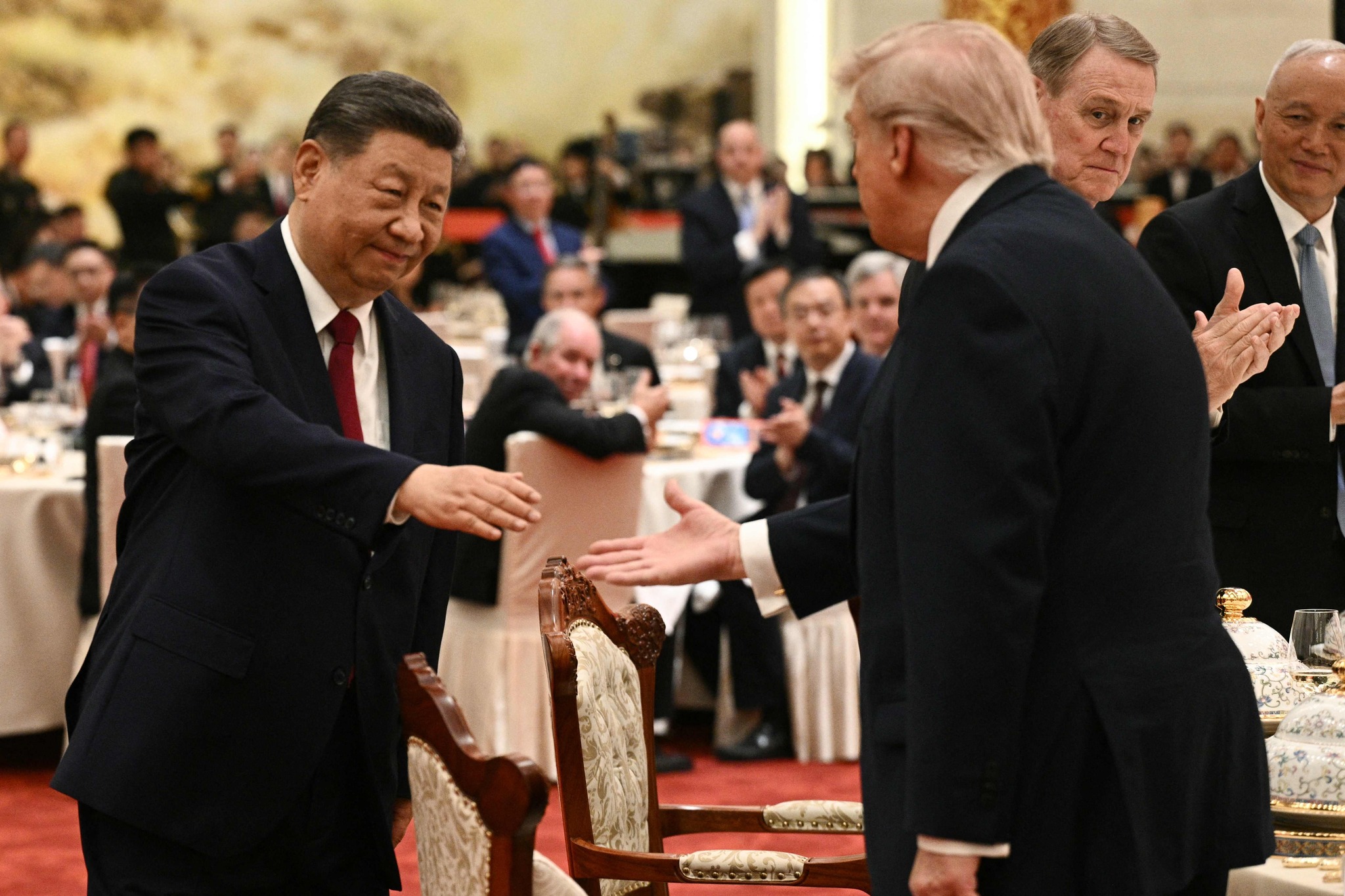
China's President Xi Jinping and U.S. President Donald Trump shake hands as they attend a state banquet at the Great Hall of the People in Beijing on May 14, 2026.
U.S. President Donald Trump’s state visit to China is a landmark diplomatic engagement. It had been more than nine years since a sitting American president last set foot on Chinese soil. Since 2017, Washington has been deeply preoccupied with great-power competition against Beijing, and the resulting tensions in bilateral relations have caused widespread concern within the international community.
Today, however, the two sides have agreed to build “a constructive relationship of strategic stability,” and such terms as “cooperation” have reemerged in policy discussions on bilateral ties. Even U.S. Secretary of State Marco Rubio, long regarded as a China hawk, has repeatedly stressed the need to explore pathways toward strategic stability between the two countries. As he told reporters at the Great Hall of the People in Beijing, “It is in everyone’s interest to see stability in the world.”
The current state of China-U.S. relations did not emerge overnight. Over the past nine years, the two sides have engaged in sustained rivalry over tariffs, the Taiwan question, export controls and a range of other issues. There is no need to romanticize the relationship: Deep mutual distrust persists between Beijing and Washington. Nevertheless, both sides have come to recognize that their competition is unlikely to produce clear-cut winners or losers, as each country possesses its own vulnerabilities. Most important, they share the common objective of preventing a military confrontation.
Against this backdrop, the new characterization of bilateral relations as “constructive strategic stability” has been hard won. In fact, diplomatic negotiations over how to define the relationship have grown increasingly difficult since the administration of Barack Obama.
Many in the United States regard competition as the defining feature of China-U.S. relations. Yet such a mindset risks allowing competition to gradually slide into confrontation, or even into what some describe as “a slow-motion hot war.”
Competition between major powers is hardly unusual, but it should not be allowed to define the entirety of a relationship. Yet without a clear framework or a shared vision, China-U.S. relations could drift into a dangerous state of strategic uncertainty. The Trump administration’s willingness to embrace the new framework of constructive strategic stability, therefore, represents a significant adjustment on the part of the United States.
Clearly, Trump is not a politician overly concerned with diplomatic phrasing or semantic nuances. Yet he does hold distinctive views on America’s global standing, the international order and China-U.S. relations. The “America first” doctrine he champions seeks to reduce the costs borne by the United States in maintaining the international order, while placing greater emphasis on creating jobs for domestic workers and addressing the profound damage that illegal immigration and other issues pose for U.S. national security.
At the same time, “flexible realism” has emerged as a guiding principle of the administration’s foreign policy. With this approach, Washington seeks to build relatively stable and constructive relations with other major countries, including China.
On the Taiwan question, Trump has likewise shown a different line of thinking. He does not endorse or accept the notion of Taiwan independence, and has reportedly questioned the so-called Six Assurances issued under the Ronald Reagan administration in 1982 and the necessity of U.S. forces traveling some 9,500 kilometers to interfere in a Taiwan Strait conflict.
In many respects, such perspectives align with common sense. In 1979, when the Taiwan Relations Act was enacted, and then in 1982, the issue of an assertive Taiwan independence movement was not as prominent as it is today. There are now political forces on the island that explicitly advocate independence as an ideological objective, and they have attempted to leverage narratives of a so-called new Cold War between China and the United States to advance their agenda. What is more troubling is that some members of the U.S. Congress and senior officials still appear to be operating within a strategic mindset shaped by the circumstances of 1979 and 1982. In doing so, they underestimate China’s determination and capability to safeguard its core interests.
If misleading signals continue to be sent to advocates of Taiwan independence, it could significantly increase the risk of drawing the two nations into a military conflict—one in which the United States would have limited prospects of prevailing.
From a historical perspective, the U.S. has abandoned many of its allies and lost a number of wars. Even the current U.S.-Iran confrontation has exposed significant shortcomings in its military capabilities. If Washington can adopt a clearer stance against Taiwan independence, rather than focusing narrowly on the narrative of the mainland’s reunification with Taiwan through military action, the worst-case scenario could be avoided—which is in line with U.S. interests.
At the recent China-U.S. summit, President Xi Jinping made a clearer statement on the Taiwan question, emphasizing that it is the most important issue in China-U.S. relations. If the question is handled properly, bilateral relations can remain generally stable; if not, the two countries could collide or even come into conflict, pushing the entire relationship into a highly dangerous situation.
Although the two countries have different understandings of the “one China” policy in important respects, preventing a war triggered by a Taiwan independence movement serves their common interests. The authorities in Taiwan, as well as external forces seeking to interfere in the matter, should recognize this reality and stop playing with fire.
It is worth noting that over past decades, visits by U.S. secretaries of defense to China were typically arranged as stand-alone trips, and these officials rarely appeared as part of the president’s accompanying delegation. This time, however, the sitting secretary, Pete Hegseth, accompanied Trump on his visit to China, signaling Washington’s intention to strengthen military-to-military engagement and jointly promote strategic stability. The administration has expressed its desire to achieve a “decent peace” with China, a term highlighted in the 2026 U.S. National Defense Strategy report.
Constructive strategic stability implies not only the avoidance of conflict but also the exploration of possibilities for cooperation between the two countries—a form of positive stability. Accompanying Trump on this visit to China were 17 leading figures from the business community, spanning agriculture, manufacturing, technology and finance. Trump announced that China would purchase 200 Boeing aircraft and also agreed to buy American soybeans, beef and energy products. However, China’s procurement of aircraft is conditional: The United States should ensure the supply of aircraft engines and key components.
China is emerging as a major consumer market, and as long as China-U.S. relations remain stable, the two countries have broad space for cooperation in the trade and economic sectors. China’s goal of achieving national rejuvenation and Trump’s “Make America Great Again” slogan are not mutually exclusive. Rather, they can coexist and reinforce each other. The two sides have agreed to establish trade and investment councils to address mutual concerns regarding agricultural market access, and they hope to expand two-way trade under a framework of reciprocal tariff reductions.
It should be recognized that China and the United States are currently exploring a model called a “manageable economic relationship,” seeking to properly address each other’s concerns in industry, technology and security, thereby injecting greater certainty into bilateral commercial exchanges. U.S. Treasury Secretary Scott Bessent has made it clear that the Trump administration is not seeking to decouple from China, but rather move toward “de-risking.”
But adjusting bilateral economic and trade relations is a complex and uneven process. As the U.S. administration continues to advance measures such as Section 301 investigations targeting China, further consultations in economic and trade arenas remain necessary. Progress on Chinese procurement and investment in the United States will inevitably be linked to the evolution of U.S. policy toward China.
During Trump’s visit, the two presidents toured the Temple of Heaven together—a place where Chinese emperors prayed for good harvests and carried out elaborate rites tied to imperial authority and cosmic order. The trip was intended not only to showcase the resilience of China as an ancient civilization but also to help the Americans appreciate the importance of “harmony among all things and acting in accordance with nature and timing.”
According to “Shangshu,” the ancient Chinese classic, “Heaven sees as the people see; Heaven hears as the people hear.” This reflects China’s people-centered philosophy of governance. China-U.S. relations concern the well-being of more than 1.7 billion people in the two countries and relate to the interests of some 8 billion people worldwide. Both sides need to safeguard the hard-won stability, honor their commitments and move toward each other to create favorable conditions for building a more promising future for relations.
