
The U.S.-Israel strikes on Iran have heightened regional instability while exposing China’s complex strategic dilemma, as Beijing seeks to safeguard critical energy imports and investments without becoming directly involved. Balancing ties with Iran, Gulf states, and the West, China is pursuing a cautious, deliberately ambiguous approach to protect its broader geopolitical and economic interests.
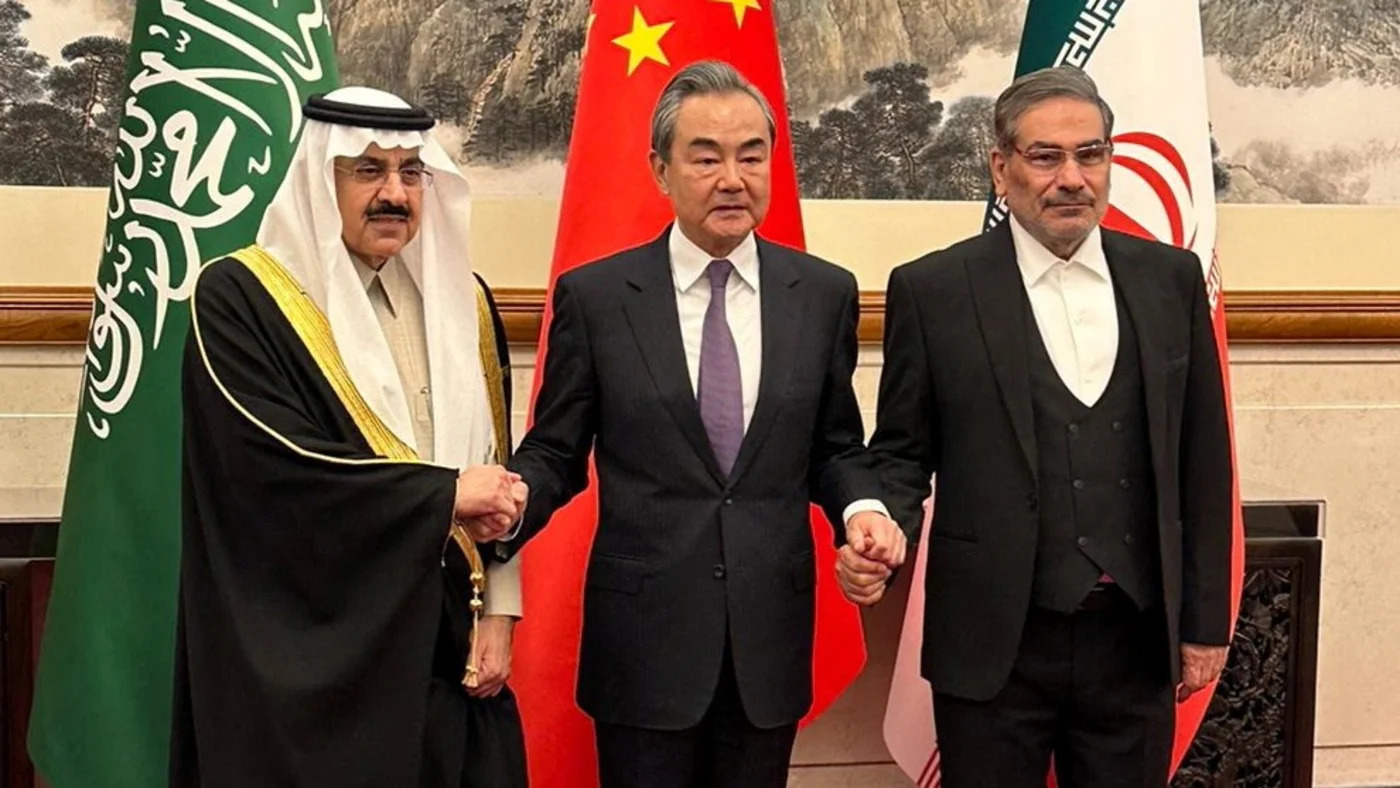
China’s Saudi Arabia-Iran Mediation in 2023.
China's Foreign Minister Wang Yi with Saudi Arabia's Musaad bin Mohammed al-Aiban and Iran's Ali Shamkhani, in Beijing on March 10, 2023.
The U.S. and Israel’s decision to strike the Iranian regime on February 28th marked a new chapter for West Asian geopolitics – it epitomised what could well be final act in a multi-year, comprehensive plan by the Israeli government to fundamentally cripple its arch-nemesis, to defeat the proverbial “axis of resistance” helmed by the theocratic state apparatus.
It is apparent that the attempt to alter Tehran’s regime and leadership has seemingly fallen short of expectations. The past month of developments have indubitably embroiled the region in significant turmoil, as well as sending seismic waves throughout the world at large, especially in relation to the global energy supply and downstream economic ramifications.
For all the talk of China’s role as a peace-broker or mediator in the region, Beijing has adopted a relatively taciturn posture on the ongoing war.
What are China’s interests in relation to Iran?
Purely from the perspective of managing Sino-American competition, setting aside broader concerns over the reliability and endurability of American military-security provision (many of the Gulf States attacked by Tehran and its proxies are, officially or otherwise, long-standing security partners to the U.S.), that Washington finds itself distracted and bogged down in yet another fault-line beyond Ukraine, appears to be a positive. Some would even posit that Beijing has benefited on net from the further diversion of American attention away from the Indo-Pacific theatre, with the U.S. re-deploying military assets and resources away from the Asia-Pacific to the West Asian theatre.
Yet such readings ignore the complex nature of China’s interests in Iran.
The primary consideration pertains to Iran’s supply of oil to China – which remains a net energy importer despite its best efforts at diversification and energy infrastructural capacity-building. Estimates of Iran’s share of China’s oil imports vary significantly, from 13% to 20% on paper, to possibly more in practice (given the clandestine nature of “shadow fleet” shipments, but also transshipments via intermediary states).
As Beijing looks to prop up its domestic consumption and double down on the AI revolution, the significant impediments to shipments through the Strait of Hormuz induced by the war pose clear short-term risks in terms of both price surges and supply constriction; such risks are compounded further by the slim – but present – prospects of a breakdown of sociopolitical order or regime reorientation towards the West in Tehran, which could lay bare Beijing’s energy vulnerability.
Notably, such vulnerabilities should be read in conjunction with China’s Russia-Europe strategy: the second half of 2025 had seen Beijing attempting to put some tactical distance between itself and the Russian invasion in Ukraine – no less epitomised by a palpable increase in frequency of high-level official talks between China and Ukraine. Whilst China might have been tempted to publicly signal greater concerns about the undue prolonging of the war in Ukraine – which has contributed towards significant misgivings and mistrust between Beijing and Brussels – such an endeavour could well take the backseat as China seeks to lock in Russian energy supplies. New Delhi, on the other hand, has also acquired newfound policy bandwidth to import and re-export Russian oil, a purported redline in the uneasy India-U.S. relationship in the era of Trump 2.0.
The second consideration concerns China’s logistical and investment interests in the region. For long, Iran had served as a critical nodule of Beijing’s Gulf- and North Africa-bound logistical chains. China has been a prime facilitator of oil and gas infrastructure in the country – as evidenced by the pipelines conjoining the Caspian Sea and Southern Iranian ports, which would allow for the exporting of oil to states in Europe and Asia. In 2021, China and Iran signed a 25-year, USD 400 billion partnership that would provide for railways, refineries, petrochemical plants, and other forms of connectivity-oriented infrastructure within the country.
In the event of a significant political realignment in Tehran, such investments could well be fundamentally jeopardised, thereby casting into doubt the perceived credibility and potency of China as a primary investment provider in the country.
Two Key Straddles
China is faced with two key straddles in relation to Iran.
The first revolves around Beijing’s balancing between placating the Gulf States that had come under extensive Iranian attacks, given their integral importance to the country’s energy and supply chain diversification efforts, and signaling the credibility of its support to other partners to China (e.g. Russia and North Korea, and – to a lesser extent – Pakistan and Cuba).
Thus far, Beijing has adopted a cautious approach – boisterously lambasting the strikes on Iran through words, whilst refraining from committing to putting boots on the ground or overtly backing the Iranian regime in its pursuit of defensive or retaliatory strikes. Chinese state-affiliated media have urged restraint and called for de-escalation on the part of all parties, as well as refraining from unwavering endorsement of the Iranian regime. Indeed, Foreign Ministry spokesperson Guo Jiakun noted that China "does not agree with the [Iranian] attacks on Gulf States" - offering a rebuke of Iran's actions in the region.
With Gulf capitals increasingly agitated and frustrated by what they perceive to be utter recklessness on the part of Tehran, China could ill-afford to come across as actively cheering on the Iranian war efforts. Yet should Beijing opt for a purely “wait-and-see” strategy that is heavy on words but light on action, between the lack of Chinese presence in Venezuela and Iran, its various other military or strategic partners may find themselves developing second thoughts concerning the credibility and value of counting too heavily on Beijing.
Of course, for many of these states, China would remain a vital supply chain powerhouse for the decades to come, and economic engagement is not an option but a necessity. Yet these governments could well be spurred to pursue more concessionary measures in reducing the proverbial ‘temperature’ in the room. Cuba, for one, has been taking a relatively demure approach in face of American pressures.
The second straddle features a clash between the symbolic-normative with the (near-term) substantive-practical. On one hand, the Chinese leadership has adamantly sought to position itself as a “leader” of the Global South, pioneering and championing South-South cooperation and castigating the West for its “colonial tendencies and past”.
On the other hand, Beijing does not intend to commit itself to exclusively countries that belong to the oft-touted ‘axis of grievance’ – namely, North Korea, Cuba, Iran, and, of course, Russia. Indeed, the recently held China Development Forum attests to Beijing’s desire to project openness to re-engaging long-standing members of the “West”, including companies and corporate players from the U.S.
Whilst the end-of-month summit between President Xi Jinping and President Donald Trump has now been postponed indefinitely (though a meeting before the end of April appears likely, given the strong levels of interests from both Beijing and Washington), all eyes are on the backroom negotiations between the two countries’ ‘sherpas’ or intermediaries, as they prepare for what could well be the most definitive (and perhaps underwhelming) meeting between the two leaders – after all, this would be the first American presidential visit to Beijing in over nine years.
The Path Ahead?
Given Iran’s hitherto successful weaponisation of the Strait of Hormuz, Beijing is unlikely to provide the Iranian regime with substantive military, security, and intelligence support on its war efforts, though it may tacitly encourage Iran to double down on upholding a selective chokehold over Strait of Hormuz, guaranteeing safe passage for oil ships bound for China, amongst other aligned countries.
Chinese diplomats will likely persist with rhetorical petitions for all sides to come to the negotiating table, criticising American and select Western powers for what Beijing terms to be blatant military aggression, whilst falling short of affirming both Iran’s and its Gulf partners’ actions vis-à-vis one another – a sign of its dexterous ambiguity.
A potential game-changer may present itself at the upcoming Xi-Trump summit, as the Chinese leader could bring up Iran as amongst a broader “package” of demands concerning China’s energy security and autonomy; this much cannot be ruled out. Indeed, if a “bargain” can be struck – with Beijing purchasing significantly more American imports (e.g. in soybeans and airplanes) and guaranteeing at least two years’ worth of unfettered supply of rare earth minerals to American producers – the increasingly war-wary White House could well be persuaded to see the case for an offramp, one that does not necessitate the Iranian regime falling, but its taking a more palatable stance vis-à-vis the U.S.
To what extent would Tehran be willing to take this hypothetical offer? As of writing, that’s a multi-billion-dollar question.
