
Europe is increasingly applying the same economic-security standards to U.S. firms that it once reserved for China, reflecting growing concerns over strategic dependence and American jurisdiction. However, while the EU has strengthened its ability to block foreign acquisitions, it still lacks the industrial capacity to replace them with competitive European alternatives.
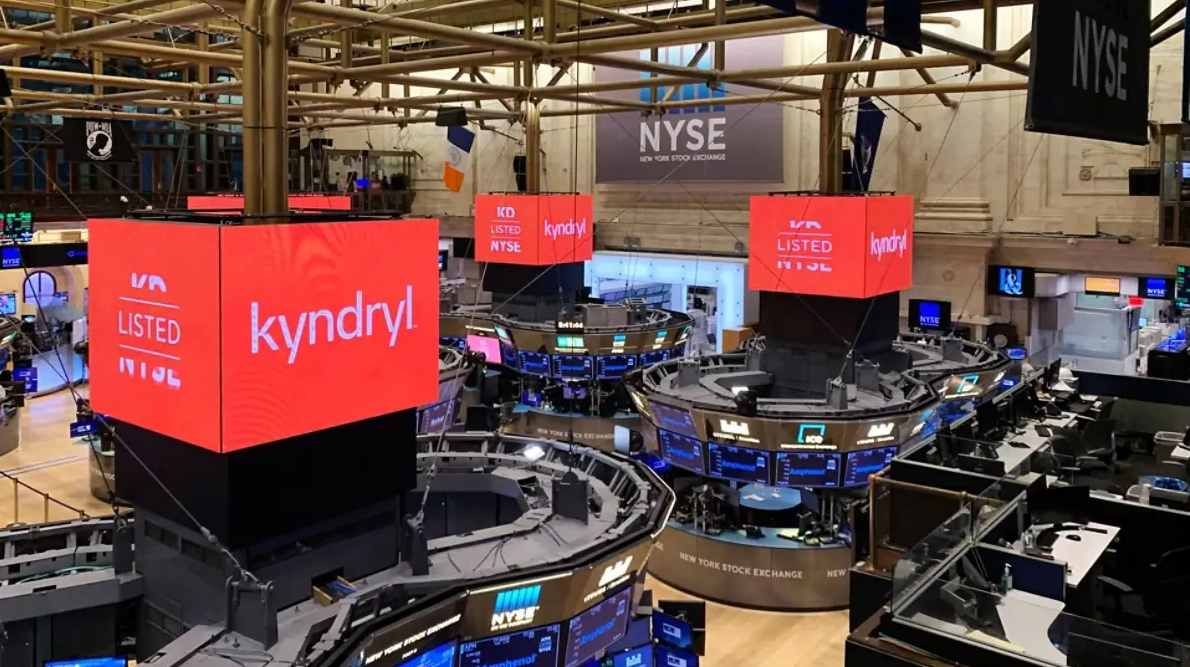
When the Dutch government blocked Kyndryl’s acquisition of Solvinity—a cloud and managed IT services provider—it applied to an American buyer the same jurisdictional logic that European regulators had spent a decade developing in response to Chinese acquisitions.
The Trump administration had been pushing them in that direction, though it took eighteen months for the lesson to register. The Hague’s reason was that the U.S. Cloud Act allows American authorities to compel firms to hand over data stored abroad, placing public digital infrastructure inside that reach.
After the Dutch decision, Washington invoked the usual refrain: “250 years of shared values.” The U.S. Embassy said it was “disappointed” and added that strong partnerships require “clear, fair, and reciprocal” rules, a characterisation that left unaddressed whether American laws offer European counterparts the reciprocity they invoke. Spoiler: they do not.
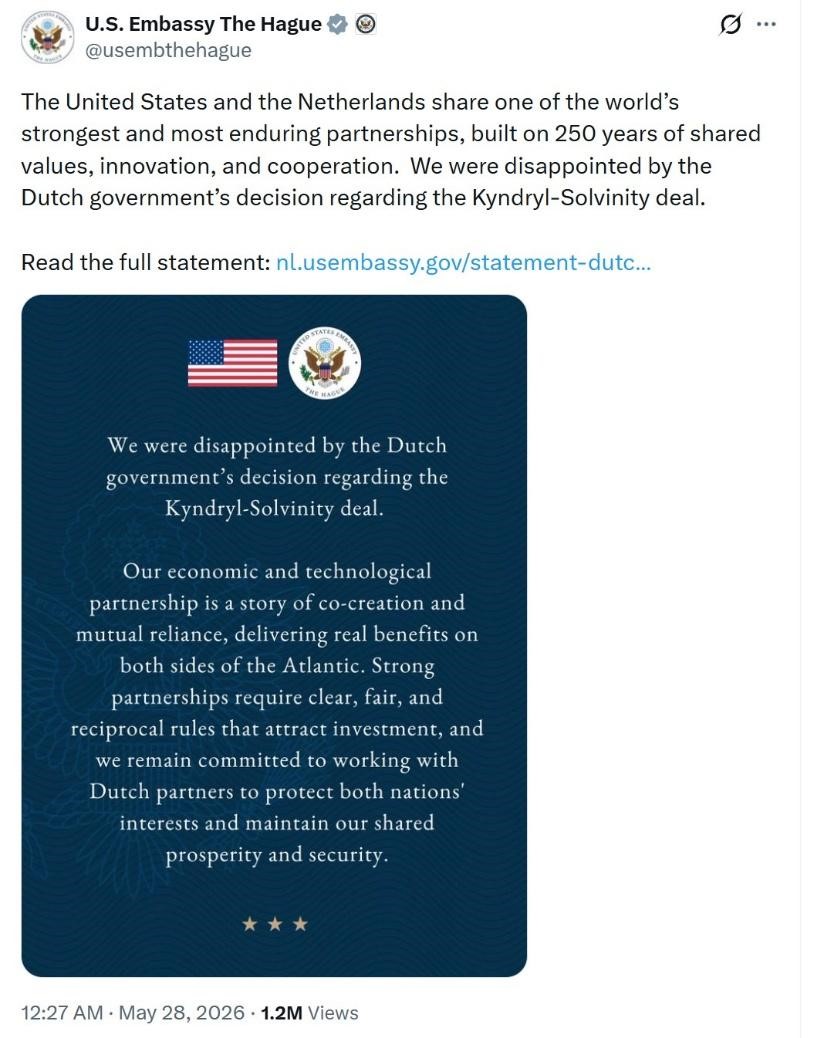
Source: https://x.com/usembthehague/status/2059672935732813927
For one of Washington’s most compliant European allies to treat American jurisdiction as a security risk is a rupture. But how could the Netherlands reach that point? Washington helped produce the suspicion: under Trump, it exported culture war into the EU, weakened European security and economic interests, and treated territorial integrity as negotiable, from Ukraine to Greenland.
Before, the Netherlands paid an enormous price for aligning with American preferences in the semiconductor sector, with the terms becoming publicly indefensible. Under pressure from the Biden administration, The Hague agreed to restrict ASML from selling its most advanced lithography systems in China and from servicing its installed customer base. China accounted for a third of their revenues; the restrictions imposed relevant commercial losses and damaged the Netherlands’ standing as a neutral participant in the global technology supply chain.
The lesson deepened with Nexperia and later with the U.S. Match Act. Introduced in April 2026 with bipartisan support, it sought to extend American extraterritorial authority through the Foreign Direct Product Rule: ASML could not service covered chipmaking tools or facilities in China if The Hague did not align deeper with Washington’s export control regime.
In the same period, Washington relaxed licensing criteria for American AI chips reaching Chinese technology companies, while Congress moved to restrict the Dutch engineers’ operations in China. Essentially, Congress tightened the screws on a Dutch company while the White House loosened them for American ones. That discrimination, enforced restrictions on Dutch activity together with preserved exemptions for American activity, gave the Solvinity veto a logic extending to the broader terms of the relationship.
Both decisions rested on the same principle: if the Netherlands pays the cost, the Netherlands decides the limit. The asymmetry nevertheless remains: ASML still faces restrictions in China, while American firms face no comparable constraints. Even so, the change in Europe is explicit for the first time: a willingness to apply the same economic-sovereignty rules when pressure comes from Washington as from Beijing.
The instrument The Hague used against Kyndryl was one Germany had lacked against Midea a decade earlier. In 2016, the Guangdong-based appliance manufacturer paid €4.5 billion for Kuka, an Augsburg top-notch robotics firm. German screening rules at the time covered defence and encrypted communications; industrial automation fell outside the framework. As a result, officials considered invoking public order powers yet backed away, because Berlin’s commercial relationship with Beijing made such intervention untenable.
With no applicable legal instrument, no EU alternative buyer, and no industrial policy capable of producing one, Germany watched a strategic asset pass into foreign ownership. Kuka exposed two weaknesses simultaneously: Germany lacked the instruments to intervene, and Europe lacked a credible industrial alternative to Midea. While the first weakness produced a decade of screening rules, the second remained largely unresolved.
The Kuka shock pushed Germany to widen its screening sectors, lower intervention thresholds, reverse its earlier clearance of the Chinese takeover of Aixtron, and pressure Cosco to cut its proposed stake in a Hamburg port terminal from 35 percent to 24.9 percent.
Brussels followed with the 2019 FDI Screening Regulation, then added layer after layer as a response to Made in China 2025, state capital intervention, sensitive assets’ takeovers, and leverage through market access: the Foreign Subsidies Regulation, the Chips Act, the Anti-Coercion Instrument, or the revised FDI framework agreed in December 2025 that mandates screening for deals in semiconductors, quantum computing, and AI.
Europe closed the legal gaps that had left Germany helpless in 2016 and built a framework that gave tools for assessing foreign ownership across sectors central to economic security. The limit was to assume that building the legal capacity to block foreign ownership was enough for protecting an adequate and competitive industrial sector.
Since then, had Beijing offered genuine reciprocity, broader market access, and negotiation instead of retaliation, Europe’s economic-security architecture would have arrived later and faced stronger resistance. Yet Europe’s vulnerabilities were structural and predated both Chinese refusal to address core grievances and American predatory overreach, accumulated through decades of underinvestment, industrial fragmentation, and a political culture that treated regulation as a substitute for capacity. Only ASML excelled meanwhile.
Europe’s screening architecture now allows us to ask a question that cuts across national origin: who holds ownership, and what jurisdictional access follows? A Chinese or an American parent company subject to their own laws create the same category of sovereign exposure for European data, as a foreign state gains a channel through which it can compel access to that data without European courts controlling the decision. On that logic, allies should not be exempt.
However, the bloc became skilled at identifying risk while leaving the productive base too weak. Brussels can now block a Chinese robotics acquisition and an American cloud acquisition; in neither case can it point to a European firm capable of filling the role at equivalent scale.
The result is “managed dependency”: identify the vulnerability, accept continued reliance on it, and deploy regulatory architecture to prevent foreign ownership from making the exposure too visible. The screening mechanism becomes a way of deferring the absence of digital sovereignty, allowing Europe to say no to specific acquirers while never having to answer why no European acquirer exists to say yes.
This is the line connecting Kuka to Solvinity. The Kuka acquisition produced a decade of policy anxiety which, in turn, built a regulatory apparatus developed enough to block the Solvinity transaction a decade later. What it did not produce was an industrial alternative. By most other measures, the Kuka acquisition itself has been managed acceptably: headquarters remain in Augsburg, data is ringfenced in the EU, research investment has continued, and Kuka’s CEO has described Midea as a stable long-term owner.
The transaction that generated the loudest alarm now looks, on the available evidence, less damaging than the policy vacuum it exposed. Kuka demonstrated that foreign ownership is not inherently destructive, but Europe lacked the capital, the industrial policy, and the political will to keep a strategic asset in European hands.
The harder question European leaders now face is whether the decade of alarm about the Kuka transaction was calibrated to the vulnerability it exposed—the absence of a European buyer—or whether the response matched the risk rather than the category of risk. If the former, the regulatory apparatus it generated was too expansive. If the latter, the apparatus was still too narrow—because no amount of screening architecture addresses a policy vacuum and the lack of competitive tech infrastructure.
Some EU governments are arriving at a conclusion Brussels spent a decade avoiding: that sovereignty, once deployed, cannot be suspended at the level of alliance. The Dutch government has already rejected the premise that American ownership is different from Chinese ownership.
In the meantime, the Bundeswehr’s exclusion of Palantir, the acceleration of cloud-sovereignty debates, and the Solvinity veto all follow the same line: American conduct has made dependency legible in ways EU representatives’ speeches never could. Europe discovered the true measure of the problem through discriminating invoices, threats, lost market access, and the spectacle of Washington demanding sacrifice from allies while preserving room for American firms.
Somehow Trump has become the most effective advocate for European autonomy. The EU leaders only have to listen to him. Obviously, without a hostile American administration, the Solvinity acquisition would have faced less political resistance. But the structural conditions are bipartisan and durable. A decade of speeches about strategic autonomy did less than months of American conduct. Some governments are now making their own sovereign assessment the operative standard.
What remains unresolved is the harder half of the problem. Europe has built the legal instruments to refuse, but it has not built the industrial base to replace. A screening architecture without an alternative is a managed acknowledgment of continued dependence, with better paperwork. The test ahead is whether European governments can translate a decade of defensive rulemaking into the sustained investment, capital mobilisation, and political coordination required to finally have a say in the global digital contest.
