Growing instability in the global order and rising uncertainty in relations with major powers are driving countries such as India, Canada, Brazil, and European states to deepen cooperation with one another. These middle powers are increasingly pursuing strategic partnerships, trade agreements, and supply-chain coordination to preserve autonomy and stability amid great-power rivalry.
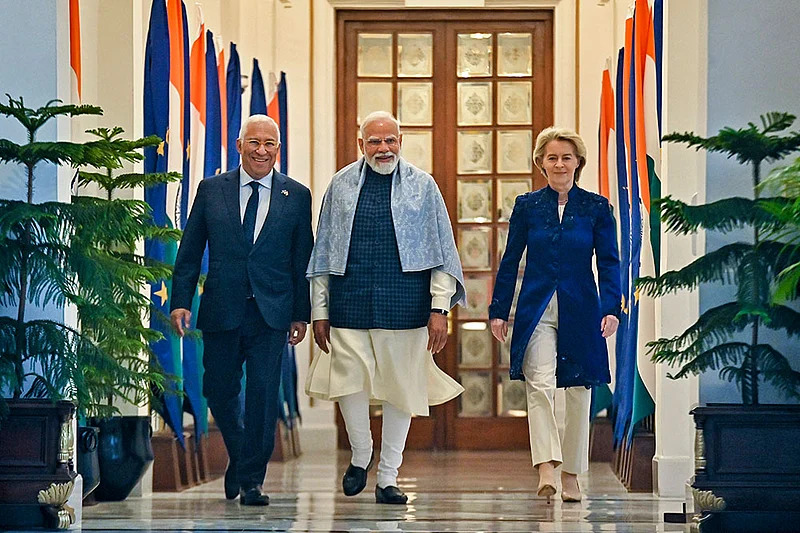
Indian Prime Minister Narendra Modi with European Council President Antonio Costa, left, and European Commission President Ursula von der Leyen, right, during their meeting at the Hyderabad House, in New Delhi on Jan 27, 2026.
Recent developments in Iran, Venezuela, Gaza and Ukraine all point to a world order that is in flux and fraying at the edges. That is certainly the perception here in New Delhi, where, in recent days and months, a steady stream of visitors has underlined the nature of a global order that is rapidly changing.
This week, Canadian Prime Minister Mark Carney was the latest prominent “middle power” leader to visit the country, as Canada and India, on March 2, 2026, announced wide-ranging agreements to deepen cooperation on energy, critical minerals, technology and Artificial Intelligence.
Both countries also announced they will, this year, conclude talks on a new Comprehensive Economic Partnership Agreement (CEPA) and launch a new Strategic Energy Partnership, starting with a $2.6 billion agreement for Canada to supply India with uranium for its civilian nuclear energy program.
Carney’s visit came close on the heels of Brazil President Lula da Silva, French President Emmanuel Macron and European Union Commission President Ursula von der Leyen all holding high-profile summits with Indian Prime Minister Narendra Modi in New Delhi in recent weeks. In January, India and the EU announced what von der Leyen described as “the mother of all trade deals” as they concluded long-running talks for a Free Trade Agreement.
For most observers in India’s capital, an FTA with the EU would have been unthinkable not so long ago. While a trade deal has long been in the works, the current strains in both India and the EU’s respective relations with Washington carry an unmistakable imprint on the timing of the announcement, regardless of the broader truth that ties between India and Europe certainly have their own logic.
The India-EU FTA will open up the Indian market to European carmakers while making Indian exports to the EU more competitive. For Indian textile makers, the agreement could be a boon. The deal will also open a pathway into Europe for India’s large services sector.
But the India-EU January summit was about more than just trade. In addition to the FTA, both sides also announced a new defence and security partnership. To underscore its significance, Prime Minister Modi invited von der Leyen and European Council President Antonio Costa as chief guests to preside over India’s grand Republic Day military parade held on January 26, an annual invitation that is widely seen as one imbued with strategic significance.
Von der Leyen said in New Delhi that India and Europe were committed to shaping “a new global order.” Modi echoed that sentiment, saying the EU leaders’ visit was “no ordinary diplomatic tour. “It is the sounding of the bugle for a new era in India-European Union relations,” he said. “For the first time, the participation of European Union leaders as Chief Guests in India's Republic Day, the conclusion of the largest FTA in India’s history between India and the European Union, and the organization of the India-European Union Business Forum on such a large scale with so many CEOs, all these achievements are symbols of the unprecedented alignment happening between the world's two largest democratic powers.”
Even as the ink was drying on the economic and defence agreements signed between India and the EU, French President Macron landed in New Delhi as both sides announced an elevation of the relationship to a “Special Global Strategic Partnership,” signing agreements on critical minerals, defence, and science and technology. Macron and Brazilian President Lula were also both present at a widely attended AI Impact Summit India hosted, emphasizing the importance of democratizing emerging technologies, including AI.
What do these middle power engagements portend? For one, they suggest a growing appetite to forge alignments with the broader goal of withstanding the extraordinary uncertainties and pressures in the current world order. Anxieties about the recent unpredictability in relations with the U.S. are one driving force. Concerns about an economic overdependence on China are another. Hence the focus on supply chain diversification and cooperation on critical minerals.
While signs are these alignments are likely to deepen and intensify, it would, at the same time, be wrong to assume a declining importance with which middle powers are engaging the U.S. and China. India is an interesting case in point. In the midst of this diplomatic outreach, India has also moved to stabilize – as much as it can – its recently disturbed relations with Washington, while also taking forward a measured normalization in its relations with China.
On February 2, days after the EU Summit, India and the U.S. finally announced an agreement on an interim framework for their trade deal. India also announced, on February 20, it had joined President Trump’s Pax Silica initiative which is aimed at building secure supply chains and forging cooperation on critical minerals. The full India-U.S. trade deal remains to be fleshed out, and has been thrown into some uncertainty following the February 20 U.S. Supreme Court ruling declaring that President Donald Trump’s “reciprocal tariffs” were unlawful. An Indian trade delegation announced, shortly after the ruling, it would postpone its visit to Washington as it studied the impact of the ruling.
India in February also resumed its Strategic Dialogue with China, as both countries continue normalizing relations following a close to five-year freeze after the border disputes of 2020. In recent weeks and months, they have restarted direct flights, relaxed visa regulations and eased some investment restrictions, all pointing to a continued even if measured effort to bring ties back to a normal track.
At the same time, India’s push to reengage with middle power partners certainly suggests a growing realization that middle powers will be best served by coming together as they deal with great power uncertainties. The on-going Iran crisis, and the wider instabilities now spreading across the region, will only reinforce that perception.
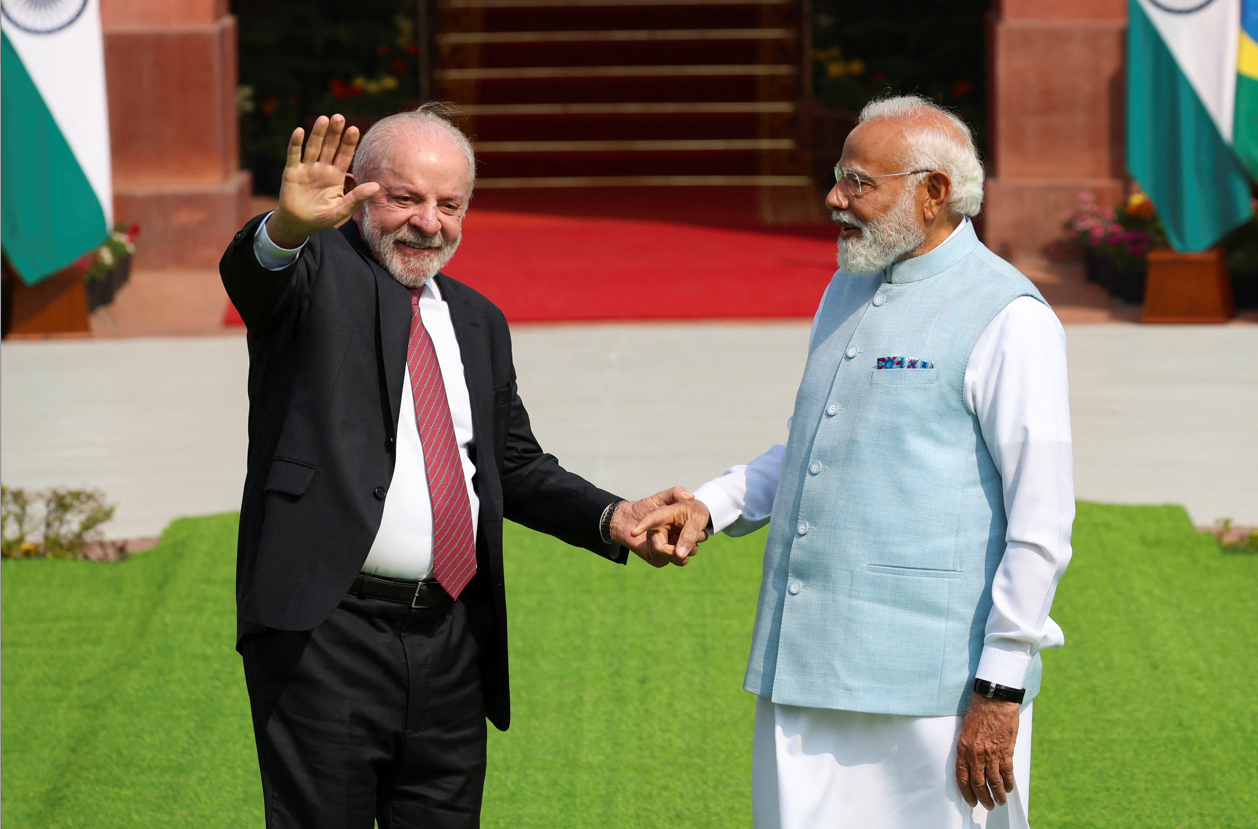
Brazilian President Luiz Inacio Lula da Silva with Prime Minister Narendra Modi after talks in New Delhi on Feb 21, 2026.
Brazilian President Lula was perhaps the most candid on this point when he remarked, in New Delhi, that “when a small country negotiates with a bigger country, the agreement will always be harmful for the smaller country.” Reflecting on his own experience as a former trade union leader, he noted that “to negotiate with the employer, all workers must get together and confront the company policy.” “If they do it individually,” he warned, “they all lose.”
Canadian Prime Minister Mark Carney delivered a similar message in India before departing for Australia and Japan, saying that “in a rapidly changing world, Canada and India are transforming their economies to be more diversified, more independent, and more resilient.” Carney made a passionate case for middle power alignment at Davos in January, where he spoke of “the beginning of a brutal reality where geopolitics among the great powers is not subject to any constraints.” “Middle powers must act together,” as Carney put it, “because if you are not at the table, you are on the menu.”
In the face of this reality, as Carney argued, middle powers are not powerless. But the challenge they are now dealing with is preserving their sovereignty when faced with new pressures, such as the weaponization of economic tariffs and supply chains. Significantly, Canada, India and other middle powers appear to be coming to the same conclusion. Seeking strategic autonomy – both in geopolitics and geoeconomics – will provide their best defence.
