
While the two countries’ maritime delimitation initiative appears on the surface to be all about maritime interests, it is in essence a strategic contest over the future regional order in East Asia, particularly the maritime order.
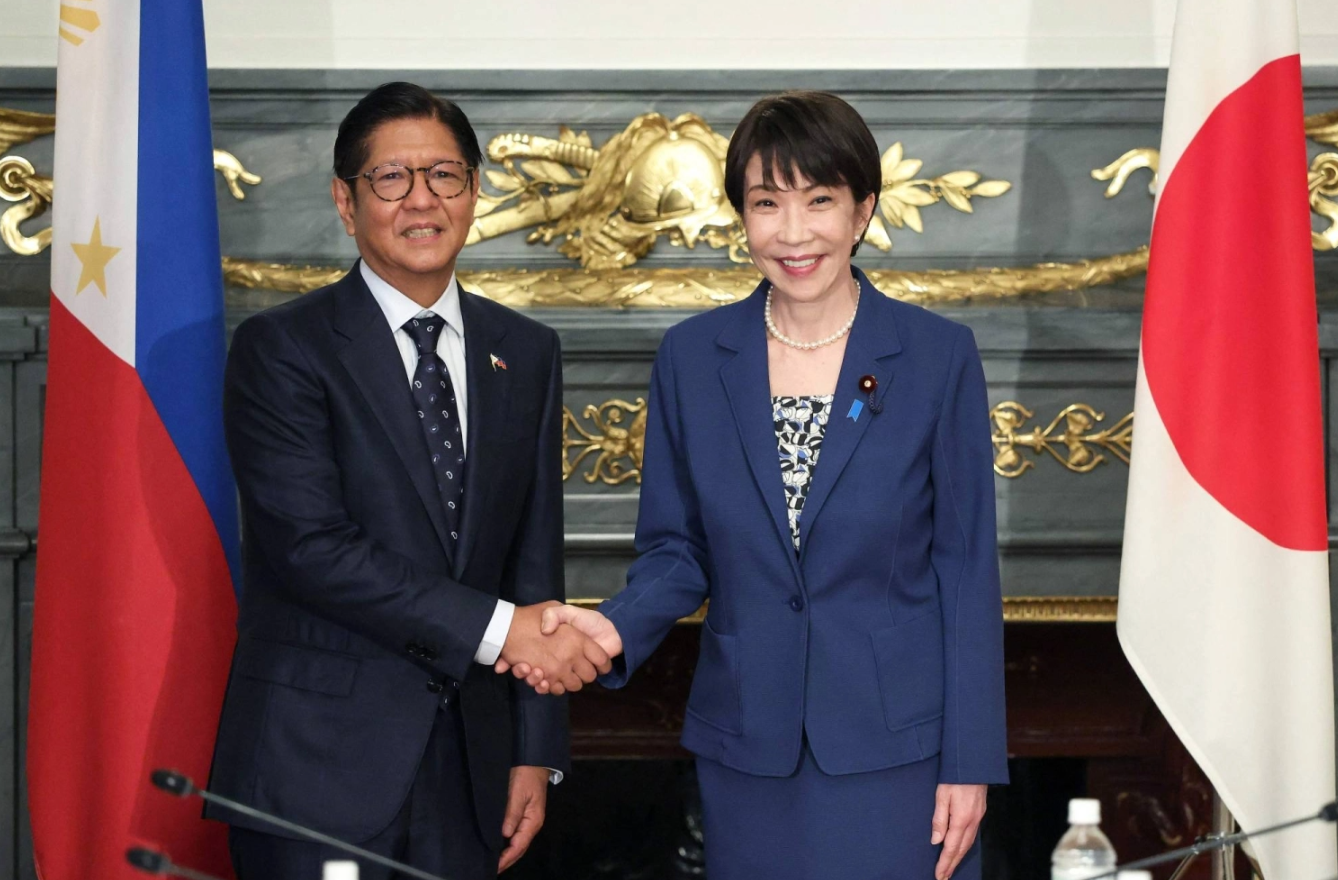
Japanese Prime Minister Sanae Takaichi with Philippine President Ferdinand Marcos Jr. before a meeting at the Akasaka Palace state guest house in Tokyo on May 28, 2026.
On May 28, Japanese Prime Minister Sanae Takaichi and the visiting Philippine President Ferdinand Marcos Jr. announced the start of formal negotiations to define their overlapping Exclusive Economic Zones and continental shelves. As the negotiations directly concern waters east of Taiwan, the Chinese government voiced its opposition, saying that the move violated international law and the basic norms governing international relations. Meanwhile, China’s coast guard and maritime authorities carried out law enforcement operations in the waters.
In recent years, strategic and security interactions between Japan and the Philippines have become increasingly frequent, even showing signs of surpassing the U.S.-Philippines alliance in certain respects. While the Japan-Philippines maritime delimitation initiative appears on the surface to concern disputes over maritime interests, it is, in essence, part of a broader strategic contest over the future regional order in East Asia, particularly the maritime order.
First, the past strategy of “integrated deterrence” by then-U.S. President Joe Biden and Japan's 2022 National Security Strategy reinforced each other, providing the foundation for the strategic convergence between Japan and the Philippines. In February 2022, the Biden administration released its Indo-Pacific Strategy, identifying China as the principal challenge facing U.S. allies and partners in the region and asserting that China was employing a comprehensive range of moves to establish a sphere of influence in the Indo-Pacific. To address this challenge, the document proposed its integrated deterrence framework, which consolidated traditional bilateral alliances and encouraged security cooperation between U.S. allies.
In December that year, the Japanese government issued a revised National Security Strategy, which characterized China as “the greatest strategic challenge ever.” While reaffirming the U.S.-Japan alliance as the cornerstone of its strategy, the document repeatedly invoked the concept of “like-minded countries” (31 times) and advocated the creation of a security network through bilateral and multilateral arrangements to strengthen Japan’s external deterrence capabilities.
For decades, the U.S. alliance system in East Asia has been built on a “hub-and-spokes” model, with Washington serving as the hub and its bilateral alliances forming the spokes. At present, however, Japan’s strategic priority is to capitalize on the ongoing transformation of the regional security landscape by deepening coordination with U.S. allies, enhancing its centrality within the alliance network and promoting a new regional order characterized by a dual hub-and-spokes structure centered on both the United States and Japan. Through this approach, it seeks to attain greater parity with the United States within the alliance framework and expand its regional strategic leadership.
Southeast Asia is the central arena for this strategic transformation. As both a U.S. treaty ally and Japan’s long-standing economic partner, the Philippines has consequently become Tokyo’s foremost choice for advancing its regional strategic agenda.
Second, the strategic narrative has evolved from “A Taiwan contingency is a Japan contingency and therefore a contingency for the U.S.-Japan alliance” to the proposition that "A Taiwan contingency is also a contingency for the Philippines.” This Tokyo-Manila convergence in strategic perception has proceeded in tandem with the rapid expansion of their security cooperation.
Following the outbreak of the Russia-Ukraine conflict, Japan’s leadership repeatedly claimed that “today's Ukraine could be East Asia tomorrow.” In shaping a heightened sense of tension in East Asia and reinforcing perceptions of a China threat, Japan has often moved ahead of the United States. Meanwhile, Washington’s encouragement of closer security cooperation among its East Asian allies has created an important opportunity for Japan to expand its strategic role.
In April 2024, former U.S. Deputy Secretary of State Richard Armitage and Harvard University professor Joseph S. Nye Jr. released a report titled “The U.S.-Japan Alliance in 2024: Toward an Integrated Alliance” in which they argued that the inauguration of the Marcos administration in the Philippines opened an important strategic window for the United States and Japan. The report recommended that Japan give priority to concluding a reciprocal access agreement, or RAA, with the Philippines.
On April 11, 2024, the first U.S.-Japan-Philippines summit was held in Washington. The three parties publicly criticized China and conspicuously expanded their involvement in issues concerning the South China Sea. Three months later, Japan and the Philippines signed tan RAA that took effect in September 2025.
This year, senior Philippine officials said that any conflict across the Taiwan Strait would directly affect the Philippines’ interests, and Japan’s Self-Defense Forces formally participated in joint military exercises in the Philippines for the first time and conducted live-fire anti-ship missile exercises on Philippine territory, marking the transition of Japan-Philippines security cooperation from a concept to an operational phase.
Third, against the backdrop of Trump 2.0, the proposed regional order, which aims to replace the U.S.-Japan-India-Australia framework with a U.S.-Japan-Philippines-Australia quadrilateral, has accelerated strategic interaction between Japan and the Philippines. Trump’s second term has left a significant mark on the U.S. alliance system. Measures such as steep tariffs on allies, criticism of so-called “free-riding” and pressure on allies to assume a substantially larger share of defense expenditures have deepened their concerns about the reliability of Washington’s strategic commitments.
Meanwhile, U.S.-India relations have become increasingly strained. For example, the U.S. Department of Defense restored the name of the Indo-Pacific Command to the Pacific Command.
Given India’s relatively limited economic interdependence with the United States and America’s East Asian allies, together with its long-standing tradition of pursuing an independent foreign policy, proposals emerged to replace India with the Philippines and establish a U.S.-Japan-Philippines-Australia quadrilateral framework. Although the Philippines is a U.S. treaty ally, the alliance is inherently subject to domestic political uncertainties, with nationalism remaining a persistent constraint on bilateral cooperation.
One notable example is the Philippine Senate’s decision after the end of the Cold War to reject the extension of the U.S. military bases agreement, leading to the closure of the U.S. naval base at Subic Bay. Moreover, ASEAN’s emphasis on strategic autonomy also constrains the development of the U.S.-Philippines military alliance.
Against this backdrop, a more prominent role for Japan enables the United States to reduce the strategic costs of maintaining its regional presence. For Japan, in turn, it provides an opportunity to enhance its international profile and expand its regional influence.
The U.S. alliance system in East Asia is the product of historical circumstances and is unlikely to disappear in the near term. However, the fundamental driving force behind the evolution of the regional order can be found in the broader trends of the times. Regional integration, rather than bloc confrontation, is the prevailing trend. The future of East Asia’s regional order will have its roots in an Asia-Pacific community. In this process, countries in the region should seek more constructive roles through positive interaction and make more constructive contributions to regional development.
