
Revising Japan’s three non-nuclear principles would require far more than a simple adjustment to national security policy. It would concern Japan’s ultimate choice of national identity and could profoundly shape the future direction of the security architecture in Northeast Asia.
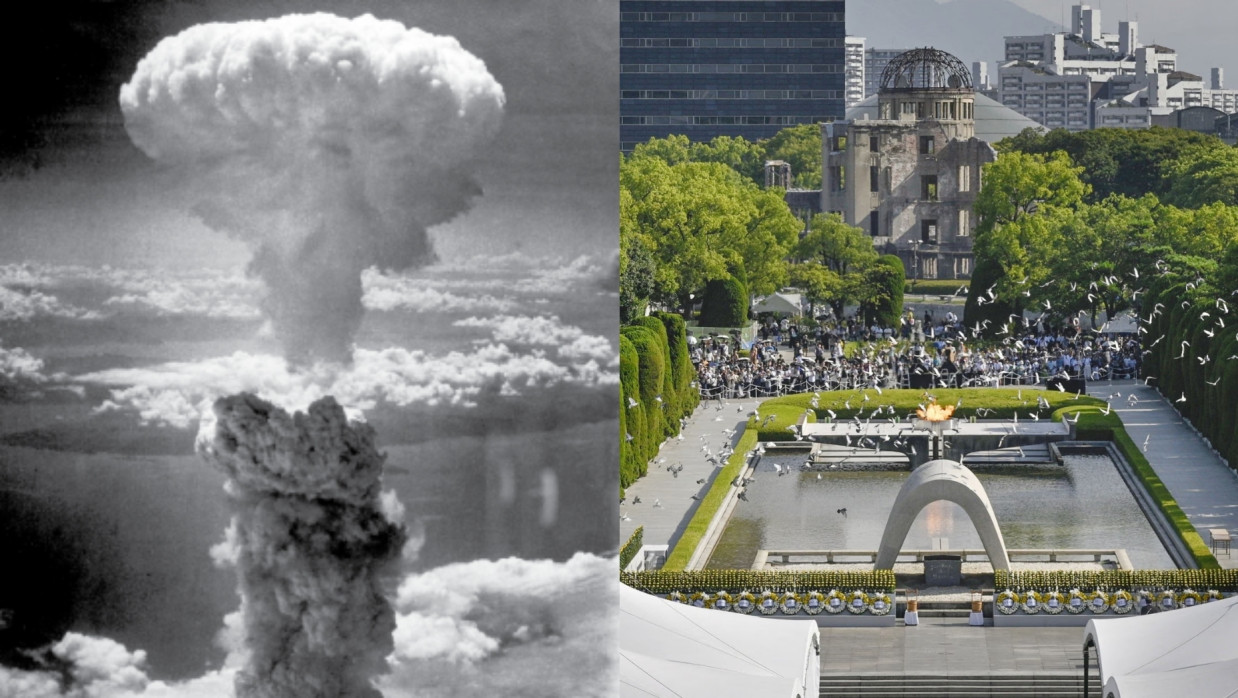
Peace Memorial Park, Hiroshima (Pierce Archive LLC, Kyodo)
On Aug. 6, Japanese Prime Minister Sanae Takaichi said at a peace memorial ceremony on the anniversary of the atomic bombing of Hiroshima that Japan continues to uphold its three non-nuclear principles: “Not producing, not possessing and not introducing nuclear weapons.” But she stopped short of making a clear commitment to maintaining those principles in the future.
The remarks heightened concerns again that Japan may revise its stance. In November, responding to questions in the U.S. House of Representatives, Takaichi declined to confirm whether the principles would be retained in the revision of the country’s security policy at the end of the year. In December, a senior official in her office publicly called for exploring the possibility of Japan possessing nuclear weapons. Within the ruling coalition, the Japan Innovation Party formally proposed that the government revise the provision banning the introduction of nuclear weapons in order to strengthen deterrence capabilities, while Defense Minister Shinjiro Koizumi also said in public that a domestic debate on nuclear policy should begin.
As the only country to have suffered atomic bombings, Japan has long championed the goal of a world without nuclear weapons and cultivated an identity as a “peaceful nation.” Its security architecture has remained heavily dependent on America’s long-arm of deterrence, meaning its nuclear umbrella. This inherent contradiction has been laid bare in the current policy debate in Japan over revising the three non-nuclear principles. At its core, the question involves a major choice over Japan’s national identity: Will Japan ultimately remain a “peaceful nation,” or will it seek the so-called ultimate deterrent for itself and become another kind of “normal state”?
The pacifist Japanese Constitution, its exclusively defense-oriented policy and the three non-nuclear principles together form the pillars of postwar Japan’s identity as a “peaceful nation.” The Constitution explicitly renounces the right of belligerency and prohibits Japan from maintaining conventional armed forces; the defense-oriented policy limits the country’s Self-Defense Forces to the minimum level of force necessary to respond to an armed attack; and the three non-nuclear principles are philosophically aligned with the nuclear-free-zone initiatives pursued by many countries around the world, reflecting postwar Japan’s choice to rely primarily on diplomatic and political means to safeguard national security.
Over the past decade or so, Japan has effectively pushed beyond the original boundaries of its exclusively defense-oriented policy by lifting the ban on the exercise of collective self-defense through a reinterpretation of the Constitution and acquisition of counterstrike capabilities through revisions to its national security strategy. Now, calls within the political establishment to revise the three non-nuclear principles suggest that the core elements underpinning Japan’s identity as a peaceful nation are steadily eroding.
Japan is now reinterpreting the meaning of “non-nuclear.” The logic of nuclear deterrence has gradually taken precedence over the pursuit of a world without nuclear weapons. Those advocating changes to the three principles argue that eliminating nuclear weapons should remain the long-term humanitarian goal but that the immediate priority is to prevent Japan from suffering a nuclear attack. This argument is based on the premise that Japan is surrounded by hostile neighbors that possess nuclear weapons and so it must rely on the U.S. nuclear umbrella as its ultimate deterrent power.
Yet China, Russia and North Korea all possess the capability to strike the U.S. mainland with intercontinental ballistic missiles, so doubts have arisen over the credibility of the U.S. nuclear umbrella covering Japan. Advocates for self-defense argue that, at a minimum, Japan should revise the provision banning the introduction of nuclear weapons, which would give the United States more flexibility to deploy nuclear forces on Japanese territory and even allow the pursuit of a U.S.-Japan nuclear-sharing arrangement, effectively giving Japan a form of nuclear capability by proxy.
Calls to revise the three principles are also linked to Japan’s pursuit of greater strategic depth at sea and its ambition to become a leading power in the maritime order of East Asia. Those pushing for changes to the principles have strong hope of acquiring nuclear-powered submarines. Their strategic logic is that, as neighboring countries expand their maritime activities, Japan needs submarines capable of staying underwater longer and traveling at higher speeds to create a stronger counterstrike capability.
Japan has limited territorial depth on land, but ranks among the world’s leading countries in terms of the area of waters under its jurisdiction. Once equipped with nuclear-powered submarines and vertical missile-launch capabilities, Japan could potentially gain control over key sea lanes in the western Pacific and establish a powerful deterrent against major maritime platforms such as aircraft carriers.
The three non-nuclear principles were an important political commitment through which postwar Japan regained acceptance at home and abroad and forged its image as a peaceful nation. The principles are also an important factor underpinning Japanese diplomacy. For now, Japan has not amended its pacifist Constitution, and continues to pay lip service to an exclusively defense-oriented policy and the three principles. Various developments suggest that Japan is seeking to change the substance of these policies while retaining the shell of the existing system, a case of putting new wine in old bottles. But history has repeatedly shown that relying too heavily on military and nuclear deterrence for security cannot deliver genuine security. Political and diplomatic means remain the most reliable way to achieve it.
At the end of this year, Japan is set to revise its three key security documents, including its National Security Strategy. How it handles the three non-nuclear principles, therefore, deserves close attention. Revising the principles would require far more than a simple adjustment to policy. It would define Japan’s ultimate choice of national identity and could profoundly shape the future direction of the security architecture in Northeast Asia.
