
Over the past year, the war between Russia and Ukraine has evolved, extending into economic and social spheres and prompting a shift in the brokering of peace. This, in turn, has allowed strategic pressure to spill across theaters.
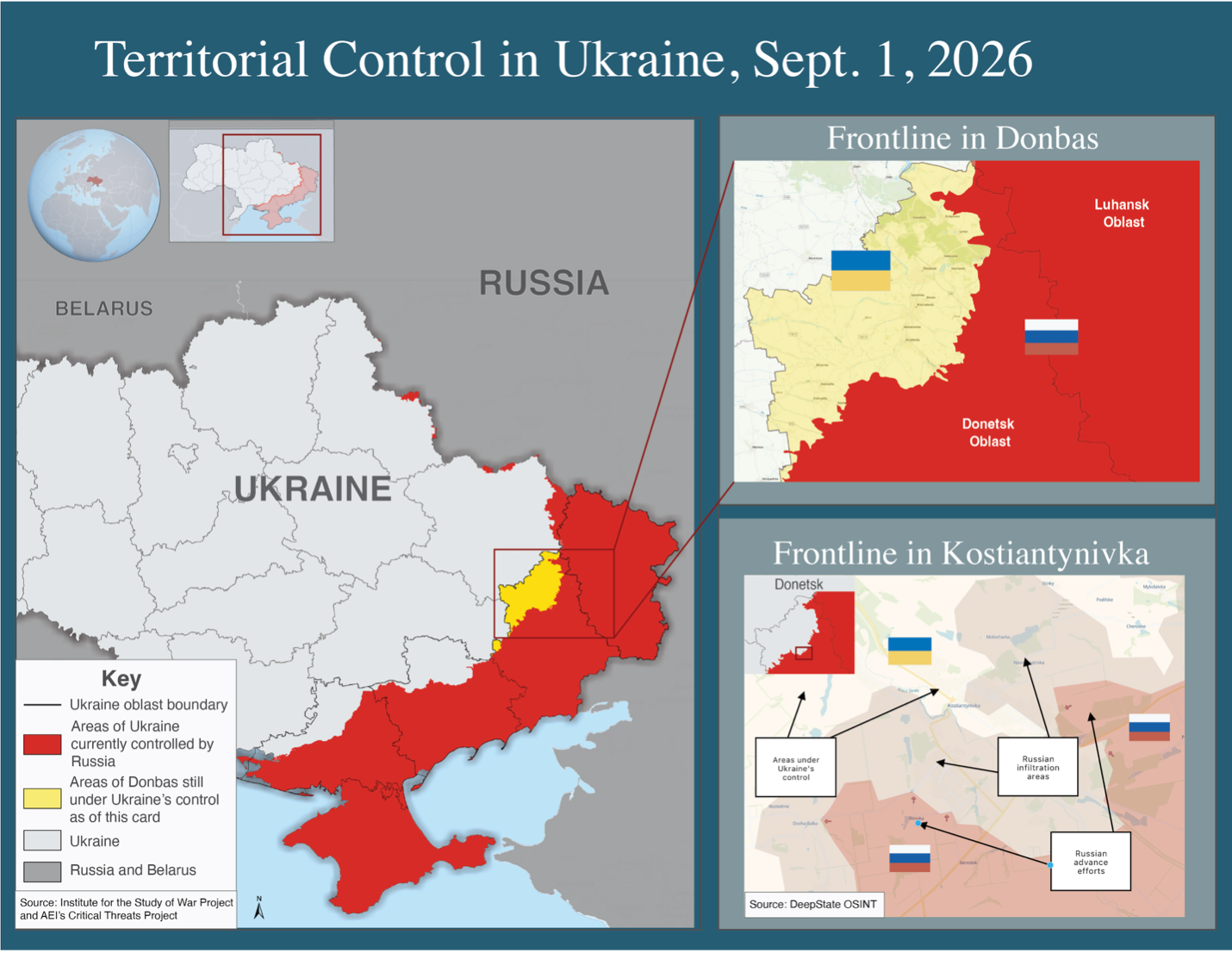
(Graphic: Russia Matters)
In August last year, U.S. President Donald Trump and Russian President Vladimir Putin met in Anchorage, Alaska. Although the two sides failed to reach agreement about a cease-fire, the meeting briefly raised hopes that a direct U.S.-Russia deal might bring the war to an end. A year later, the optimism of Anchorage has all but vanished. The war continues, while the confrontation has deepened into economic and social spheres. The United States has adjusted its approach to ending the war, and its strategic pressure is beginning to extend beyond Europe’s geographic boundaries.
In August this year, Putin traveled to Iturup Island, far from the battlefield in Ukraine. The visit may have appeared unrelated to the war in Ukraine, but it created a new link between the European conflict and the distant Pacific.
Long-range sanctions
The conflict in Ukraine remains a high-intensity war of attrition, and both sides are increasingly relying on long-range strikes to undermine the other’s ability to sustain the war.
Ukraine has continued to expand its long-range attacks on targets deep inside Russia using drones and other weapons, with oil refineries, energy facilities and logistics infrastructure emerging as key targets. Kyiv has described the campaign as “long-range sanctions” aimed at raising the cost of the war for Russia. Based on Russian official data and industry information, Russia’s oil-refining throughput is estimated to have fallen by 25 percent to 27 percent year-on-year as of August. The attacks have also extended to agricultural export facilities along the Black Sea, with Russia’s wheat exports in August about 40 percent below the average of the past five years. These targets support both the wartime economy and the energy supplies and livelihoods of ordinary people, meaning the costs of the war are increasingly being transmitted into the broader Russian society.
Russia, meanwhile, has continued its large-scale attacks on Ukraine’s electricity, natural gas and transport infrastructure. According to publicly available information from Ukraine’s state oil and gas company, such facilities have come under attack nearly 300 times since the beginning of this year. United Nations monitoring data show that strikes on power-generation and electricity transmission and distribution facilities have at times left millions of civilians without power. Ukraine has dubbed this the “weaponization of winter,” arguing that Russia is seeking to weaken its ability to sustain the war by disrupting energy supplies and heating.
Both Russia and Ukraine are seeking to prove that they can outlast the other, while embedding the war ever more deeply in each other’s economic and social systems. Yet there is still no sign that this pressure has reached the point of forcing either side to make concessions. The patience of both countries’ populations is likely to face an even sterner test.
“Spirit of Ankara”
After the Anchorage meeting, Russian diplomats repeatedly invoked the “spirit of Anchorage” to reflect Moscow’s hopes that the Trump administration might help bring the war to an end through a direct U.S.-Russia deal. A year later, those hopes have been dashed. U.S. Secretary of State Marco Rubio acknowledged that some of the understandings reached in Anchorage would be difficult to implement and that new ways of resolving the conflict would have to be explored. Dissatisfaction within Russia has grown, but Putin has publicly reaffirmed that “denazification” remains a military objective—one that could be achieved in part through negotiations, but only if Ukraine makes fundamental concessions.
These changes are directly linked to Trump’s adjustment in his approach to ending the war. At the NATO summit in Ankara in July, Russia was described as a “long-term threat” to Euro-Atlantic security and stability, and the Trump administration began increasing pressure on Moscow. Some Russian commentators summed up the shift as replacing the “spirit of Anchorage” with the “spirit of Ankara” as the United States moves from primarily pressuring Ukraine for peace to putting greater pressure on Russia and seeking to force Moscow to compromise by raising the cost of continuing the war.
However, this shift is unlikely to produce immediate results because the Trump administration remains focused on breaking the deadlock with Iran and has yet to develop a sustained strategy of maximum pressure on Russia. The spirit of Ankara within NATO will take time to prove itself.
Spillover effects
More consequentially, the effects of the war are breaking beyond Europe’s borders. In Europe, the protracted conflict is reshaping the post-Cold War security architecture, while uncertainties over America’s security commitments in Europe are heightening strategic anxiety. The two strategic theaters of Europe and the Asia-Pacific, once relatively separate, are becoming increasingly interconnected, with Japan playing a more prominent role. In January 2025, Japan established a permanent ambassador-level mission at NATO headquarters. In April this year, around 30 ambassador-level representatives from NATO member states collectively visited Japan to discuss the situation in Ukraine, as well as North Korea’s nuclear program, Russia-North Korea military cooperation and China-Russia relations. Japan has also increased defense spending and identified Russia as a “strong concern” for national security.
This means that security issues in Europe and the Asia-Pacific are increasingly being viewed within the same strategic framework. Given Japan’s territorial claims against Russia, Moscow remains highly wary. At the same time, Russia has continued to step up military activity in the direction of the Sea of Japan, the Sea of Okhotsk and the Kuril Islands. In exercises in August, Russia said its forces included around 60 warships; 30 aircraft, including helicopters and drones; and more than 13,000 personnel taking part.
More symbolically, Putin subsequently traveled to Iturup Island. The move immediately drew strong protests from Japan, prompting Russia to summon Japan’s ambassador in Moscow. To some extent, this shows that, as the war drags on, Russia is increasingly viewing Western strategic pressure through the lens of a broader Eurasian security space. Moscow sees the United States and Europe exerting pressure on it from multiple directions by strengthening security cooperation with countries in the Indo-Pacific, diverting and constraining its security interests in the Asia-Pacific, collectively constituting an effort to influence the course of the Ukraine war.
The significance of Iturup Island, therefore, lies not in its becoming a second battlefield in the Ukraine war but in showing that battlefields can be geographically separated while strategic pressure can spill across theaters.
The two distant geopolitical coordinates—Anchorage and Iturup Island—seem to neatly trace the changes in the Ukraine war over the past year. The war has expanded into the economic and social spheres, the approach to brokering peace has shifted and strategic pressure has begun to cross theaters. This also reflects a deeper rule of geopolitical conflict: The longer a war drags on, the less peace is determined by the battlefield alone.
