
When lawless behavior by powerful nations can be carried out with virtual impunity—with no significant international opposition—a civilized world order founded on rules rather than brute force can no longer be guaranteed.
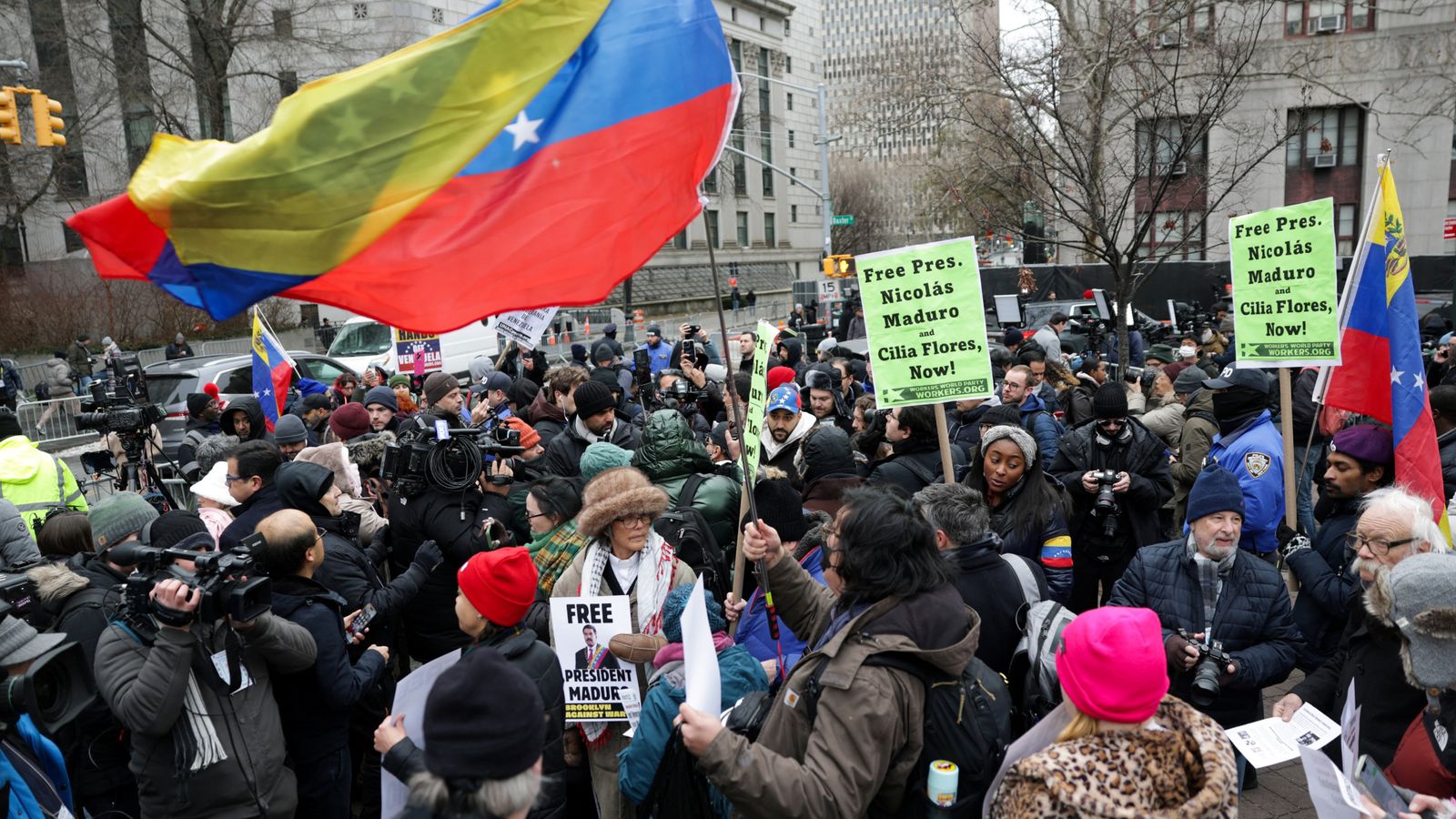
People protest outside Manhattan Federal Court before the arraignment of Venezuelan President Nicolas Maduro, Jan. 5, 2026, in New York. (Reuters)
What becomes of the rule-based global order when a president of a sovereign state is kidnapped and taken on a warship by another country, blindfolded and handcuffed, and imprisoned until a suitable election satisfactory to the same government is held?
This is a powerful illustration of the extreme crisis in international law, state sovereignty and global governance being experienced today. A painful photo is currently trending that captures the moment in Venezuela. Once the possibility that such a deed can be carried out with no significant international opposition, a civilized world order, founded on rules rather than brute force, can no longer be guaranteed.
China has been very critical of the United States with regard to Venezuela. It demanded the release of President Nicolas Maduro immediately after U.S. military strikes devastated Port Sancha and other regions of the country, and when Maduro was kidnapped. On Sunday, Beijing stressed that the safety and the dignity of Maduro and his wife, Cilia Flores, should be ensured. China appealed to Washington to stop the overthrow of the government of Venezuela and called the operation a clear and serious violation of international law and the principles of state sovereignty. It has been cited to express Beijing’s broader view that unilateral military interference and the forced change of regime are hostile to international stability and the principles of global order.
The role of China, in this respect, is crucial. As a permanent member of the UN Security Council and the overall representative of the Global South, China cannot afford to sleep. Such interventions would have to be disputed by active Chinese diplomacy. This does not imply championing Maduro’s policies, but it is a defense of the principle that leadership changes should not be imposed but should be brought about internally.
The example of Venezuela illustrates a paradox. No matter what one might say about his leadership or national credibility, Maduro is the current president of a state recognized internationally. The United States has, however, justified his capture via military attacks, arguing that it has a right to manage the country until a safe and just transition can be negotiated. Washington pledged to provide an effective solution for the oil sector in Venezuela. What was said is quite explicit: Prevailing sovereignty is conditional, and international rules are discriminatory.
It is not just a worrying episode for Venezuela. It reaches directly to the heart of the post-World War II international system, which is based on the principles of sovereign equality, non-intervention and collective security under the United Nations. The reason is that the world has more than 200 countries, and the UN’s institutional watchdog is not yet in place. When one of the world’s strong states invades another state, seizes its leader and proclaims de facto trusteeship, the world’s response was no thunderclap. Silence in this instance is complicity.
U.S. President Donald Trump has tried to sell the operation as part of a broader war against drugs, gangs and security threats that have their roots in Venezuela. Maduro was charged in New York with narcotics-related crimes, and Washington feels that extreme measures had to be employed. These claims, however, have been opposed by various defense and security analysts, who have described them as overblown or even politically motivated. It makes no sense, they say, that drug trafficking was at issue because the U.S. has not carried out similar actions against other states that are also involved in transnational crime. The discriminatory intervention suggests a novel calculus.
Oil is right in the middle of that calculus. Venezuela has the largest proven oil reserves in the world and has been an attraction for many powers throughout history. Several times, Trump himself has stated that American companies had been operating freely in Venezuela but that their oil rights had been stolen.
When the crisis is put in terms of a security and narcotics matter, critics hold the view that Washington is simply trying to justify what is fundamentally a battle for resources and power. The history is unpleasant: Since the wars in Iraq and Libya, humanitarian intervention and security were cited, but the undertone was always deeper geopolitical and economic interests.
This raises an appalling question: Are the mightiest states more capable as a result of gaining the capacity to exploit the resources of weaker states by using military and economic resources disguised as servants of the world order? When that happens, the rules-based system is transformed into a hierarchical system, where might may be used to define right. This impression of the situation of dubious norms is reinforced by the fact that no similar acts are being committed against strong countries but only against weak ones. In that case, the slap in the face is executed without the slightest hesitation.
Hostage-taking of international institutions also seems to have been paralyzed. The UN Security Council, which is supposed to guarantee global peace and security, has failed to take decisive action against a powerful state. The council is rendered useless at the moment when veto politics, strategic alliances and geopolitical bargains override it. This teaches smaller states that international law may not be on your side when it is most needed.
Internal politics in Venezuela have also been identified as problematic. Was there some internal betrayal? Can elite groups bring about intervention from the outside? As much as such arguments need to be considered, they fail to justify the increased violation of sovereignty. It is wrong to apply the military power of another state or to become a kidnapper. To justify intervention and reject accepted norms of international behavior is to say the opposite.
The Venezuela crisis points to a significant transformation of the world order. The rhetoric of regulation has turned the world increasingly into a place of power politics—where the application of international law is selective, where human interests are politicized and where humanitarian institutions are trampled. This will put developing countries into an absolute state of insecurity in which they lack political sovereignty and are at the mercy of stronger ones.
In any case, the question is not whether Nicolas Maduro is a good or a bad leader. The issue is whether the world is prepared for a situation where the law is subservient to power and sovereignty is based on strategic convenience. Venezuela will not be exceptional unless the international community does something substantial, The scenario will become the precedent.
Haphazard, half-indignant silence will never sustain a strictly rules-based international system. What is required is sameness, alleviation and collaborative accountability. The current situation in Venezuela will be the fate of any country when the world is afraid to stand up to the interests of mighty states. Sabotage of the rule of law anywhere is a threat to justice everywhere. And that is the tragedy.
