
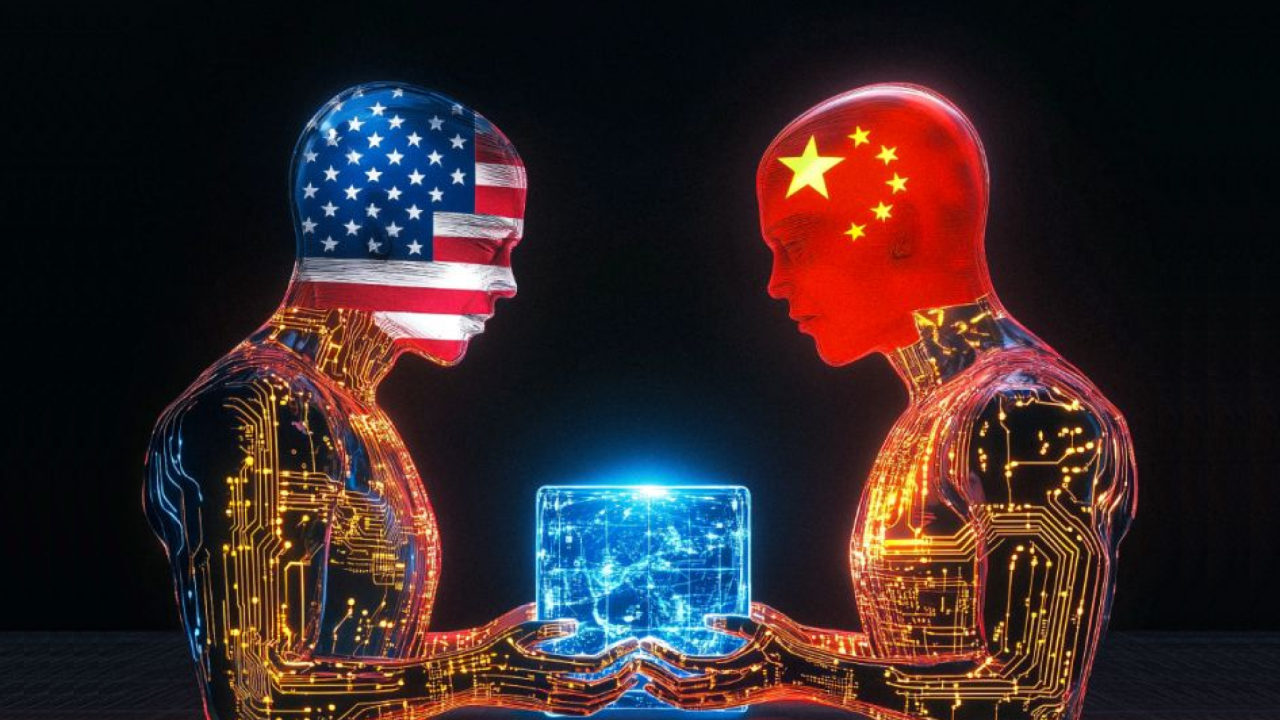
Looking back over the past period, even as technological competition between China and the U.S. has intensified, the two sides have also made some constructive progress in cooperation on artificial intelligence (AI).
In May 2024, China and the U.S. held the first meeting of the inter-governmental dialogue on AI in Geneva, Switzerland. The discussions focused on risks associated with AI technologies, global governance mechanisms and issues of mutual concern. This meeting marked the formal inclusion of artificial intelligence as a standing item in China-U.S. governmental dialogue, signaling a cautious but meaningful step toward managing emerging technological risks through direct communication.
Subsequently, in November 2024, Chinese President Xi Jinping and then U.S. President Joe Biden met and reached an important consensus on the principle of ensuring that nuclear weapons are always under human control. This shared understanding drew a clear red line with respect to the potential militarization of artificial intelligence, particularly in nuclear-related domains. It also laid an important foundation for bilatera, and potentially global efforts to strengthen risk management and strategic communication in the face of rapidly advancing technologies.
Following Donald Trump’s return to office, competition between China and the U.S. in the field of artificial intelligence has remained intense. Yet after the 2025 leaders’ meeting in Busan, both sides stated that they would continue to advance mutually beneficial cooperation in AI. This signal suggests that, regardless of whether a Democratic or Republican administration is in power, there is a shared recognition in Washington of the necessity to maintain engagement and coordination with China on artificial intelligence-related issues.
That said, under the current political climate in China-U.S. relations, pursuing deeper and more concrete cooperation in areas related to artificial intelligence and the AI-nuclear nexus continues to face significant practical constraints. Nuclear weapons and other key strategic capabilities remain highly sensitive, making mutual transparency difficult to achieve in the near term. Challenges related to verification and persistent deficits in strategic trust in the arms control domain further complicate dialogue between the two sides. Even so, China and the U.S. still have a strong incentive to explore cooperation to the greatest extent possible in less sensitive areas.
On military-related issues, both sides could focus on promoting and deepening existing principled consensus, rather than rushing into substantive military dialogues or technical cooperation. In non-military domains, however, there remains considerable room and necessity for China and the U.S. to engage in dialogue and cooperation on assessing technological risks, addressing ethical concerns, and guiding the development and application of artificial intelligence toward beneficial and responsible ends.
The consensus that nuclear weapons must remain under human control provides a solid foundation for the next stage of cooperation, especially in managing AI-related risks in the military domain. President Trump is also trying to shape his image as a peace president, which opens space for both expansion and deepening of this consensus.
In terms of expanding cooperation, China and the U.S. can move in two directions. First, they can encourage other nuclear powers, such as the U.K., France, and Russia, to adopt the same principle, gradually transforming a bilateral understanding into a multilateral one. They could also take this issue to the UN framework and jointly promote statements reaffirming the principle of human control over nuclear weapons and emphasizing responsible deployment of military AI. Second, they could extend the principle beyond nuclear weapons to other strategic systems with high deterrence potential. The definition and scope, however, require further discussion and could begin in Track-2 dialogues.
On deepening cooperation, both sides can work on more detailed risk assessments and management mechanisms, breaking down nuclear weapon systems and conflict scenarios into deployment and decision-making steps to identify specific risks. A complete ban on AI in NC3 (Nuclear Command, Control, and Communications) systems is unrealistic, and both sides should also consider the potential benefits of AI-nuclear integration. Therefore, identifying mutually acceptable red lines is crucial.
Against this backdrop, Track Two dialogue serves as an important supplementary channel. Think tanks, scholars and retired military officers can continue discussions on risk assessment, ethical norms, and crisis decision-making. These efforts help sustain communication and build expert consensus that can eventually support official talks.
In non-military domains, China and the U.S. could also work together to advance global governance of artificial intelligence. To begin with, both sides could focus on the cross-border risks generated by AI and seek to promote risk-tiering, classification, and assessment frameworks that are acceptable to a broader range of countries, while jointly exploring possible responses.
These governance challenges are shared by both countries. At the technical level, they include risks related to loss of control over advanced AI systems, the limited interpretability of large models, and so-called “hallucinations” in model outputs. At the application level, they encompass AI-related biosecurity risks, the potential for AI to “enable” terrorist organizations and other non-state actors, and the erosion of social trust caused by deepfakes. All of these issues transcend national boundaries and cannot be effectively addressed by any single country acting alone.
Approaching cooperation from a risk-based perspective may also help reframe China and the U.S. from mutual “technological competitors” into “co-risk bearers.” Even under conditions of strategic competition, this reframing could enable the two sides to identify shared concerns and practical areas for cooperation in AI risk assessment and management.
Second, China and the U.S. could engage in dialogue on the profound impact of artificial intelligence on economic and social structures. AI is reshaping labor–capital relations and transforming traditional modes of production. Across a growing number of sectors, trends toward unmanned operations and high levels of automation are becoming increasingly visible. While these developments may significantly enhance productivity, they also carry the risk of structural unemployment.
A shared challenge for both countries is how to ensure that AI improves people’s livelihoods rather than exacerbating disparities in the distribution of social resources. Closely related are questions of how to enhance societal adaptability to technological change through policy measures such as education reform, skills transformation, and more inclusive access to digital infrastructure. These issues represent areas of common concern for China and the United States. By taking the lead in advancing such dialogue, China and the U.S. could also offer useful reference points for other countries grappling with similar challenges, thereby contributing to broader international discussions on the societal governance of artificial intelligence.
Third, China and the U.S. could further explore how AI might be leveraged to provide new solutions for global public governance. In the field of climate governance, AI can be applied to disaster forecasting, extreme weather modeling and emergency response. In the realm of international peace and security, AI technologies may help support conflict mediation, optimize peacekeeping deployments and enhance early warning of crises. In global development, efforts to promote open-source technologies and the sharing of foundational algorithms could also contribute to narrowing the technological gap between the Global North and the Global South.
Building on existing United Nations frameworks, China and the U.S. could embed cooperation on AI as a global public good into multilateral agendas. This could include launching pilot projects in areas such as climate monitoring, disaster management, public health early-warning systems, smart agriculture, cross-border infectious disease forecasting and the digitalization of basic education. Cooperation in these fields would not only highlight the positive potential of artificial intelligence, but also help inject elements of collaboration into a bilateral relationship otherwise characterized by intense technological competition, thereby contributing to a modest improvement in overall China–U.S. relations.
Finally, China and the U.S. should also jointly address the ethical and legal challenges posed by AI. The rapid development of AI technologies has brought fundamental ethical questions into sharper focus, including how to define human identity and how to preserve human agency and a sense of value in an era of increasingly autonomous systems. How to maintain effective human control over critical decision-making processes, how to establish baseline ethical principles for the development and deployment of AI, and how to clarify responsibility and accountability mechanisms in cases of harm have all become issues of global concern. Dialogue on these questions could help further build mutual trust between China and the U.S., while also contributing to the exploration and consolidation of normative consensus within the international community on technological development.
It should be emphasized that cooperation between China and the U.S. on global AI governance is not intended to construct any form of a “G2” model. Rather, it reflects the responsibilities that arise from the two countries’ respective capabilities in technological innovation, industrial capacity and international influence. Any effective framework for global technology governance cannot function without the participation of both China and the United States.
As a paradigmatic disruptive technology, AI will not only profoundly reshape economic, social, and security landscapes, but will also help define the rules and governance structures of the future international order. If China and the U.S. can take early cooperative steps in areas such as risk perception, ethical principles, and public-interest applications, such efforts would carry important demonstrative value and reflect the responsibility of major powers to lead by example.
