
The 2026 oil crisis revealed a transformed China: no longer just the world's largest oil importer and refiner, but a state actor deploying stockpiles, export controls, and strategic opacity to shape global energy markets on its own terms.
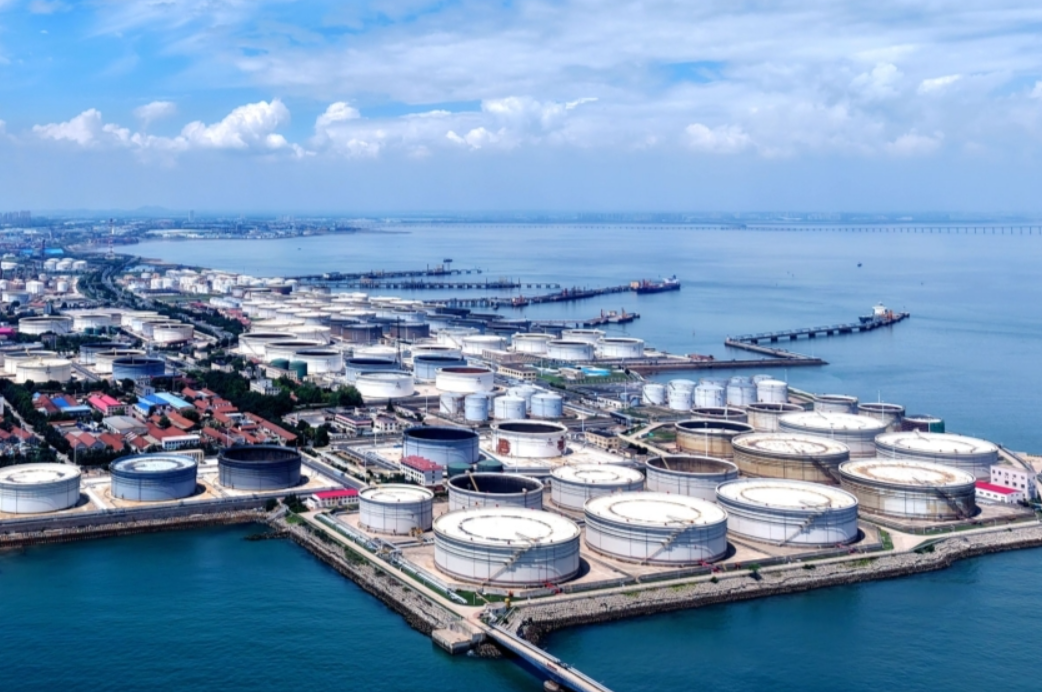
Aerial view of Qingdao Port Crude Oil Terminal in Qingdao, China, on April 12, 2026.
Since the outbreak of the Iran War, the global energy paradigm has shifted in favor of Beijing. As the world's largest importer and refiner of crude oil, China has an unrivaled appetite for oil. As the conflict unfolded, however, it revealed a striking transformation in China's energy posture. Beijing demonstrated its ability to weather shocks, drawing on renewables, fuel switching, and a state toolkit of stockpiling, strategic buying, and export controls. By sharply cutting crude imports even at the height of the war, China freed up supply for other buyers, relieving pressure on global prices. But its export restrictions on refined products did the opposite, magnifying the crisis in the markets China sells to. Overall, China emerged from the conflict stronger. Armed with state tools, Beijing can now act as both market stabilizer and market distorter, leaving greater volatility in its wake.
Since the start of the war in February, China has reduced its baseline seaborne crude imports by 44 percent—roughly equivalent to the combined daily oil consumption of Germany, France, and the UK. This was not an unplanned response to the war. Rather, it marked the culmination of a long-term energy diversification strategy built on three pillars. First, the prevalence of electric vehicles: EVs already displace more than 1 million barrels per day of oil demand according to the International Energy Agency (IEA). Second, renewables: by the end of 2026, wind and solar will account for nearly half of China’s installed power capacity. Third, coal conversion: China transforms its vast domestic coal reserves into oil-like fuels, synthetic gas, and feedstocks for plastics and fertilizers. Taken together, these anchors form a scalable insurance policy against imported crude. As a result, China’s demand for oil is becoming increasingly discretionary, giving it greater leverage over the market rather than forcing it to accept prevailing conditions.
Strategic stockpiling reinforces this advantage. China holds by far the world’s largest oil reserves, estimated at 1.3 to 1.4 billion barrels. Beijing maintains both a Strategic Petroleum Reserve (SPR) and commercial stocks that refiners and other industry players keep. Unlike governments in market economies, Beijing can draw on both through its state-controlled system. Despite the war, China continued to expand its stockpile between March and April through purchases of heavily discounted Iranian and Russian oil and rerouted imports from non-Gulf suppliers. Only in May did it begin drawing down inventories at a rate of roughly 1 million barrels per day, primarily from commercial stocks. China’s vast reserves enable it to buy aggressively when prices are low and draws down inventories when supply falters or prices spike. This insulates Beijing from the global spot market. It can supply its domestic system from reserves rather than buying at whatever price the market demands, and it can keep accumulating stocks regardless of market volatility. What makes this strategy especially consequential is its opacity. China publishes no official figures on its SPR levels, commercial stock changes, or detailed energy balances. As a result, demand signals from the world’s largest energy consumer become increasingly difficult to interpret. Beijing holds the strategic high ground, with full visibility into markets abroad and near-total concealment of conditions at home.
Beijing paired its stockpiling with a blunter instrument: export restrictions. China has been the world's largest net importer of crude oil since 2013, and in 2022 it overtook the United States as the world's largest refiner, turning imported crude into the gasoline, diesel, and jet fuel that power its economy. China serves its own market first, keeping most of that fuel at home, yet its small export market remains a lifeline across Asia. Beginning in early March, Beijing banned or severely limited exports of key products, including gasoline, diesel, and jet fuel. It cut refinery runs, with some independent refiners dropping to as low as 50 percent utilization. The cuts helped China manage domestic supply, conserve crude stocks, and limit its exposure to high global prices. China has long managed refined product exports through annual and batch quotas, but during this crisis, Beijing weaponized existing policy as an instrument of crisis management. Such intervention would be unthinkable in most market economies, where refiners are private companies and governments have no authority to dictate their output or exports. These directives distorted demand, generated false bearish signals, and masked underlying physical tightness. The result was distorted arbitrage and a market in which other participants could neither forecast nor plan around Beijing’s opaque moves.
Futhermore, Beijing’s export restrictions amplified the war’s impact across the rest of Asia. Australia, Bangladesh, and the Philippines faced shortages, higher inflation, reduced air travel and surging prices for diesel and jet fuel. State control over refining exports allowed Beijing to wield power over regional friend and foe alike. Later in the crisis, Beijing permitted limited shipments to "friendly" or strategically important neighbors such as Vietnam, the Philippines, and Australia. The war demonstrated geopolitical levers Beijing may pull in the future, creating a new asymmetry of power in regional energy security.
Since the beginning of July, China has stepped up its oil purchases for late summer delivery and, following a four-month suspension, Beijing has partially lifted export restrictions on refined products. It is unclear whether the easing of posture will continue through the summer, especially given recent escalations of violence and ongoing volatility with peace talks. Regardless, China could theoretically sustain commercial draws at current rates for many months—potentially into 2027—leaving little urgency to return to pre-war levels.
The consequences extend beyond oil markets. These events mark a new understanding of market behavior: China will buy when prices are low and rely on inventories when prices are high—a pattern market participants must now incorporate into their expectations. Yet Beijing's opacity ensures that its true position remains unknowable. Events have also revealed that Asian economies, including U.S. allies, now depend on a supplier that has proven willing to wield fuel as an instrument of statecraft. The culmination is clear—Beijing's state tools give it an advantage in any future crisis.
This edge signals a broader transformation. China may indeed be becoming structurally less oil-intensive through energy diversification, but that alone cannot explain the market behavior on display during the conflict. Beijing’s use of stockpiling, export controls, and opaque reporting demonstrates that state intervention has become an equally important source of market power. The world’s largest net importer of oil can now modulate demand and the physical availability of supply while operating outside traditional reporting systems. China has demonstrated its optionality as a buyer, willing and able to impose uneven patterns on global markets. As China’s energy security deepens, the rest of the world’s energy uncertainty may increasingly depend on Beijing’s directives.
