
South Korea has recently proven atypically successful in straddling regional tensions involving China, but Beijing’s strained relations with Washington and its allies will sorely test Seoul’s pragmatic diplomacy in 2026.
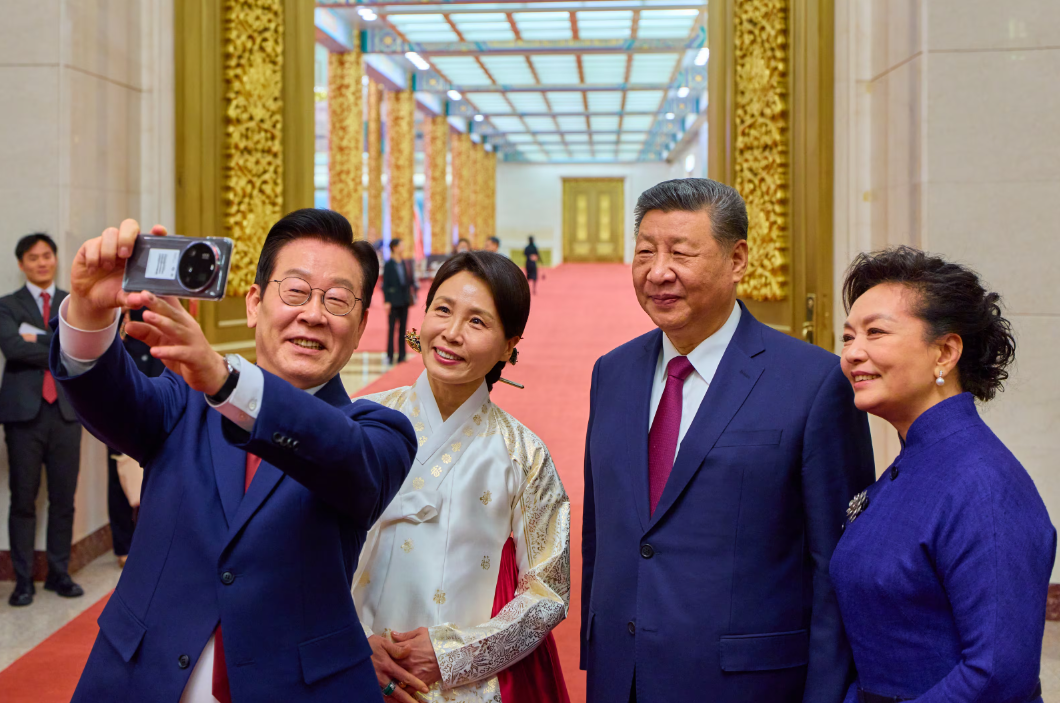
South Korea's President Lee Jae Myung has called for a "new phase" in ties with China as he met Chinese President Xi Jinping in Beijing on Monday, January 4, 2026.
On January 4, Lee Jae Myung became the first president of the Republic of Korea (ROK) to travel to the People’s Republic of China (PRC) since 2019. During his four-day state visit, Lee met with President Xi Jinping, Premier Li Qiang, Chairman of the National People’s Congress Zhao Leji, and other senior PRC leaders. Lee stated that, "Korea-China relations will advance to an entirely new stage through this visit to China." This will almost certainly not be the case.
The visit did address a wide range of important topics. However, the trip did not resolve any of the main differences between the two countries. The two governments deferred several sensitive questions to future discussions between the PRC and ROK officials. Implementing the economic and commercial agreements will depend on the capacity and willingness of many public and private sector actors to transform memoranda of understanding (MOUs) into concrete business projects. The pledge to "restore strategic dialogue channels in various fields, including between the diplomatic and security authorities of both countries,” was also vague.
Lee has termed his approach “pragmatic diplomacy.” Upon his return from China, he explained that, "In a ruthless international order where there are no eternal enemies, friends or rules, the fate of the Republic of Korea hinges on pragmatic diplomacy centered on national interests.” After winning a snap presidential election and assuming office in early June, Lee initially focused on shoring up relations with the United States. More recently, he has concentrated on improving ties with the PRC and the DPRK.
Lee’s visit made some progress on enhancing economic ties. The two governments signed MOUs to expand cooperation in more than a dozen areas, including supply chains, digital technology, business startups, intellectual property, child welfare, and environmental preservation. Lee’s delegation included many senior executives, who joined the president at the China-Korea business forum, where Lee called for expanding consumer goods sales and artificial intelligence cooperation. However, concerns about industrial espionage and U.S. export controls will continue to limit Sino-ROK high-tech trade.
Lee secured only a vague promissory note to end China’s undeclared “Korean wave ban” on ROK cultural products, which began after the ROK angered the PRC by deploying a U.S. Terminal High Altitude Area Defense (THAAD) missile defense system in 2016. The sides reportedly agreed to begin by engaging in sports and games, such as football (soccer) and baduk (Go). They deferred expanding academic, entertainment, media, and youth exchanges to interagency deliberations. Following the trip, though, ROK Presidential Chief of Staff Kang Hoon Sik acknowledged that China was unlikely to halt its informal ban anytime soon.
The governments also deferred their dispute over the Yellow (West) Sea to future vice-ministerial-level talks on maritime and ocean issues. The South Koreans have complained about illegal Chinese fishing in their territorial waters and China’s placing various metallic structures in the jointly managed Provisional Measures Zone (PMZ). This is located between each country’s coastal territory but inside their overlapping exclusive economic zones. PRC representatives termed these structures fish farms, though some observers view them as the same kind of creeping territorial expansion through artificial islands that Beijing has employed in the South China Sea. Lee unsuccessfully proposed drawing a border line in the middle of the PMZ.
Regarding North Korea, Lee repeated the same appeal to Xi that he made the previous November on the sidelines of the Asia-Pacific Economic Cooperation meeting in Gyeongju: that Beijing use its influence with Pyongyang to rein in its nuclear program and resume diplomatic engagement with Seoul. Xi responded that patience was needed. His government committed only “to continue exploring creative ways to reduce tensions and build peace on the Korean Peninsula.” Official Chinese statements, including during Lee’s visit, no longer call for the Peninsula’s denuclearization. On the positive side, the Chinese side did not display major public concern about the South’s pursuit of nuclear-powered submarines, which ROK officials said they explained in detail to the PRC counterparts.
Xi made an overt effort to pull South Korea away from Japan and possibly the United States. In his meeting with Lee, Xi explicitly referred to both nations’ war of liberation against Japan: “Over 80 years ago, China and the ROK made great sacrifices in resisting Japanese militarism and achieved the victory. Today, it is all the more important for the two sides to join hands to defend the victorious outcomes of World War II, and safeguard peace and stability of Northeast Asia.” Xi also urged Lee to "firmly stand on the right side of history and make correct strategic choices."
In his own comments, Lee also referenced the two countries’ historical partnership and visited a building in Shanghai where the Korean government-in-exile had met during Imperial Japan’s occupation of Korea. Lee also distanced himself from the Japanese-U.S. line regarding Taiwan. He helped defuse the issue by telling the PRC media in advance of his trip that he respected the “One China” policy.”
Lee understandably wanted to keep South Korea from suffering Japan’s fate of heightened PRC denunciations and sanctions, which the ROK also experienced a decade earlier. When he visited Japan the following week, Lee avoided making public comments regarding China or Taiwan even while affirming intent to maintain robust relations with Japan. However, the two governments did discuss strengthening supply chains, an acknowledgement that PRC sanctions on Japan also impose costs on the ROK due to the three countries’ economic interdependencies.
Other Asian governments face the same challenge as the Lee administration: how to balance the imperative of dealing with an increasingly assertive and economically preeminent China with their interest in sustaining economic and security ties with the United States and its allies. Lee has thus far adroitly juggled South Korea’s diverse interests through pragmatism and multi-vector diplomacy. But the viability of this strategy will be sorely tested if Sino-U.S. relations undergo a renewed downturn over trade, Taiwan, North Korea, or the many other policy differences between Beijing and Washington.
