
The American-Israeli war against Iran failed to produce the Middle East security order the two parties had hoped for but instead has spurred the emergence of a new security architecture in the Gulf to work around regional distrust of U.S. guarantees.
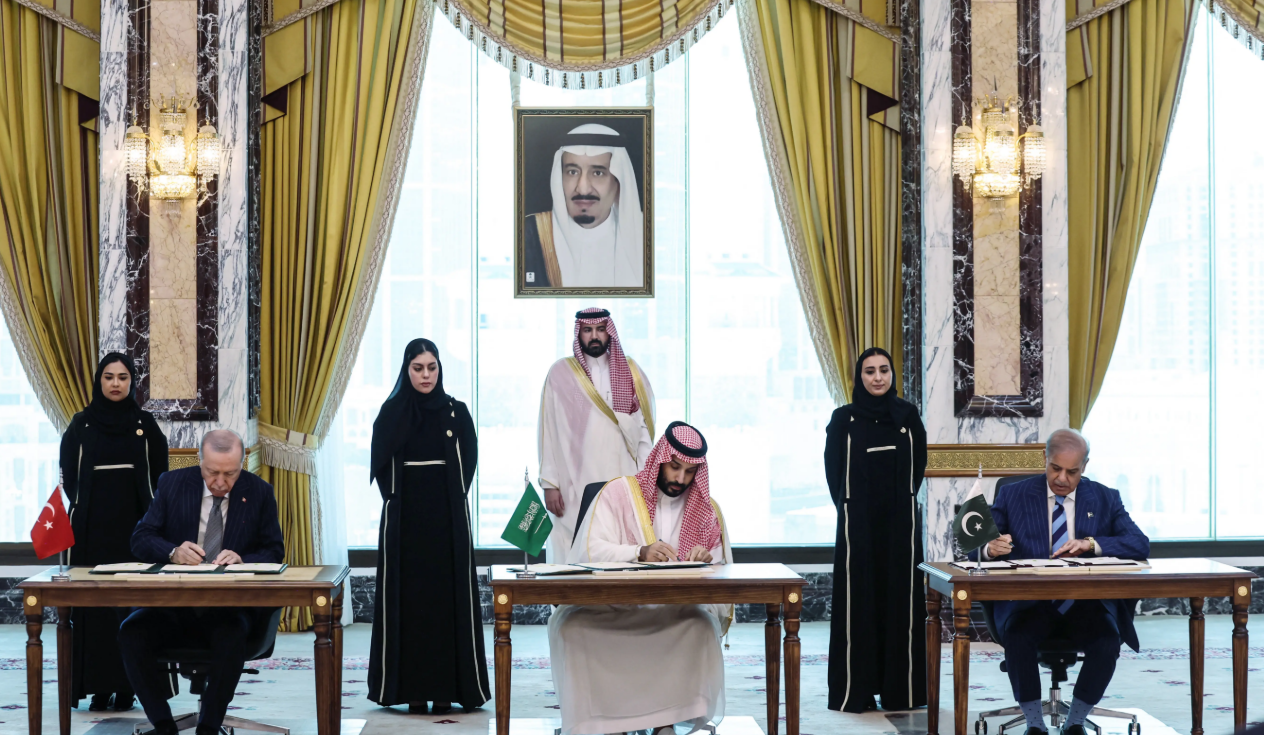
Turkish President Recep Tayyip Erdogan (L), Saudi Crown Prince Mohammed bin Salman (C) and Pakistani Prime Minister Shehbaz Sharif (R) sign a trilateral defense agreement in Mecca, Saudi Arabia, Aug 7, 2026. (Photo by Handout / Turkish Presidential Press Office)
Saudi Arabia, Turkey and Pakistan signed a joint defense agreement in Mecca on Aug. 7 under which an armed attack on any one of the three countries would count as an attack on all. The agreement means that the three countries intend to safeguard one another through a collective security pact, underscoring their lack of confidence in the United States as a security guarantor.
The Mecca Agreement is a product of a war that the U.S. and Israel started in late February. For decades, the Gulf states, led by Saudi Arabia, have largely outsourced their national security to the United States under an implicit “oil for security” arrangement. They assumed that American military bases in the region, together with the U.S. weapons purchased with their vast oil revenues, would be enough to keep them safe. But the conflict with Iran shattered their hopes.
A series of U.S. military bases in Saudi Arabia, Qatar and the United Arab Emirates came under Iranian missile attack, and the very bases that were supposed to protect the Gulf states also became the eye of the storm as the conflict widened. Some civilian facilities were caught in Iranian attacks as well.
The subsequent standoff between the United States and Iran over the Strait of Hormuz inflicted even greater economic losses on the Gulf states, which rely heavily on the strait to transport oil and gas. It exposed serious vulnerabilities and risks to their economic security. The presence of U.S. military bases in the Gulf, along with Washington’s Middle East security strategy, has now itself become a source of security risk in the region.
The Mecca Agreement also reflects the Gulf states’ determination to pursue strategic autonomy and reshape the regional security architecture. Because of the Israeli-Palestinian conflict, the sectarian tensions between Sunnis and Shiites and the strategic importance and abundant oil and gas resources of the region, the Middle East has long been a place prone to great-power intervention and conflict. With various regional security actors and competing security demands difficult to balance independently, and the U.S. security umbrella proving unreliable, Saudi Arabia and other Gulf states have been forced to explore a new security architecture and seek alternative paths.
Even before the U.S.-Israeli conflict with Iran erupted, Saudi Arabia and Pakistan had signed the Strategic Mutual Defense Agreement. That was in September last year. Under the agreement, an attack by a third party on either country would be regarded as aggression against both. With Turkey now joining the group, a trilateral collective security framework has formally taken shape—an effort by three major regional powers to lead the framing of a new regional security architecture, pursue autonomous security cooperation to ensure collective security and jointly respond to security threats.
The Mecca Agreement is open-ended, with other countries that share the same aspirations welcome to join in the future. The three regional powers, Saudi Arabia, Turkey and Pakistan, each bring distinct advantages in defense resources. Saudi Arabia has economic clout, abundant oil and gas resources, and considerable influence in the Gulf. Turkey is not only a NATO member but also has a powerful military and advanced military technology, particularly in drones. Pakistan, meanwhile, possesses a crucial nuclear deterrent capability not possessed by the other two.
After Saudi Arabia and Pakistan signed their mutual defense agreement, Pakistani Air Force units were deployed to a Saudi air base in April. In July, Kuwait also approved a defense-cooperation agreement with Pakistan, creating a Saudi-Kuwait-Pakistan defense triangle. Whether Kuwait, the United Arab Emirates and other countries will join the Mecca Agreement remains to be seen.
In short, the U.S.-Israeli war against Iran has failed to produce the Middle East security order they sought, but has instead spurred the emergence of a new security architecture in the Gulf. Media in India have even hailed the birth of an “Islamic NATO,” arguing that the three largest and most influential Islamic countries have come together at this historic moment to form a military bloc.
Of course, how far the Mecca Agreement will go and whether it can truly serve as a framework for collective defense in the Gulf remains to be tested.
