
The chaotic conditions created by the U.S./Israeli war against Iran are now in an escalatory phase. The reverberations will be severe worldwide.
(This is an updated version of an interview with Dr. Steinbock by Espresso, a leading Portuguese newspaper.)
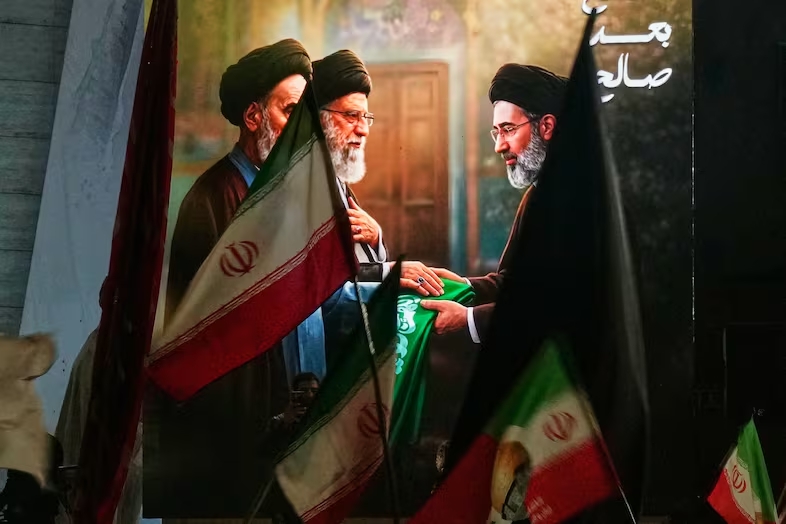
Protesters wave Iranian flags and hold a portrait of the late Iran's Supreme Leader Ayatollah Ali Khamenei and his son Ayatollah Mojtaba Khamenei to support his selection as the new Iran's Supreme Leader in Baghdad, March 9, 2026. (Photo: Hadi Mizban / AP)
Espresso: U.S. President Donald Trump is scheduled to visit Beijing for a high-stakes summit with Chinese President Xi Jinping at the turn of April. Will the trade talks be threatened by the Middle East War?
Dr. Steinbock: By destabilizing the entire region, the U.S./Israeli War poses a risk not only to China, but the entire world, particularly to the energy importers in the Global South.
Despite its current energy sufficiency, this crisis poses huge risks to the US as well, due to elevated energy prices, the likely return of stagflation, the billion-dollar daily bill for the attacks and rapidly-rising debt.
Ironically, the Iran war may strengthen Beijing's bargaining position in the trade talks. China may seek to leverage its response to the U.S. strikes to secure a more durable truce.
Divergent goals
Espresso: China is sending a special envoy Zhai Jun to the Middle East to de-escalate the situation. Is Operation Epic Fury, as it is known in the U.S., intended to continue until the objectives defined by Trump and Israel regarding Iran are achieved?
China's envoy will seek a path to de-escalation. This has long been the consistent Chinese stance. But the U.S. stance, and certainly the view of Prime Minister Netanyahu, suggests that hostilities will prevail until Iran's military capacity is dismantled or the regime capitulates. After all, the two began the war when the peace talks in Oman were about to succeed.
Neither President Trump nor the Israeli government have clearly stated the objectives for their massive attacks. Furthermore, their strategic objectives are divergent. The US administration’s objective seems to be to dismantle the Iranian leadership and gain control of Iran’s massive untapped energy reserves. Whereas PM Netanyahu has long sought to fragment Iran as a nation.
Operation Epic Mistake?
Operation Epic Fury is Israel’s "Operation Roaring Lion" disguised. It reflects the interests of the Netanyahu government, which has a rationale for the endgame. By contrast, the U.S. administration has alienated most Americans and even its MAGA base. This is why Iran’s leaders call the U.S./Israeli operation “the Epic Mistake.”
As evidenced by thousands of deaths and tens of thousands of injured in Iran and hundreds of thousands of displaced in Lebanon, Israel seeks to use the opportunity to extend its obliteration doctrine - one that I describe in The Obliteration Doctrine (2025) – from Gaza and South Lebanon to Iran.
The U.S./Israeli strikes violate Article 2(4) of the UN Charter, which prohibits the use of force against the territorial integrity of another state. According to Amir Saeid Iravani, Iran's ambassador, US/Israeli airstrikes have destroyed or damaged nearly 10,000 civilian locations, including homes, schools, and healthcare facilities. Such deliberate targeting of civilians and civilian infrastructure represents a gross violation of international law and war crimes.
Meanwhile in the fog of the war, terror reigns in Gaza against Palestinians, while ethnic cleansing is deployed in the West Bank to create “new facts on the ground.”
Few short-term gains, huge long-term losses
Espresso: With the problems in the Strait of Hormuz and risks in the Red Sea, who will be the main beneficiaries of this energy crisis regarding critical supplies to China and Asia?
With the disruption in the Strait of Hormuz, the primary short-term beneficiaries may feature those energy exporters—Russia, the U.S., possibly Turkmenistan, Kazakhstan, and Australia—that can bypass Middle Eastern chokepoints through pipelines or alternative maritime routes.
In the long-term, all stakeholders will lose. There are no winners in trade wars, cold wars, and unwarranted hot wars. And this war against Iran could have far, far worse long-term implications than the proxy wars in Ukraine and Gaza. If President Trump presumed it would be Venezuela déjà vu, the awakening will be brutal.
Espresso: Is it still too early, as the IMF Managing Director says, to assess the impacts of this war on 2026 growth and inflation forecasts?
The early damage has already occurred. The long-term impact will depend on the conflict's duration and whether it escalates into a wider regional war. Unfortunately, the Pandora’s Box has now been opened. Things won’t get better until they get worse.
Dire but divergent impact on Asia
Espresso: Which regions or sectors in Asia are more fragile and likely to be most affected in terms of growth and inflation? Or are the fundamentals in Asia resilient to this shock, particularly in China and ASEAN?
The year 2026 will likely see increasing economic divergence in Asia. Technology-driven economies could remain resilient. Those reliant on traditional manufacturing face intense competition and trade policy pressures. In turn, commodity-dependent economies reliant on oil imports will be hit from all sides.
Thailand, Indonesia, and the Philippines are likely to underperform. Those countries with a "China+1" strategy (e.g., Vietnam, Malaysia, Thailand) cope with new risks and higher operating costs. Export-dependent advanced manufacturing economies such as Taiwan, Singapore, Korea, and Malaysia could remain resilient, driven by AI-related demand, advanced electronics, and FDI.
Impact on China's prospects
The Iran shock poses an economic threat to China, primarily through a surge in oil prices. Beijing imports 90% of Iran's crude and 50% of its total energy from the Middle East. With the disrupted routes in the Strait of Hormuz, the conflict is forcing higher shipping costs.
But unlike the West, China has also long prepared for the Iran crisis. To a degree, its large oil stockpiles and shift to electric vehicles can help insulate the economy from supply disruptions.
Espresso: Can China maintain the political goal of a growth of 4.5-5% for 2026? Will the dynamics of its internal market accommodate the problems in imports and exports?
The internal market's ability to accommodate or offset trade problems is the primary economic challenge for 2026. Amid a long property slump, it faces elevated trade headwinds (US tensions, Iran war), cautious consumption, structural rebalancing toward high-tech (AI, green energy) and services.
A longer global energy crisis would pose a global challenge. The longer this war is allowed to continue, the more the future prospects of all major economies will be penalized.
Severe hits in Asian markets
Espresso: In the exchange markets, Asia was the most 'injured' last week with a collapse particularly at Seoul and significant lows in Tokio. Thailand and Taiwan. The Asia Pacific MSCI index has fallen some 7% since the end of February, more than twice the global world index. Why?
The sharp decline is driven mainly by a perfect storm of regional energy dependencies and a sudden reversal in technology sector momentum. As the U.S./Israel Iran attack led to the closure of the Strait of Hormuz, the skies darkened in Asia. South Korea, Japan, and Thailand import nearly all their crude oil and natural gas through this chokepoint.
Global shipping traffic through the region has already dropped by 70%–90%. A full month of closure would exhaust "just-in-time" inventories for electronics and automotive sectors in Asia and Europe.
While Brent prices peaked near $120 on Monday, March 9 - the largest surge in a single week in modern records - they have since moderated slightly, hoping for the release of emergency reserve releases (which the International Energy Agency has proposed). Yet, prices remain highly sensitive to the ongoing war.
In a worse-case scenario, Brent crude hits $100 per barrel, which would raise global headline inflation by 0.7 percentage points. Under current conditions, global GDP growth would suffer a 0.1 to 0.2 percentage point drag.
What happens in Asia won't stay in Asia
Espresso: What could be the combined effect of this Middle East war with the new global 10% tariff framework (possibly 15% still this year)?
The combined effect of the Middle East conflict and a global 10–15% tariff framework could morph into a highly damaging supply shock at the worst historical moment. In a geopolitical and trade "dual shock," inflationary pressures and growth stagnation hit simultaneously from two different directions. The longer the duration of the crisis, the more corrosive the stagflation impact would be.
Worse, what happens in Asia won't stay there. Since emerging economies in Asia account for some 60% of global growth, anything that undermines their economic expansion will penalize the already-dire global prospects.
