
Du Lang, Research Assistant of the Centre on Contemporary China and the World, HKU
Mallie Prytherch, Manager of Research Affairs, Centre on Contemporary China and the World, University of Hong Kong
Oct 13, 2026
Over the past century, the legal and social status of women in China has undergone a remarkable transformation. In 1949, an estimated 10 percent of women could read—today, women make up more than half of higher education and graduate school enrollments, a gender gap that has essentially closed within three generations. In terms of representation in the leadership, however, progress has been uneven.
Li Cheng, Professor of Political Science and Director of the Centre on Contemporary China and the World, HKU
Du Lang, Research Assistant of the Centre on Contemporary China and the World, HKU
Sep 03, 2026
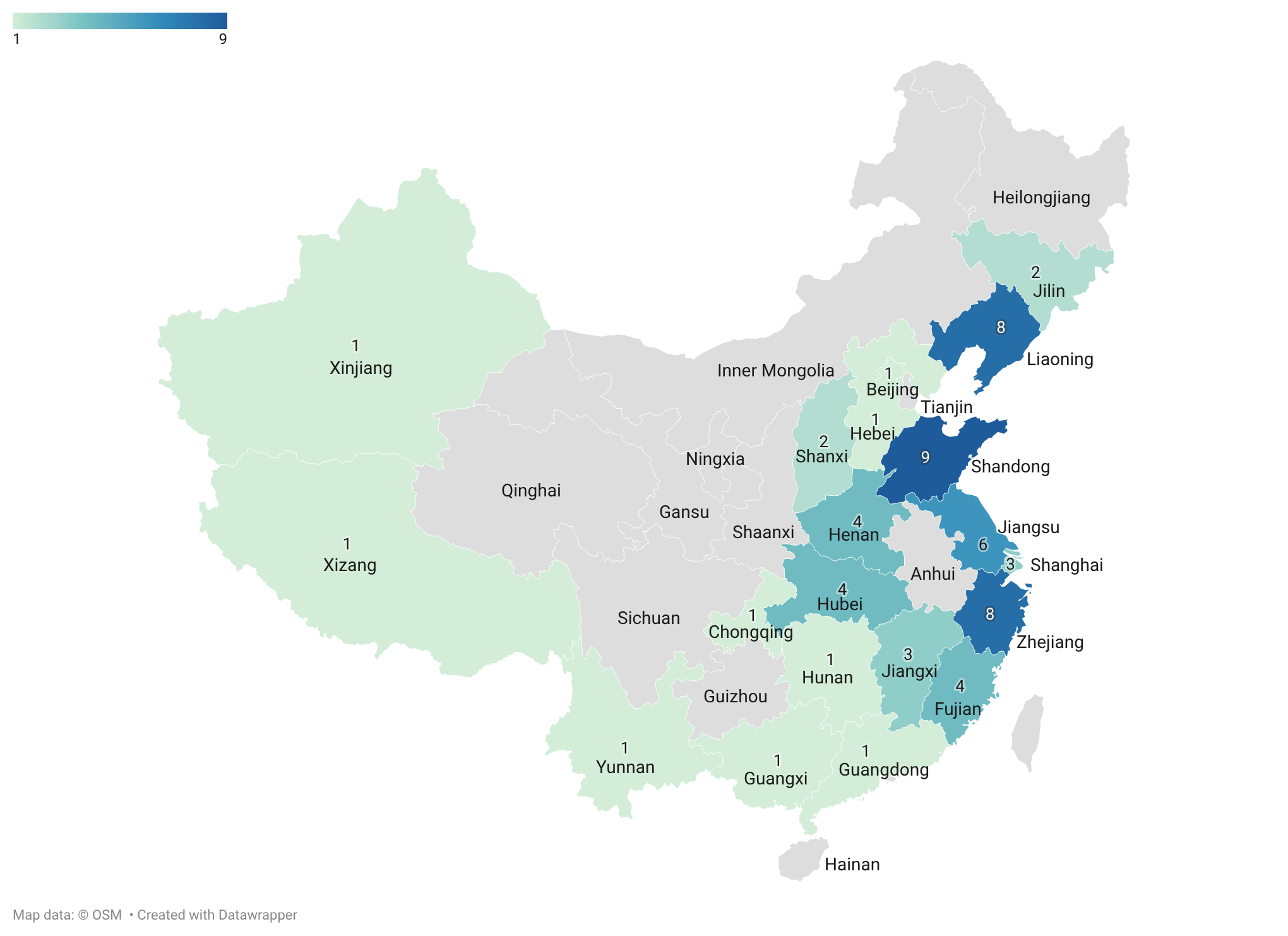
“All politics,” as the familiar English saying goes, “is local.” For Chinese political elites, however, locality carries two distinct meanings: the jurisdiction in which political authority is exercised, and the geographic origins of the political elites who exercise it. In contemporary China, the frequent gap between where officials are from and where they serve has long drawn public and scholarly interest. Two main questions are commonly raised: How often do officials’ places of origin overlap with the jurisdictions in which they serve? And how is regional origin distributed across the national leadership?
Li Cheng, Professor of Political Science and Director of the Centre on Contemporary China and the World, HKU
Du Lang, Research Assistant of the Centre on Contemporary China and the World, HKU
Aug 20, 2026
Observers of Chinese elite politics routinely prioritize Beijing as the primary focus of analysis, searching for clues about leadership changes in the limited information coming from the center. Yet critical insights worthy of attention are not exclusively concentrated in Zhongnanhai. A substantial share of early indicators often initially emerges within the leaderships of China’s 31 provincial-level administrations.
Sourabh Gupta, Senior Fellow, Institute for China-America Studies
Dec 14, 2022
China’s market reforms and economic restrictions have transformed its economy into a more capitalistic state since 1979. What can it do to ensure equality as costs of living rise and income disparity becomes more pronounced?
Lucio Blanco Pitlo III, Member of Board of Directors, Philippine Association for Chinese Studies
Nov 09, 2022
The 20th Party Congress of the Communist Party of China recently concluded, and with Xi Jinping entering his third term with a Politburo Standing Committee of allies, the stage is set for coherent leadership over the next five years.
Zhong Yin, Research Professor, Research Institute of Global Chinese and Area Studies, Beijing Language and Culture University
Oct 25, 2022
As China grows stronger, its approach to the world will naturally shift to cope with new conditions and challenges. President Xi Jinping’s report to the 20th Party Congress illuminates China’s diplomatic stance in the new era. He set the direction for China’s foreign policy development in the years ahead.
Xu Hongcai, Deputy Director, Economic Policy Commission
Oct 25, 2022
After the 20th Party Congress, relations with the U.S., Europe and Japan are likely to improve, as China continues to pursue high-quality development and the integration of domestic demand with supply-side structural reforms.
Li Cheng, Professor of Political Science and Director of the Centre on Contemporary China and the World, HKU
Oct 23, 2022
“Upper echelon strategists,” a term coined in some quarters of the Chinese political establishment, support Xi Jinping by playing an increasingly key role in China’s strategic thinking, ideological discourse, and propaganda work. And as some top scholar-officials move to the center stage in propaganda and ideological work during Xi’s third term, one can expect that “upper echelon strategists” like them will gain more influence in the years to come.
Li Cheng, Professor of Political Science and Director of the Centre on Contemporary China and the World, HKU
Oct 14, 2022
Chinese think tanks have far-reaching influence – their scholars serve as researchers and disseminators of state-approved information, and their leaders are also assuming positions of power in the Party. Xi Jinping has relied on think tanks more than his predecessors, and they deserve a closer look.
Li Cheng, Professor of Political Science and Director of the Centre on Contemporary China and the World, HKU
Oct 10, 2022
A significant portion of senior officers of the People’s Liberation Army has been trained in Russia. As the relationship between China and U.S.-led NATO countries continues to deteriorate, an examination of Russian-educated military elites within the Chinese leadership is critically important.
Back to Top

- China-US Focus builds trust and understanding between the U.S. and China through open dialogue among thought leaders.