
How Europe uses the electoral outcome will determine the shape of diplomacy with Washington. If Europe slows its efforts to build its capabilities, the same anxieties will return when Washington changes course again sometime in the future—as it surely will.
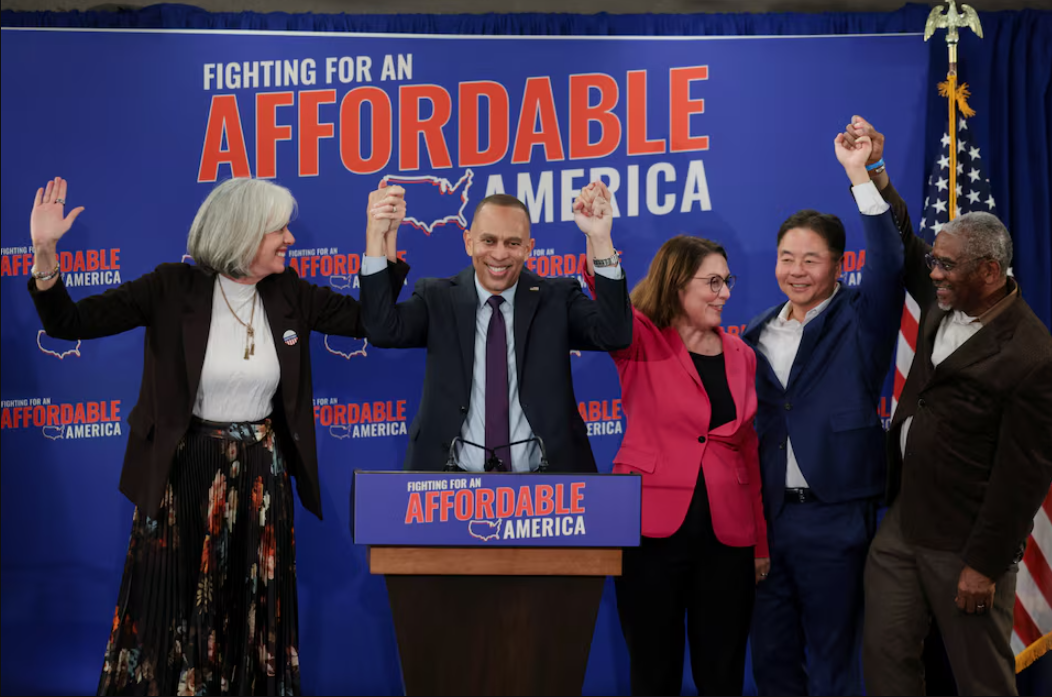
U.S. House Democratic Leader Hakeem Jeffries, House Minority Whip Katherine Clark (D-MA), and Democratic candidate for House of Representatives Suzan DelBene celebrate at a Democratic Congressional Campaign Committee (DCCC) midterm election night watch party as election results point toward Democrats regaining control of the US House of Representatives, in Washington, DC, U.S, November 3, 2026. (Photo: REUTERS/Jonathan Ernst)
My flight touched down in Brussels on Nov. 4, just as the results of the U.S. midterm elections were becoming clear. As soon as my phone reconnected to the network, notifications began arriving one after another: The Democrats had retaken both the House and the Senate and swept other races all across the country.
In the heart of the European Union, the Europeans I met all breathed a sigh of relief and felt a little more hopeful about the future of transatlantic relations. Some even felt that the post-Trump era had arrived two years early.
The mood was understandable. After tariff shocks, disagreements over Ukraine and repeated shifts in U.S. security commitments, Europe is eager to find reliable sources of support in Washington again. In its post-election statement, the European Parliament’s Renew Europe Group called on the new Congress to act as a counterweight to the White House and promote a more constructive relationship.
The midterms have indeed given Europe some grounds for hope. Atlanticism rests on a sustained U.S. willingness to invest in European security and on Europe’s belief that cooperation can survive changes in U.S. partisan power. The Democrats’ congressional majority has opened new opportunities for Europe to influence U.S. policy. Whether it can turn those opportunities into stable cooperation will depend on how much both sides are prepared to commit to the effort.
Positive changes are most likely in the security sphere. Once Democrats control the relevant committees, they can subject Donald Trump’s changes in U.S. troop deployments in Europe, the U.S. commitment to NATO and defense cooperation in general to closer congressional scrutiny. They can push the administration to explain the reasons for withdrawals and the implications for allies.
Support for preserving NATO has persisted within the United States. In April, senators from both parties issued a joint statement supporting the U.S. military presence in Europe and assistance to Ukraine. The new Congress has an opportunity to give those voices greater weight.
Developments on Ukraine warrant particular attention. Europe hopes the Democrats will advance new funding for Ukraine and sanctions against Russia, while raising the political cost for Trump of bypassing Europe to reach a separate arrangement with Russia.
Europe’s concerns about a peace plan center on security guarantees after a cease-fire and whether Europe itself will have a say in shaping the outcome. At its October meeting, the European Council again stressed Europe’s role in a future peace settlement and expressed regret over the U.S. decision to temporarily lift sanctions on Russian diesel. Such differences increase Europe’s need for supporters in Congress.
There is also room for an easing of trade and economic tensions. What European businesses want most is relief from the operating costs imposed by tariffs and policy reversals. The current U.S.-EU trade arrangement sets a 15 percent tariff ceiling for most EU goods exported to the United States, and both sides are still seeking further tariff reductions and broader cooperation. Democrats can use hearings, legislation and oversight of the administration to draw attention to the costs that pressure on Europe imposes on American consumers and businesses. On artificial intelligence, platform accountability and cybersecurity, Europe may also now find more members of Congress willing to discuss cooperation.
Europe is likely to place greater emphasis on engagement with Congress. Over the past two years, European leaders have devoted considerable effort to managing their relationships with Trump himself. They will now seek support more frequently from congressional committees overseeing foreign policy, defense and appropriations. Europe can encourage lawmakers to translate support in principle into concrete requirements, such as consultation procedures before changes in troop deployments, reporting obligations on aid implementation and funding for key joint projects. This would give Europe a better chance of limiting the disruption caused by abrupt policy shifts in the White House.
Europe already has channels for such engagement. In August, members of the European Parliament and the U.S. Congress met in San Francisco for the Transatlantic Legislators’ Dialogue, covering technology, security and trade. Mechanisms like this can help Europe gain an earlier understanding of U.S. legislative developments and bring its concerns into the policymaking process. But Europe also needs to engage newly elected members of Congress and explain clearly how European investment relates to local jobs and business interests. For lawmakers elected primarily on bread-and-butter issues, a long history of friendship is far less tangible than jobs in their constituencies.
This also requires Europe to maintain ties across party lines. Republicans who support NATO and European security remain worth cultivating, and communication with the White House must continue. If Europe casts its cooperation with the new Congress as a united front against the president, Trump could come to view it as an extension of his domestic opposition. Ultimately, Europe seeks to influence U.S. government policy, and Congress is only one avenue for doing so.
The limits of this approach are equally clear. The new Congress will not take office until January, and Trump will retain executive power and the initiative in foreign policy. He can veto legislation he opposes, and overriding a presidential veto requires a two-thirds vote in each chamber. Democrats will still need the support of a substantial number of Republicans to push through policy changes over presidential opposition. Meanwhile, efforts to lower living costs, investigate the administration and prepare for the 2028 election cycle are likely to absorb more of the Democrats’ political resources than repairing relations with Europe.
Even when legislation passes, implementation remains a hurdle. Over the past two years, the White House’s withholding or rescinding of funds already approved by Congress has generated a steady stream of controversy. An October analysis by the European Council on Foreign Relations cautioned that Europe should judge the reliability of U.S. commitments by money actually disbursed. For Ukraine, congressional approval of aid, authorization by the executive branch and the eventual delivery of weapons are separate stages. Europe must factor potential delays between those stages into its planning.
The more difficult problem is that setbacks at home may lead Trump to devote more attention to foreign policy. He needs results that show he is still in control, and negotiations over Ukraine, engagement with Russia and trade arrangements could all become opportunities to claim political success. Europe could get caught up in the confrontation between the White House and Congress. A narrowing of the president’s domestic space for maneuver may not bring the policy restraint Europe hopes for.
The Democrats’ policy choices are also constrained by domestic interests. A poll released by the Council on Foreign Relations in October found that 53 percent of respondents regarded the EU as a fair trading partner, but only 23 percent supported the next president removing all tariffs on the EU. These figures show that Americans can value Europe as a partner while supporting the retention of trade barriers. As the Democrats respond to pressure over manufacturing, jobs and cost of living, they will still have to negotiate competing interests with Europe on industrial subsidies, public procurement and market access.
The shift toward greater European responsibility for security will also be hard to reverse. The bipartisan statement supporting NATO also endorsed calls for Europe to increase defense spending. Views of the alliance’s value differ across the U.S. political spectrum, but there is broad support for requiring Europe to spend more and do more. Europe has a better chance of negotiating the pace and form of that shift such that the United States maintains crucial support while Europe buys time to close its capability gaps.
More troubling is that efforts to repair U.S.-Europe relations increasingly depend on a joint approach to China. Democrats tend to place greater emphasis on coordination with allies, and the bipartisan consensus on competition with China could give that coordination further momentum. For Europe, closer coordination on China in exchange for U.S. security support would bring new economic and diplomatic costs. If Europe wants greater autonomy, it must retain the ability to judge different issues according to its own interests. Tying an improvement in relations with Washington to wholesale alignment with U.S. policy on China would only restrict Europe’s own choices.
The next two years are therefore more likely to bring improvements in some areas of transatlantic relations alongside recurring friction. Congress can provide greater support for security cooperation, impose more constraints on executive decisions and make Europe’s voice easier to hear in Washington. Deeper mutual trust will have to be rebuilt through policies that are consistently put into practice. Whether aid commitments to Ukraine are fulfilled, changes in troop deployments are discussed in advance or trade disputes are handled through negotiation will be more telling.
How Europe uses this period will also shape the prospects for Atlanticism. Continuing to advance joint procurement, defense production and the development of critical capabilities can give Europe greater confidence in negotiations with the United States and put alliance cooperation on a firmer footing. If Europe slows its efforts to build its capabilities whenever the political mood in the United States improves, the same anxieties will return when Washington next changes course.
