Trump’s high-stakes visit to China against a backdrop of conflict with Iran and economic tit-for-tat exchanges have made those issues the central focus for observers, but the shift in the U.S. President’s tone on Taiwan’s defense may be just as consequential as any deal that emerges.
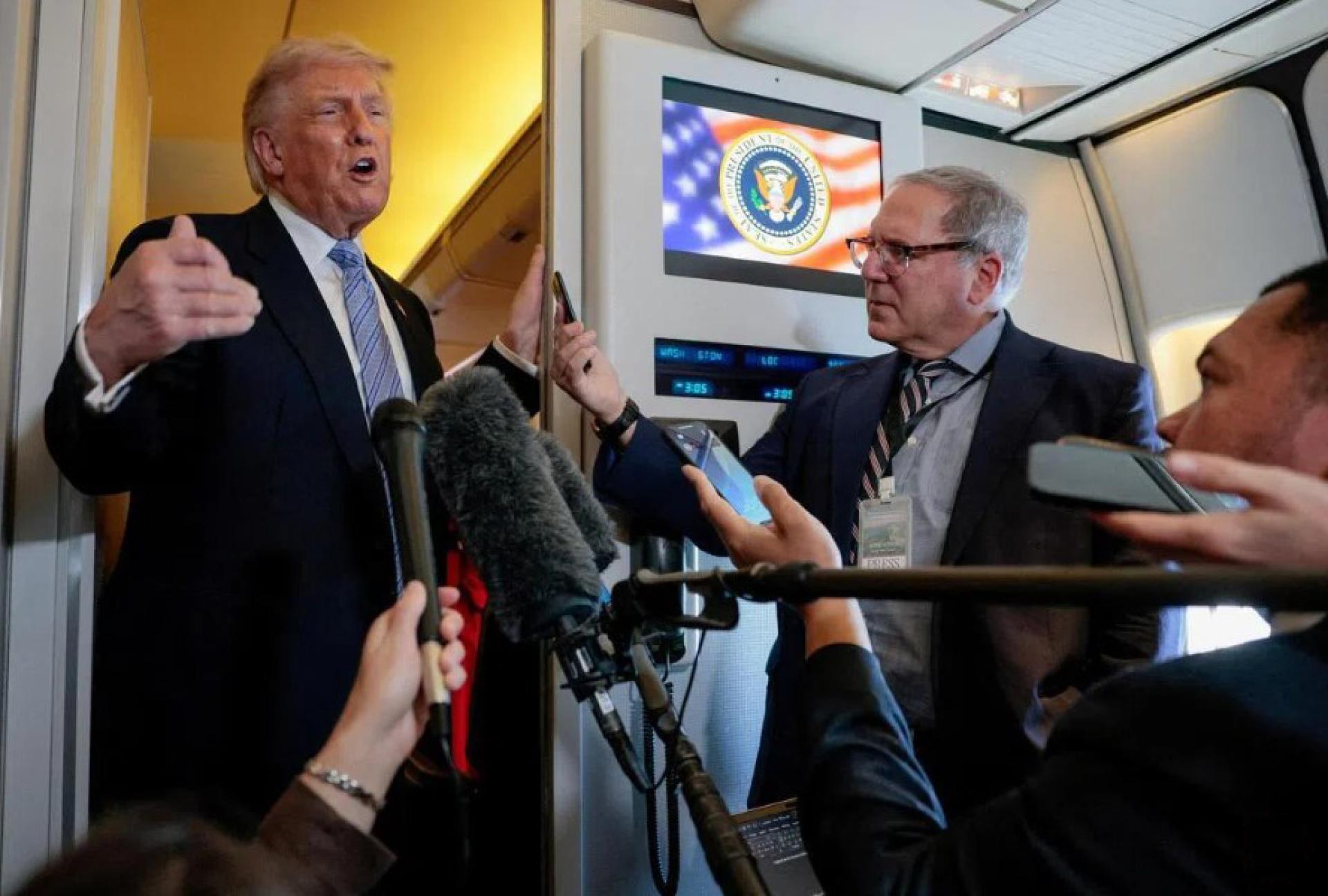
U.S. President Trump told reporters on Air Force One that he had discussed the weapons package with China’s President Xi Jinping during their summit in Beijing.
In 313 BCE, Zhang Yi arrived at the court of Chu with a tidy offer for a vain king: abandon your ally Qi, and Qin will give you six hundred li of land. King Huai took the bait, severed the alliance, and sent officials to collect. Zhang Yi then clarified the number had been six, not six hundred. The king had mistaken promise for payment, while his alliance was already dead.
The 13-15 May 2026 U.S.-China summit followed a related logic of power. The currency had changed (aircraft orders, soybean purchases, market-access gestures, photo-ops) but the structure of the trick had not. In Beijing’s most secluded compound, Donald Trump turned to Xi Jinping and asked: “Do you bring others too?” King Huai could not have phrased it better.
Trump arrived in China needing proof that his foreign-policy formula, tariffs plus personal charisma plus transactional bravado, framed earlier in this outlet as “realpolitik on steroids,” could deliver visible wins. He also came amid war, with the confrontation with Iran still unresolved, and desired a diplomatic success to offset it.
Xi gave Trump enough paper to wave, enough ceremony to claim victory, and enough commercially legible gestures to dominate a news cycle. Trump returned home selling tribute from Xi: “Historic Deals.” Yet the exchange was cheaper than it looked. Earlier American presidents used ceremony as the wrapping around hard bargaining; Trump treated ceremony as part of the bargain itself.
In return, China bought space. Beijing entered the summit more confident than most analysts had assumed, and once the outcomes were confirmed, it turned out to have been right. The Chinese readout described Taiwan as “the most important issue in China-U.S. relations” and warned that mishandling it could produce “clashes and even conflicts.”
Wang Yi called for a “constructive China-U.S. relationship of strategic stability,” a formula to keep commercial channels open, manage rivalry between the two poles, and place Taiwan inside China’s red-line system rather than inside America’s deterrent perimeter.
According to Trump, Xi asked whether the U.S. would defend Taiwan. Trump answered: “I don’t talk about that.” Pressed on whether Xi had enquired about sending troops, Trump reformulated: “He asked me if I defend them.”
On a scale of diplomatic outcomes, China’s worst nightmare would have been Trump publicly repudiating the one-China policy. Its best case would be Washington signaling that it might stand aside if Beijing forced “Chinese reunification.”
What actually happened right after the visit fell closer to the second option than anyone in Beijing had ever seriously expected, or anyone in Taipei can afford to accept. Beijing received the clearest signal in decades that Taiwan can be treated as a negotiable item inside a broader bargain with Washington.
Taiwan, formally the Republic of China, sits at the core of the Communist Party’s sovereignty claim: unfinished business folded into the regime’s timetable, with 2049 looming as the centenary by which Beijing wants the island under its control as part of “great rejuvenation.” Taking Taiwan would place the world’s semiconductor chokepoint under their command and strengthen Beijing’s military position across the first island chain and the South China Sea. It would also shake confidence in Washington from Manila, Tokyo, Seoul, and Canberra, where American commitment anchors national defence planning.
Across conversations in Taiwan, one conviction surfaced with unusual consistency from American and European diplomats, Taiwanese representatives across the political spectrum, and Western observers: our mission is to make China believe that an attack would be catastrophic. That is the practical content of deterrence, a psychological fact that has to be planted inside the adversary’s planning before any crisis begins.
Trump’s remarks placed an explosive charge at the center of that enduring effort when he told he was “not looking to have somebody go independent,” asked whether America was supposed to travel 9,500 miles to fight a war, called Taiwan “a place that nobody knows how to define,” and described China as “very, very powerful.” In one sequence, he handed Beijing the storyline it has spent years trying to put in Washington’s mouth. Essentially, he reduced the island to a geography problem: China is powerful, America is far, Taiwan is small.
Specifically, American “strategic ambiguity,” imprecise by design for almost five decades, was built to deter Chinese military action without committing Washington to war. Trump has somehow invited us to wonder whether Washington has already begun to price Taiwan against other assets. Indeed, he left Taiwan’s largest pending arms package, worth around $14 billion, hanging in the air; perhaps conditioned on Beijing’s weapons supply to Iran. Once missiles migrate from deterrence into deal-making, they cease to deter.
Taiwan is a self-governing democracy of 23 million people, with its own constitution and is the world’s most consequential chip node. It is also trapped inside a perverse diplomatic architecture requiring Taipei to perform permanent calm. No Western power, not a single one, formally recognizes Taiwan as a sovereign state. The U.S., the EU, and every major Western government remain publicly bound to the one-China policy; there is only one China, and that one is the People’s Republic.
Western governments speak of Taiwanese rights that their own policies don’t even formally recognize. That duplicity gives Beijing its opening, casting Western language as geopolitical pressure, then answering it with a vocabulary borrowed from Washington itself. Xi absorbed Allison’s “Thucydides Trap” and recast it as Zhongnanhai’s preferred frame. In Chinese usage, it carries two claims at once: China must be treated as America’s peer, and Taiwan is the fault line on which Sparta may strike Athens if Athens misreads the boundary. Formal or informal, Trump’s appetite for a G-2 gives that claim an American blessing.
This is precisely the raw form of orbital bipolarity, two powers, the U.S. and China, large enough in economic weight, military reach, and technological capacity to pull everyone else into their orbits. Those caught inside the magnetic field keep bargaining, while absorbing the consequences of deals struck by the two poles. Taiwan has less room for manoeuvre than ordinary secondary states, because its existence sits at once inside Beijing’s sovereignty claim and Washington’s position on China.
This is where Trump’s distance argument reveals the broader geopolitical backdrop. Washington does not stare across the Pacific from “9,500 miles” of empty water. It has bases, ports, airfields, treaty allies, forward-deployed forces, and command structures distributed across the Western Pacific. It happens to be the same country that projects force into Hormuz, who claims that Taiwan’s problem is mileage. Every ally from Tokyo to Warsaw read that verdict as a test of whether American commitments stand.
Meanwhile, Beijing has spent years proving that pressure can alter the status quo without forcing an American president into a clean choice between war and retreat. Tightening the ring around Taiwan has worked perhaps because it never crossed the threshold that would compel Washington to act. After the summit, that threshold has been revised: when the American president describes Taiwan as far away, small, undefined, and inconvenient, the reason for Beijing to stop pressing vanishes.
Three outcomes might follow from this historic G-2: the status quo is thinned, the perimeter is squeezed, or deterrence is repaired. The first two depend on how far Beijing believes the threshold has moved; the third depends on whether Washington decides to push it back.
The first is attritional accommodation. Trump keeps banking commercial packages as Chinese concessions, Beijing offers enough to keep the relationship from breaking, and Taiwan pays the price through a thinner status quo. The route to “reunification” would pass through the steady reduction of Taiwan’s autonomy without triggering a crisis.
The second is coercive compression. Beijing reads the new American posture as a rare opening and begins to test the perimeter, ultimately escalating through measures that blur the line between pressure and blockade. The test is whether Washington contests those new facts or absorbs them as another tolerable adjustment. The issue would no longer be whether China invades, but whether it can make Taiwan’s external life conditional on Beijing’s permission. Taiwan would be weakened with no dramatic landing on the beaches, and the threshold for “reunification” would move closer through repetition.
The third is deterrent repair. If Washington concludes that ambiguity has begun to read as permission, it would have to restore cost in visible form: arms at wartime speed, export-control discipline, and forward coordination with allies that amounts to more than the Western ritual declaration of “unwavering support.” This path would yield few television images and no signing-table ceremonies—which is why this White House may find it least attractive.
Zhang Yi grasped the ruthless simplicity of unequal bargaining: a ruler can lose before battle begins when he accepts the prize before fixing its terms. The commercial package will age fast; the premise Trump appeared to accept will endure: China is powerful, America is far, Taiwan is small. In Beijing, that sentence may travel from television into the machinery of state.
