
Donald Trump’s second-term foreign policy has accelerated the collapse of the postwar liberal international order by abandoning its institutions, norms, and sources of legitimacy. Economic integration is now widely used as a tool of coercion, placing middle powers in an unstable interregnum defined by great-power rivalry, forced alignment choices, and a widening contrast between U.S. unilateralism and China’s defense of globalization and multilateralism.
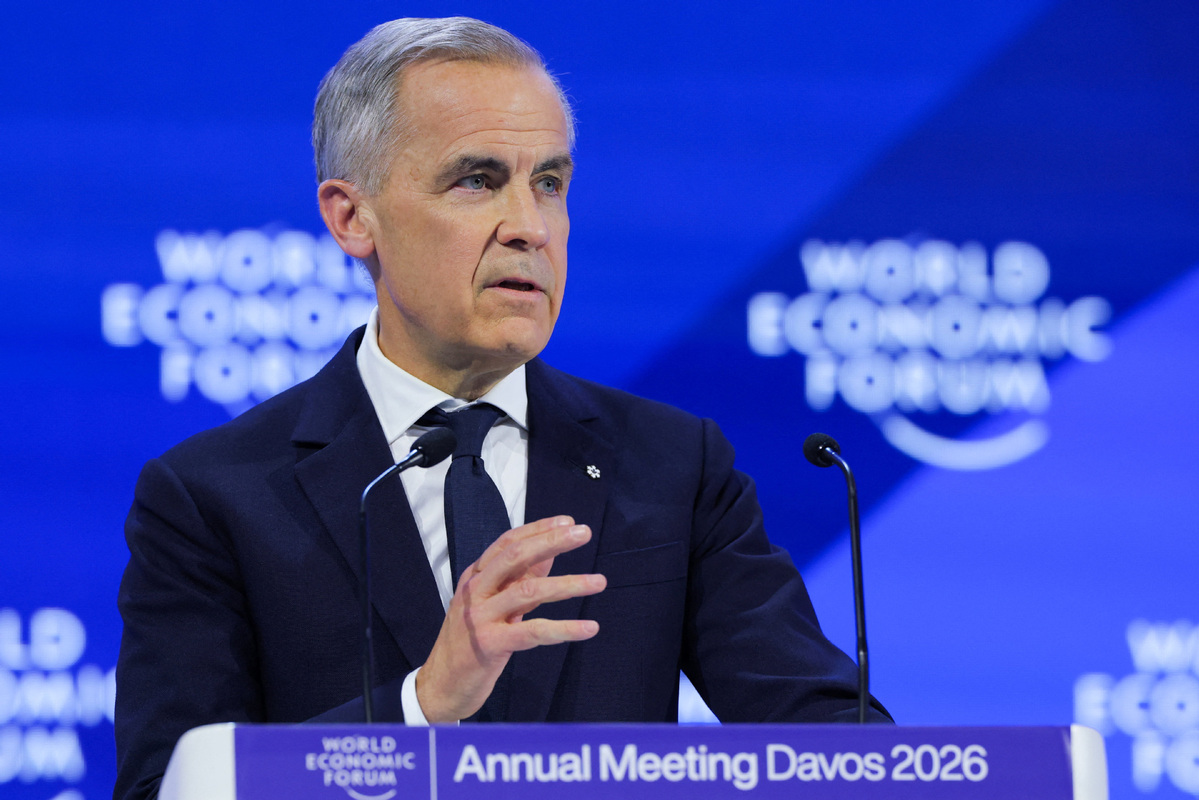
Canadian Prime Minister Mark Carney speaks during the 56th annual World Economic Forum (WEF) meeting in Davos, Switzerland, Jan 20, 2026.
During the first year of his second term, U.S. President Donald Trump fundamentally reoriented American foreign policy. He pulled the United States out of international organizations and agreements while focusing strategically on the Western Hemisphere, including military intervention in Venezuela and on-again and off-again threats to annex Greenland and Canada. Everything that seemed solid in the international order for over 75 years, its institutions, understandings, and alliances, are now starting to melt away.
No other than Canadian Prime Minister Mark Carney crisply captured this key moment in world history. During his speech at the World Economic Forum’s annual meeting in Davos, he put down a symbolic marker of when the so-called “rules-based liberal international order” crumbled. In Mr. Carney’s own words, the system dominant since World War II is in the “midst of a rupture” and is “not coming back.”
Mr. Carney called for honesty about the world as it is. In this respect, his most stunning telling of truth was: “We [Western leaders] knew the story of the international rules-based order was partially false. That the strongest would exempt themselves when convenient. That trade rules were enforced asymmetrically. And we knew that international law applied with varying rigour depending on the identity of the accused or the victim.”
In one fell swoop, Carney, the leader of one of the globe’s most liberal minded countries espousing a values-based foreign policy, took the West off its pedestal. His realist mindset casts aside much of the legitimacy Western governments enveloped themselves in to criticize others, especially in the global South. In fact, it must have sounded refreshing for developing countries to finally hear a Western leader “live in the truth.”
In comparison, U.S. President Trump’s speech, which followed Carney’s at Davos, is unlikely to be remembered as anything special. The most notable aspect was once more the rapid 180-degree reversals Trump managed just after opposite pronouncements on Greenland. Trump’s ire at Carney’s speech also was to be expected, since the Canadian clearly had stolen the show at Davos. But the American President should have welcomed Carney’s keen analysis of what a global “Donroe Doctrine” truly implies.
Prime Minister Carney made three pertinent arguments. First, the rules-based international order has ceased to function. Integration, once seen as a mutually beneficial road to the future, has now become a tool of leverage used by great powers. In his words: “Tariffs as leverage. Financial infrastructure as coercion. Supply chains as vulnerabilities to be exploited.”
What we are now living in is an era of intensifying great power rivalry. Powerful countries employ economic integration as a weapon of coercion. For middle powers and smaller countries, the very calculus of economic integration has thus flipped, since now integration can easily become a source of subordination.
Second, now that the vulnerabilities of global integration have been exposed, each country is seeking to develop greater strategic autonomy in sectors such as energy, food, medicines, critical minerals, finance, and key technology supply chains. But taken to an extreme, this would create a world of economic fortresses that will forego the immense efficiencies inherent in global production and innovation. As a result, everyone will be poorer and less secure.
Third, middle powers face a stark choice. They can attempt to curry favor with great powers, giving into subordination. Or they can group together because, as Carney put it, “if we're not at the table, we're on the menu.”
As great powers pursue their power and interests unhindered, Carney called on middle powers to act together in flexible coalitions. He even offered a pithy rationalization for economic cooperation in an era of securitized economics: “collective investments in resilience are cheaper than everyone building their own fortresses.” Carney plans to visit Australia soon.
And, as Carney further emphasized, the pursuit of national interest at the expense of any consideration of international rules, norms, and institutions creates its own risks. The most powerful form of legitimacy is rational-legal legitimacy, derived from a system of institutionalized laws and procedures that foster a collective belief in the fairness of major institutions. Rulers do not need to exert power directly with force; they can rely on widespread self-compliance by the citizenry.
In the international system, hegemons have similarly attempted to foster a sense of the legitimacy of international rules and norms, even if the hegemon sometimes puts itself above them. This is the very essence of the “rules-based liberal order” touted by the Biden administration as providing a bulwark against revisionist powers. But this legitimacy is vanishing fast. Trump has abandoned any pretense of traditional constraints in a quest for transactional gains. Ironically, this means that American geopolitical power will become ever harder to exert in the future. If no one buys into the benevolent nature of the international system, brute coercion on a global level becomes very costly.
Carney hopes that dense webs of connections across trade, investment, and culture among like-minded middle powers can tame the excesses of great powers. Such a new world order based on middle powers like Canada espousing similar values is a laudable project, but idealistic.
Antonio Gramsci’s famous conception of the interregnum comes to mind. The interregnum refers to a transitional period where an old established order collapses, but a new one has not yet successfully taken its place. "The crisis consists precisely in the fact that the old is dying and the new cannot be born; in this interregnum a great variety of morbid symptoms appear."
As the Trump administration pursues an exclusive sphere of influence in the Americas, restraints on other great powers vanish. We return to the law of the jungle. One great power will only be restrained by another, making a classical balance of power system the only means to sustain global institutions, integration, and communication.
Here China is beginning to take on an important global role. Perhaps this is less as an outright leader, and more as a necessary stabilizer. Chinese Vice Premier He Lifeng’s special address at the World Economic Forum in Davos defended globalization and multilateralism while warning against the rising tides of protectionism, trade wars, and fortress economies.
He starkly portrayed China as an anchor of stability that supported universally beneficial and inclusive economic globalization, arguing that China aims to be the "world's market," not just its factory. Every great power is likely to make arguments that are self-serving, but China’s fundamental attitude and outlook on the international system stands in stark contrast to that of America in this moment. Who is the revisionist power now?
