The U.S. kidnapping of President Maduro represents one of the worst violations of international law by a major power in decades. It also reflects the role of Venezuela as a battleground of U.S. and Chinese interests.
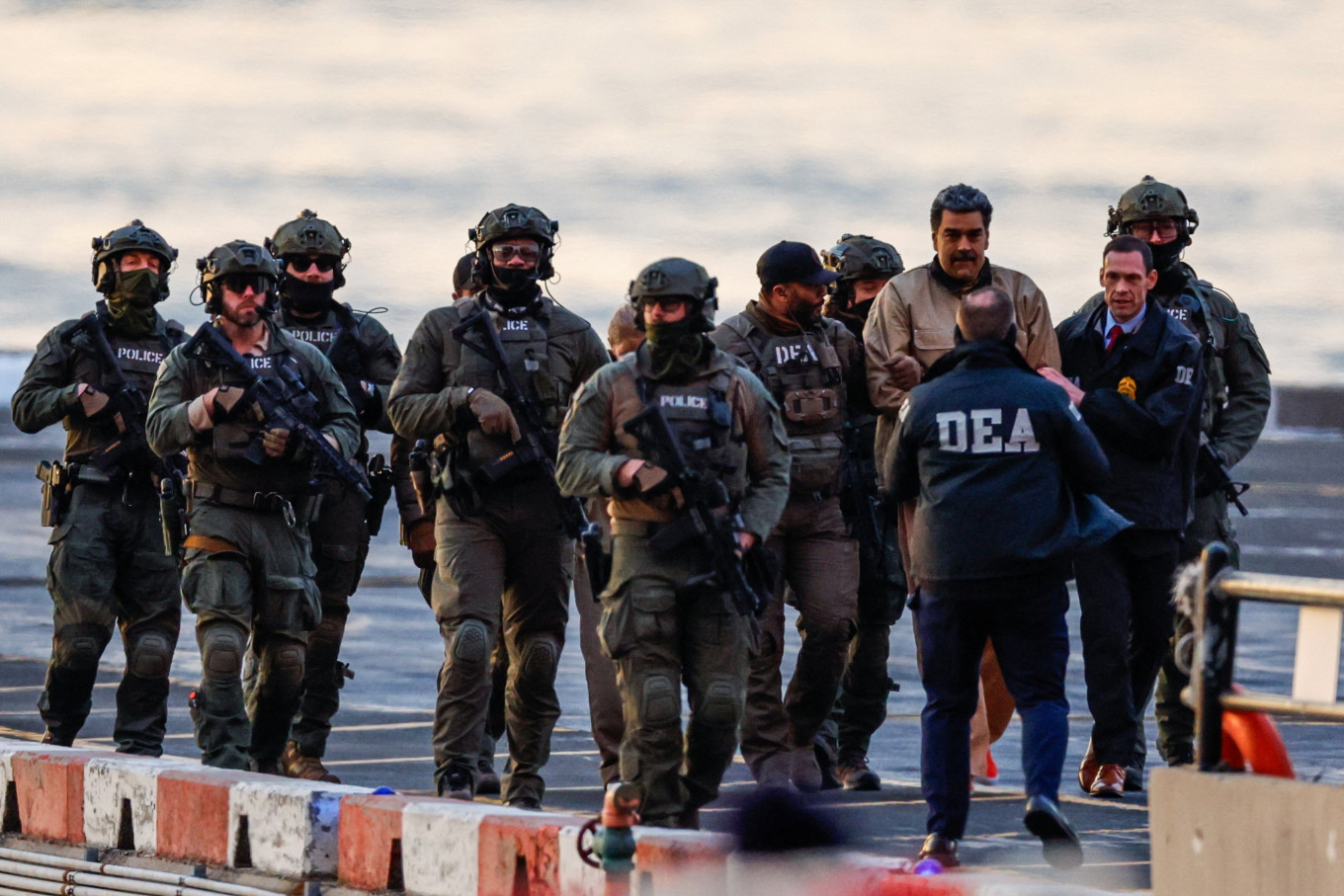
Captured Venezuelan President Nicolas Maduro arrives at the Downtown Manhattan Heliport, as he heads towards the Daniel Patrick Manhattan United States Courthouse for an initial appearance on January 5, 2026. (Reuters/Eduardo Munoz)
In the early hours of January 3, 2026, Venezuela’s President Maduro and his wife, Cilia Flores, were dragged from their bedroom and transported to New York. Having been months in-the-making behind the back of the U.S. Congress, the military raid involved more than 150 aircraft and drones, likely causing tens of deaths and far more injured.
Concurrently, the U.S. Department of Justice unsealed an indictment against Maduro and his wife on several serious narco-terrorism, cocaine and guns conspiracy charges.
In view of the Venezuelan government, it was an "imperialist attack." In view of the international community, it was widely condemned as a violation of international law, specifically the UN Charter, which prohibits the use of force against the territorial integrity or political independence of another state. Critics of the U.S. action, including the foreign ministries of China, France, Mexico, and Russia, have cited violations of key UN Charter principles.
Neither the regime change operation nor the charges could disguise the cold reality that, as President Trump acknowledged, what the U.S. really wants is to tap Venezuelan oil reserves.
U.S. effort to exploit untapped reserves
Venezuela has the world’s largest proven crude oil reserves with some 303 billion barrels, accounting for 17% of global reserves. Despite the sizable reserves, Caracas produced barely 0.8% of total global crude oil still in 2023.
Since the Venezuelan economy heavily relies on oil, U.S. sanctions have sought to undermine the efforts by the state oil company Petróleos de Venezuela SA (PDVSA) to fund government revenue.
However, thanks to eased sanctions by the Biden administration, there were some promising signs in the Venezuelan economy in the past year or two. Nonetheless, due to the escalatory measures by the U.S., Venezuela’s oil production has collapsed from over 3 million barrels per day (bpd) to around 1 million bpd or less, due to lack of investment, decaying infrastructure and mismanagement.
In the early 2020s, for the first time in a decade, Venezuela’s crude oil production increased, thanks to assistance from Iran and China National Petroleum Corporation (CNPC).
As a result of two decades of increasing economic coercion by the U.S. government and the escalation of maximum pressure by the Trump administrations, Venezuela's economy is today highly fragile. Hence, the timing of the attack.
It was fostered by the new U.S. national security strategy (NSS) legitimizing America’s greater control of the Western Hemisphere.
China as Caracas’ prime buyer
Prior to the U.S.-imposed sanctions on Venezuela, the U.S. was the largest importer of Venezuela’s crude oil. The heavy crude oil is well suited for U.S. refineries, particularly those along the Gulf Coast. Most of the remaining crude oil was destined for India, China, and Europe.
But since the 2019 sanctions, a significant portion of Venezuela’s crude oil exports has been part of oil-for-loans arrangements. As of 2023, China received 68% of Venezuela’s crude oil exports. Only 23% went to the U.S.
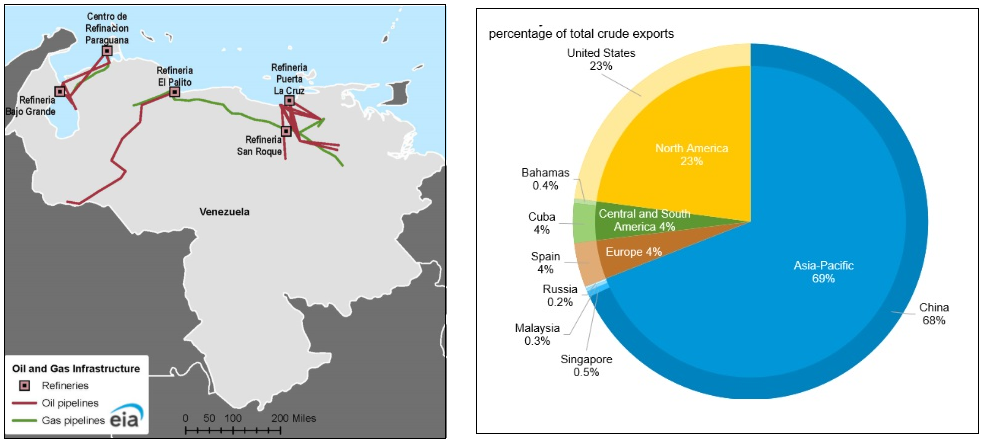
Venezuela’s crude oil exports by region and country, 2023 (Source: Data from EIA)
U.S. intervention in Venezuela is not only in line with its attempt to ensure privileged access to the country's energy for decades to come. It is also fueled by the effort to neutralize China's growing influence in the region, secure access to Venezuela's vast oil and critical mineral reserves, including rare earths.
Both powers see Venezuela's massive energy resources and strategic location as crucial to global power dynamics. The difference is that China has been willing to play by the rules of the international law, which the US administrations have violated with unilateral sanctions and the Trump administration chose to undermine.
The U.S. rogue raid took the prior bilateral friction in Panama to another, far more violent magnitude.
The perception of conflicting interests
U.S. intervention was defined by several interests. A primary driver is stopping Beijing from filling the economic vacuum left by U.S. sanctions and solidifying its strategic ties with Caracas. In turn, China seeks to secure stable oil shipments, occasionally through large loans-for-oil deals, to fuel its economy and reduce reliance on other sources.
Starting in 2007, former Venezuela President Hugo Chavez agreed to $50 billion in credit lines and loan-for-oil deals with China. A decade ago, rout in oil prices and declining output from Venezuelan fields compelled Caracas to ask for grace periods on debt owed to China. In the process, China has become the main destination to these oil exports. As Venezuela owes some $10 billion to China, Beijing has an interest to ensure the repayment of these loans through a stable flow of oil, even if Venezuela is not a top-ten supplier of Chinese crude overall.
In the Trump administration’s view, Venezuela's huge proven oil reserves, plus significant gold, rare earths, and critical minerals are vital to make America great again. The collateral damage is Venezuela’s problem and China’s headache.
With deepened economic ties through infrastructure and resource extraction, China has gained influence in the region. In Beijing, this is not seen as a win-lose game. After all, Washington has long had a substantial presence in East and Southeast Asia.
But unlike the U.S., China is disinclined to raid presidents and their wives to undermine regimes.
Bullying vs partnering
Loyal to its new national security strategy, the Trump administration has been both able and willing to reassert U.S. dominance in Latin America, as in the imperialist 19th century. These strategic objectives are readily framed with humanitarian and security pretexts addressing drug trafficking, terrorism, and human rights abuses under the Maduro government, effectively to legitimize the intervention.
In Beijing’s view, 19th century imperialism is the kind of dark history that should have no role in the 21st century multipolar world. After all, China suffered a century of colonial humiliation, precisely as a result of such illicit actions.
Securing stable oil shipments is vital to its continental economy which is still developing. Accordingly, China has supported the Maduro government to maintain its investment and access to resources, viewing it as an "all-weather" ally.
That’s why Beijing strongly opposes U.S. military action, condemning it as a violation of sovereignty and an infringement on international law.
In Washington's view, China is positioning itself as a defender of state rights against U.S. "bullying.” But that's not the case. Rather, the Trump White House has undermined those very rights by bullying its Latin American neighbors with economic coercion and lethal firepower.
Untenable status quo
After its intervention, the Trump administration wants American oil companies to invest billions in rehabilitating Venezuela's dilapidated oil infrastructure and production, hoping this would stabilize global energy prices and create opportunities for U.S. businesses.
Yet, the Trump administration is acting in a way that undermines the peace and stability that are the prerequisites for long-term investment, with potential price destabilization that is penalizing U.S. opportunities in the region.
China has strongly condemned the U.S. intervention as an act of "hegemonic" interference and a violation of Venezuelan sovereignty, advocating a more inclusive multipolar world order. This is a quest that’s strongly supported by the populous economies of the Global South, which believe in principles of sovereignty, economic cooperation, and opposition to Western interventionism.
Today, Venezuela is a battleground in the broader struggle against U.S.-led unipolarity. Like China, the Global South favors multilateral solutions through international bodies like the UN, in contrast to unilateral military action. Both advocate for a world order based on international law rather than a Darwinian "law of the strongest.”
The world economy and the international community are in a potentially perilous crossroads. Effectively, the Trump administration is forcing the world states to choose – not between the United States and China, but between international law and illicit plunder by the mightiest military power.
