
Europe’s dissatisfaction, anxiety and dependence will continue to shape the next stage of transatlantic relations. The rift may not lead to a break. But it will likely lead to a relationship that becomes ever more transactional, more realist and ultimately more fragile.
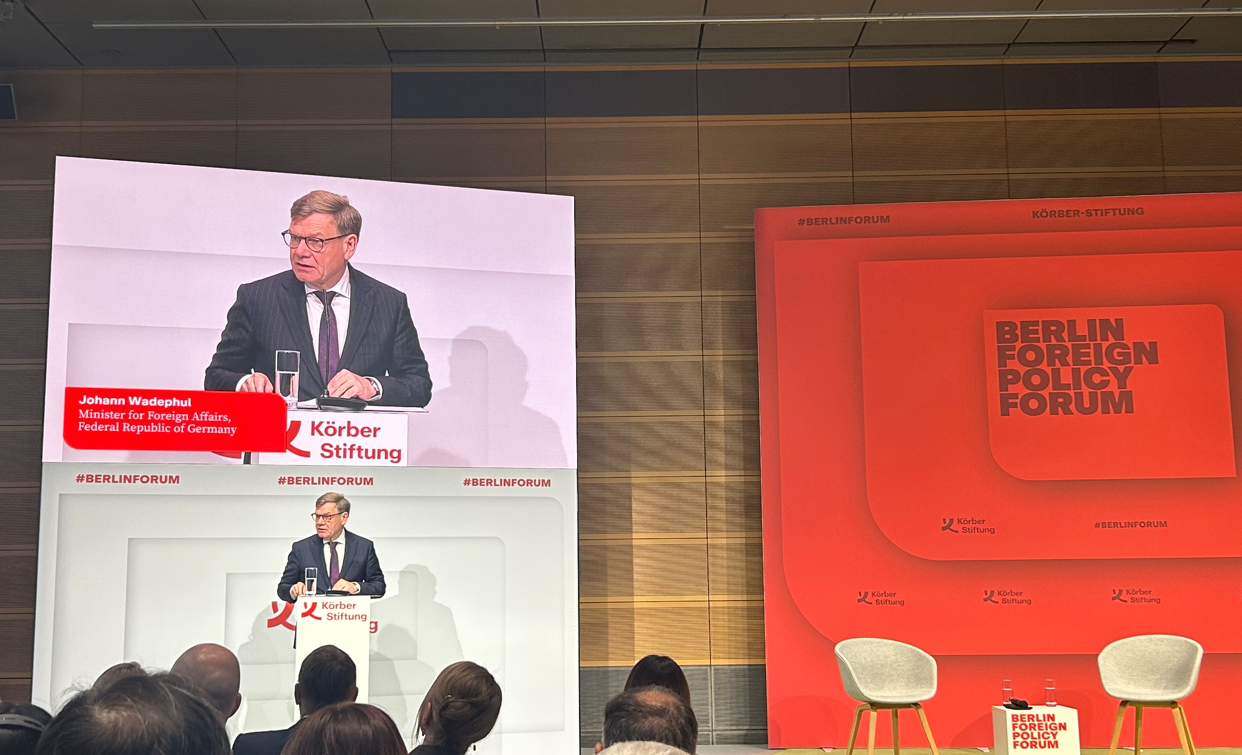
German Foreign Minister Johann Wadephul speaks at the Berlin Foreign Policy Forum on Nov 25, 2025. (Photo provided by Sun Chenghao)
Not long ago, I attended this year’s Berlin Foreign Policy Forum. The discussions centered on European security and transatlantic relations, with the Ukraine crisis unsurprisingly occupying the spotlight. What struck me most was how firmly Europe’s strategic community had been pulled along by the “28-point peace plan” that was suddenly unveiled by Washington. Nearly all conversations—whether by policymakers, scholars or journalists—began with this plan, which was drafted by the United States without European involvement yet would directly shape matters at the core of Europe’s security interests.
The mood at the forum was complex, combining surprise, dissatisfaction and anxiety. But what stood out even more was the rapid spread of a kind of self-adjustment. On one hand, Europeans emphasized that the U.S. had failed to consult them in advance; on the other, they kept reassuring themselves that at least U.S. President Donald Trump still appeared willing to engage in the Russia-Ukraine conflict.
This emotional shift itself shows that Trump has, in effect, already succeeded in managing Europe’s expectations.
In private conversations I had with participants, many admitted outright that they had no idea the U.S. would publish a peace plan in such a precipitous manner. However, once they finished complaining, they quickly pivoted to stressing that “ at least the U.S. is still paying attention to the conflict, which is better than we expected.
This instinct for self-reassurance reflects Europe’s deep structural dependence on American security commitments. Even when Washington behaves unpredictably, Europeans would rather believe that the worst-case scenario has not yet arrived. This does not constitute an endorsement of U.S. policy but is rather an unavoidable judgment shaped by reality.
Europe’s initial reaction to the peace plan was, of course, negative. Some in the strategic community argued that the plan nearly crossed several long-held European red lines—rejecting changes to borders by force, opposing restrictions on a sovereign state’s alliance choices and resisting limits on Ukraine’s military capabilities. But what truly puts Europe in a bind is that, even while recognizing the grave problems in the U.S. proposal, it still cannot openly confront Washington’s “arrangement” or handle the Russian threat independently.
Several experts at the forum noted that if Trump ultimately decided to abandon Ukraine, Europe would not have the capability to deal with Russia on its own. This explains why attitudes shifted so quickly from dissatisfaction to pragmatism. The core issue is not that Europe agrees with Trump, but that it has no viable strategic alternatives.
At the same time, the forum saw the release of new polling from The Berlin Pulse that revealed Europe’s internal contradictions. Only 27 percent of Germans consider German-American relations to be good, while 72 percent support nearly doubling Germany’s defense budget over the next decade. Public trust in the U.S. is dropping across Europe, and there is broad acceptance of the notion that Europe must strengthen its military capabilities. Yet when asked whether Germany should assume a military leadership role in Europe, 61 percent of Germans opposed the idea.
This captures Europe’s strategic predicament: anxiety over an “unreliable America” is growing, but the political and social willingness to take on greater security responsibility remains weak.
This context gave rise to several striking remarks at the forum. Some said, “We need to improve the American plan, not reject it.” Others argued, “The goal is not to confront Trump but to prevent him from being misled.” In some discussions, the focus was not on building European strategic autonomy but on how to “manage Trump” to prevent decisions even more unfavorable to Europe. Such “role misalignment” reflects how Trump’s influence is taking concrete form in Europe: Instead of trying to shape U.S. behavior, Europe is proactively adjusting its expectations to fit Trump’s decision-making style.
At a deeper level, this dynamic reveals not only the immediate pressure created by shifts in U.S. policy but also Europe’s long-standing structural constraints. Europe has hoped to reduce dependence on Washington, but in defense industry capacity, financial resources and strategic culture it still lacks the foundations for genuine strategic autonomy.
The Berlin Pulse poll found that while 56 percent of Germans support deploying a European peacekeeping mission to Ukraine in the future, European states remain divided over force integration, equipment standards and deployment capabilities. As a result, Europe cannot detach itself from the U.S. strategic framework and can only try to exert influence within a limited space.
From the perspective of the Trump administration, Europe’s discontent does not translate into meaningful pushback but rather becomes something to be managed. By forcefully putting forward its plan, Washington leaves Europe with no choice but to adjust within the parameters set by the United States. This reinforces the structural asymmetry in the transatlantic relationship. Trump is not explicitly demanding concessions from Europe, yet Europe is already conducting policy discussions around an American agenda. In a sense, Trump is achieving maximum psychological influence over Europe with minimal investment.
Looking ahead, the transatlantic relationship will not undergo a complete rupture. Europe has no geopolitical alternative to the United States, and Washington cannot entirely abandon its key European allies. But the underlying structure of trust is undergoing fundamental change.
Europe increasingly sees the U.S. not as a predictable, reliable and communicative security provider but as a powerful partner that must be constantly managed and whose risks must be hedged. Trump has made Europeans recognize that the U.S. may no longer view the transatlantic alliance as an irreplaceable strategic asset but as a relationship subject to bargaining and redefinition.
For Europe, the real challenge is not how to respond to a U.S. peace proposal but whether it can psychologically and institutionally reduce its deep dependence on the United States and build a more stable strategic framework. At present, European strategic autonomy remains highly endorsed in theory but difficult to implement in practice. Trump’s reemergence has merely accelerated the exposure of this contradiction.
Reflecting on the many conversations at the Berlin Foreign Policy Forum, my strongest impression is that Trump does not need to change Europe. He only needs Europe to accept that the U.S. will not change. This acceptance is the clearest sign that expectations have been managed successfully.
Europe’s dissatisfaction, anxiety and dependence will continue to shape the next stage of transatlantic relations. The rift may not lead to a break. But it will likely lead to a relationship that becomes ever more transactional, more realist and ultimately more fragile.
