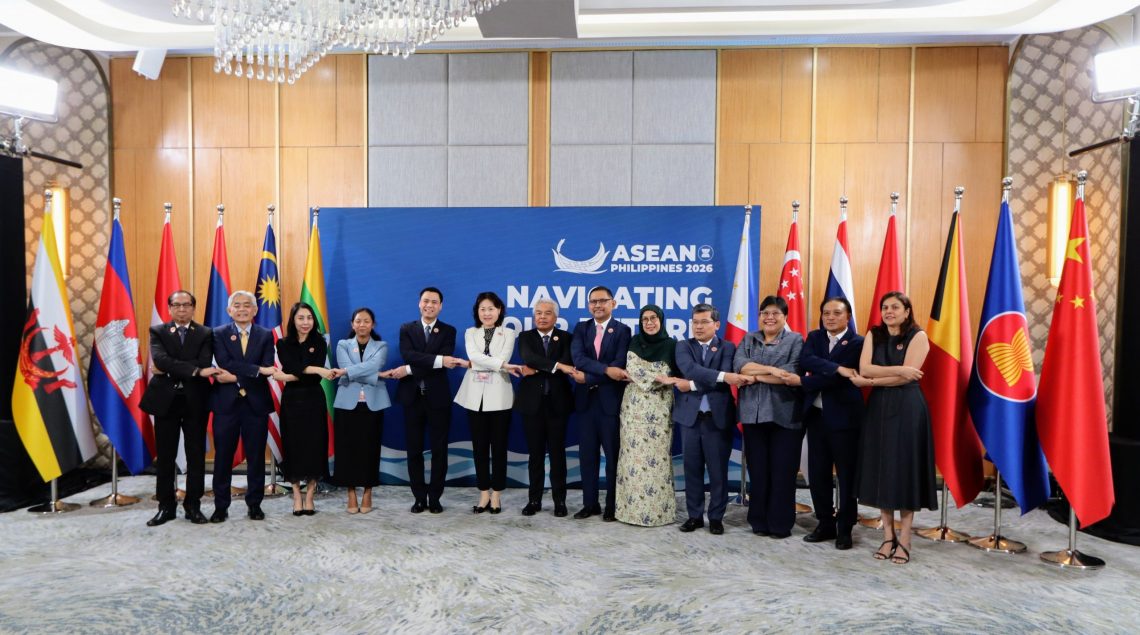
Senior Officials of ASEAN Member States and China met for the 25th ASEAN-China SOM-DOC on 30 January 2026 in Cebu, the Philippines.
The resumption of diplomatic dialogue between the Philippines and China in Cebu on January 29, ahead of the ASEAN-China Senior Officials Meeting on the Code of Conduct negotiations, is a welcome development. Avoiding conflict and preventing the deterioration of bilateral relations are imperative for the Philippines and China. Cooperation and productive ties can persist amid differences. The practice of other South China Sea coastal states is illustrative. Several points are worth considering.
First, do not make a bad situation worse. Although China has held de facto control over Scarborough Shoal since 2012, Manila restored fishing access in 2016 and even proposed turning the feature into a marine sanctuary before Beijing did. While far from ideal, the efforts to reassert Philippine authority are unmistakable. Fishing and patrols resumed, not without occasional challenges. This has been the uneasy status quo in the contested atoll. But in recent years, worsening ties diminished restraint. When Manila passed a maritime zones law in November 2024, Beijing replied by drawing baselines around Scarborough in a legal tit-for-tat. A week after the 10th Multilateral Maritime Cooperative Activity (MMCA) between naval and air assets of the Philippines, Australia, Canada, and the United States (September 2-3) in waters near the shoal, Beijing designated the feature a nature reserve (September 10). This State Council-approved move only made matters worse for Manila.
Second, if you cannot improve the situation on one front, why add another? Calming boiling tensions in the West Philippine Sea (WPS) is Manila's immediate priority. As the spike in daring mishaps over the last two years has shown, Manila's transparency campaign, deepening of alliance ties with the U.S., and induction of new security partners have yet to deter China or lower the temperature. While exposing near misses and skirmishes paints China as the bully or aggressor, the theorized reputational costs that would sway Beijing's behavior have yet to materialize. In fact, quite the opposite, China is doubling down. This raises questions about the endgame for Manila's bare-all, tell-all approach.
Meanwhile, Beijing's firm stance on Taiwan did not dissuade Manila from warming to a cross-Strait contingency, prompting a stern warning from its big neighbor against infringing on the One China Policy. Using the Taiwan card to gain concessions in the SCS can be a risky game. Last January 2025, President Ferdinand Marcos Jr. hinted at returning the U.S. Typhon missile system stationed in northern Luzon facing Taiwan if China would cease its expansive claims and exercise restraint to avoid untoward incidents. Geographic proximity and the presence of a large Filipino community on the self-ruled island gave Manila ample reason to be wary of recent developments. Whether hosting more U.S. arms and troops is the only role it can play is the question.
Third, avoid using force against civilians, especially artisanal fisherfolk making a living in choppy waters. It is one thing to make excessive claims. It is another thing to employ lethal force to implement it. China has little to gain and has a lot to lose from disrupting Filipino fishers operating in their own country’s exclusive economic zone. The diplomatic or economic fallout from injury or casualties in a high-profile fishing incident far outweighs law enforcement gains. Manila’s ties with Taipei suffered a crisis in 2013 after an elderly Taiwanese fisherman was killed in the course of a Philippine Coast Guard operation in Balintang Channel. Taiwan issued a travel alert, suspended hiring Filipino workers, recalled its representative in Manila, and conducted drills in the Bashi Channel.
In 2017, former President Rodrigo Duterte apologized for the death of two Vietnamese fishermen after a Philippine Navy ship chased and apprehended their vessel near Sual, Pangasinan. The government dropped charges, waived fines, and promised compensation to the families of the two casualties. Duterte personally witnessed the return of the five remaining fishermen to their home country. In 2016, he likewise led the send-off of 17 Vietnamese fishers caught in waters off Ilocos Sur. Such deeds earn goodwill. Fishermen should be spared from inter-state jurisdictional fracas. Extending assistance to distressed fishers and sailors should be encouraged. The Philippine Coast Guard thanked its Chinese counterpart for the rescue of 17 distressed Filipino crew of the cargo ship MV Devon Bay, which sank near Scarborough Shoal last January 23.
Fourth, praise in public, criticize and negotiate in private. China's nine or ten dash lines, or its "four shas" gained little international adherents, but Manila's neighbors neither endorse nor are likely to adopt its megaphone play. Quiet, discreet diplomacy still delivers for them. Besides, they prefer tangible, on-the-ground results rather than noise or diplomatic plaudits. Vietnam is stepping up its reclamation work in the Spratlys and may even surpass China's artificial island building. Last August 2024, Malaysia began gas production at its Kasawari field, an offshore block located 200 kilometers off Sarawak's South China Sea (SCS) coast, a site of contention with China.
State-owned Petronas discovered Kasawari in 2011, the same year China interfered with a Philippine-sanctioned exploration ship in the hydrocarbon-rich Recto Bank. How did Malaysia move from discovery to exploitation, while Manila declared force majeure and froze upstream work in its most promising petroleum site? Malaysia is even positioning Kasawari to become one of the world's largest carbon capture and sequestration projects. The opposite of transparency is not acquiescence, and silence is not surrender. Negotiating with China is not appeasement. In fact, it is shrewd diplomacy that works if one does it astutely.
Fifth, be on the table, not on the menu. Talks restored Filipino fishing access in Scarborough Shoal in 2016. It facilitated unimpeded resupply missions to Second Thomas Shoal after the June 2024 incident. However, apart from the annual vice-ministerial level bilateral consultation mechanism, regular and high-level channels between the two sides are few and far between. In contrast, China and India, post-Galwan, patiently committed to de-escalation and a phased withdrawal, with several rounds of meetings among top diplomats, special representatives, working-level officials, and military commanders on the ground. No such mechanism exists between Manila and Beijing in the South China Sea. Previous hotline communications between their two coast guards and security dialogues were discontinued. The Philippines skipped the 19th Western Pacific Naval Symposium held in Qingdao last year and has been absent from recent iterations of Beijing's Xiangshan Forum.
Meanwhile, Manila's ASEAN neighbors, including SCS littoral states, have been increasing security exchanges with China. Joint military drills are taking place, such as the sixth round of the Aman Youyi exercises between Malaysia and China last October. High-level dialogues were also established, such as the "2+2" Indonesia-China Defense and Foreign Policy Dialogue last April and the 2024 "3+3" Vietnam-China Strategic Dialogue between their defense, foreign policy, and public security ministries. ASEAN countries even went so far as to procure Chinese arms. Malaysia got patrol ships, Thailand bought submarines, and Indonesia ordered fighter aircraft.
The U.S. is also reviving military-to-military ties with its near peer competitor. Secretary of War Pete Hegseth met Defense Minister Dong Jun in Kuala Lumpur on the sidelines of the ASEAN Summit last October. In a subsequent phone call, both agreed to set up a communications channel. More importantly, Presidents Donald Trump and Xi Jinping met in Busan during the APEC Summit last October. The two leaders also had a subsequent phone conversation where they discussed trade, tariffs, Taiwan, and Ukraine. They may meet in Beijing this April.
Leaders from U.S. allies have also travelled to Beijing for landmark trips to meet Xi and other Chinese leaders since December. They include French President Emmanuel Macron (December 3-5, 2025), Irish Prime Minister Michael Martin (January 4-8, 2026), South Korean President Lee Jae-myung (January 4-7), Canadian Prime Minister Mark Carney (January 13-17), Finnish Prime Minister Petteri Orpo (January 25-28) and British Prime Minister Keir Starmer (January 28-30).
Regrettably, no such thaw is in sight between Manila and Beijing. The Philippines should avoid being sidelined in any major power deal between its largest trade partner and its longstanding treaty ally. There is no substitute for direct, preferably even multiple, contact lines between neighboring disputants.
Sixth, while it is true that might be not right, right is not the only form of might. There is a huge power asymmetry between the Philippines and China, with Beijing light-years ahead in terms of many metrics. But it does not mean one can, one should. As the bigger power, China should exercise more restraint, a mark of a responsible major power. On the part of the Philippines, having tried the legal approach, taking China to court in 2013, it should carefully assess the utility of filing a second lawsuit. More than nine years have passed, yet enforcing the 2016 arbitration award remains an enigma. China continues to defy the ruling and has weathered the costs of ignoring it. While G7 countries pressured or encouraged China to abide by the award, other SCS littoral states had been careful in referencing the judgment. Given Manila's quandary, it is hard to imagine other SCS neighbors following Manila's lead. This underscores the realpolitik limits of international law in challenging a big power's excessive territorial or maritime claims.
Seventh, both sides should avoid taking it too far down the road with little face-saving exits or off-ramps. The July 2024 provisional arrangement to facilitate unfettered resupply runs to BRP Sierra Madre helped defuse tensions in Second Thomas Shoal. It came after one of the most violent episodes between Manila and Beijing in SCS. Many other hotspots in the contested sea demand similar mechanisms or agreements, whether informal or otherwise. There had been proposals to expand the interim deal's geographic coverage. Proposals to create foreign ministry and presidential hotlines were made, but not much was heard of them since. Allowing the temperature to rise with little or no outlet for exhaust may lead to worse encounters neither side wants.
Finally, preventing lasting damage to bilateral ties is important. The Soviet Union dismantled the nuclear missiles it had installed in Cuba in 1962, with the U.S. reciprocating by withdrawing Jupiter missiles from Italy and Turkey the following year. However, U.S.-Cuba relations never recovered. To this day, Havana suffers from one of the longest-running U.S. sanctions spanning over 60 years. The capture of Venezuelan President Nicolas Maduro may mean precluding oil deliveries that can further starve the island of much-needed energy. Nicaragua took the U.S. to court and won in 1986. The U.S. did not participate, blocked enforcement, and refused to pay compensation. The U.S. continued to intervene in Nicaragua's domestic affairs well after the International Court of Justice's ruling, covertly aiding the Contras until the Sandinistas lost the elections and a new leadership came to Managua in 1990. The U.S. remembers, so does China.
Disputes, suspicions, and power asymmetry exist. Managing them effectively is imperative, especially for smaller states living alongside larger actors. And for big powers with global ambitions, respect is first earned at home and in their immediate neighborhood.
*This piece is based on the author’s article “Manila Alza La Voce Ma Perde Il Suo Mare,” published by Limes (The Italian Review of Geopolitics) in Italian text last December. It was updated to factor recent events.
