
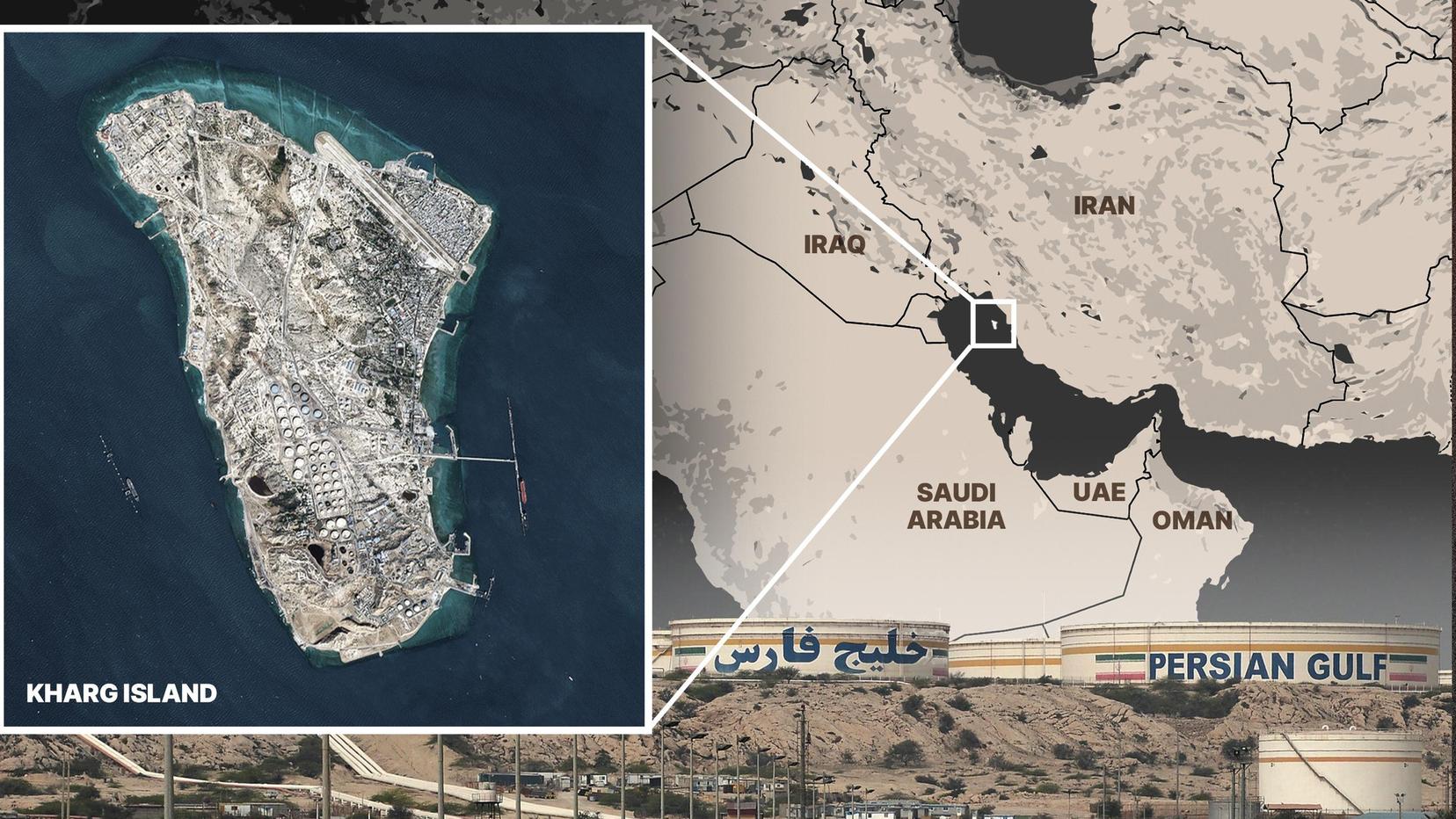
Kharg Island is home to a terminal that handles 90 per cent of Iran’s oil exports. (Credit: The Nightly)
The war against Iran is not going well for Israel, which is being bombarded daily, nor is it going well for the US, which has seen its military bases and strategic facilities in the region attacked and degraded by Iranian drones and missiles. Of course, Iran suffers most of all, but it has shown a remarkable capacity to fight a war of attrition, despite the dreadful daily onslaught from the skies. Its reconstituted leadership has shown not a hint of the “unconditional surrender” that Trump is demanding.
When a government, even an extremely cruel, autocratic and unpopular one, is attacked with generalized strikes that blow up schools, desalination plants and set civilian neighborhoods on fire, the citizenry can be forgiven for not welcoming their self-styled foreign liberators with open arms. History convincingly shows that air attacks alone rarely induce regime change, let alone the installation of a government friendly to the attackers. Sooner or later, it comes down to boots on the ground and a willingness for the visiting military forces to make the kind of huge sacrifices that people defending the only home they have ever known are capable of sustaining.
In a conflict that sees goalposts shifting daily, the U.S. is touting the idea of landing U.S. troops in Iran, which signals a failure of the massive decapitation strike and instead points to a long, drawn-out war, with attendant disruption of shipping and oil flow that will transmit shock waves throughout the global economy.
Although it’s a fool’s game to guess what the erratic, impulsive and at times mentally unstable U.S. president is thinking, he does give clues to what’s on his mind. One word that comes up often is oil.
It came up even before the smoke cleared from the blistering U.S. attack on Venezuela that resulted in the successful kidnapping of its head of state Nicolas Maduro and its coming up in relation to Iran. Some of the grandstanding about oil can be understood as domestic messaging as Trump tries to placate a MAGA political base with strong isolationist tendencies and contempt for foreign expenditures.
Oil is the magic word, to placate the base and to suggest long-term profits from the very unprofitable exercise of U.S. military flexing for which billions of dollars are frittered away in a matter of days, not to mention the loss of expensive systems such as the THAAD radar sites, that cost a billion dollars a pop, a full five of which have allegedly been hit and perhaps permanently damaged due to inadequate planning and underestimation of enemy capabilities. Or consider the three advanced U.S. jets costing 99 million dollars each that were felled by friendly fire in the opening hours of the war.
Oil is the balm that helps reassure a rattled political base that these enormous financial expenditures are not being thrown away, that somehow these mistakes and investments can be recouped; though continually raising the tantalizing promise of oil is a coward’s game — the worst kind of obfuscation — because it does nothing to address the lives lost and permanently altered by the ferocious violence.
It is often simplistically noted by critics of U.S. imperial aggression that it’s all about oil; and while that premise is appealing due to its utter simplicity, it’s at best one of many complex considerations when a country contemplates crossing borders to kill strangers for a cause.
One school of wishful thinking about the full-throttle sneak attack by U.S. and Israeli forces launched in the midst of negotiations, is that it would all be over so quickly that ethical qualms about lies and murder could be placated by a stunning victory resulting in compliant regime change within days.
Few would argue that the regime was not in need of changing — the recent state murder of tens of thousands of Iranian protesters lays bare that fact — but if the hidebound regime, badly shaken though it might be, does not change, where does that leave the wannabe “liberators”? And more tragically, where does it leave the innocent citizenry of Iran?
The gamble, that an odious government would collapse in the shock and awe, did not happen, and there are few indications that it will happen any time soon. To say U.S. military attacks are making the world safe for democracy no longer convinces, if it ever did, but to admit outright it’s all about greed does not meet the propaganda needs of the moment either.
The erratic messaging of the Trump White House is a daily public relations disaster, reeking of incompetence, disregard for the truth and unapologetic sycophancy, but it leaves wiggle room for a leader who doesn’t like to be pinned down or follow through on promises made.
One day it’s about Iran’s nuclear program, the next day it’s about its conventional ballistic missiles. Perhaps the most unconvincing claim of all is that it was a preemptive strike against an imminent attack on the U.S. There are subsidiary justifications for untenable actions, such as citing the need to annihilate the Iranian Navy to ensure an uninterrupted flow of oil, invoked as a fig leaf to cover the Pentagon chief’s Peter Hegseth’s outrageous gloating when a U.S. sub torpedoed and sank an unarmed Iranian vessel in the Indian Ocean during its return journey from a military exercise in India.
Trump has also tried to gild his ill-considered strikes as a golden opportunity for the Iranian people to “take back” their country, though as the history of the hapless Kurds in Iraq amply demonstrates, the U.S. rarely does anything lasting or concrete to help the minority peoples it encourages to rebel.
Trashing the Iranian Navy in the name of preserving the flow of oil is overkill in the sense that it takes little more than persistent low-level drone strikes to make the Straits of Hormuz a passage too perilous for commercial shipping.
Trump, being a big talker interested in a quick buck, boasted that US military escorts could ensure safe passage — for a fee — but the promise, infeasible from the start, was quietly abandoned.
Given the prospect of a prolonged conflict that has no obvious endgame or criteria for success, the world awaits the latest crazed order from the White House with bated breath.
Already one can hear grumbling about boots on the ground, an extremely unpopular move that would unnerve Trump’s MAGA base and alienate most of the American population. Iran’s a huge mountainous country with resources and resistance potential enough to make Afghanistan look like a sideshow.
What might happen instead, even if it is not well-advised militarily, is a U.S. takeover of an Iranian island in the gulf rather than the attempt to penetrate the intimidating landmass of Iran proper. The island would likely be Kharg, sitting an hour from the Iran mainland, and currently the choke point for Iran’s oil processing through which 90% of the country’s crude oil flows.
It’s an island — easier to take, though perhaps not easy to defend given Iran’s drone capabilities. But with two aircraft carriers in the region, and soon a third, it might be a tempting target for the US to make a stand, with boots on the ground. It would appear to answer the need for Trump to convince his base that the U.S. stood to profit — 90% of Iran’s oil! — and even if it proved hard to exploit the oil or untenable to defend, it could be a spoiler, with the negative consequence of decimating Iran’s oil industry. Trump is far from alone in coveting control of oil, it is the lifeblood that sustains the Iran Revolutionary Guards as a viable fighting force.
