
Li Yan, Director of President's Office, China Institutes of Contemporary International Relations
Jul 24, 2023
A recent IAEA report says that Japan’s plan to dump radioactive wastewater from the Fukushima nuclear power plant into the Pacific Ocean meets safety standards. Not everyone is so glib. In navigating the controversy, China can play a positive role.
Karen Mancl, Professor Emerita of Food, Agricultural & Biological Engineering, The Ohio State University, and Fellow, Woodrow Wilson Center for International Scholars
Jun 02, 2022
The advent of plastic mulch has electrified agricultural output globally, with China leading the way in its application. Sadly, plastic fragments are now heavily polluting China’s agricultural soils. New regulations within the 14th five-year plan set out to greatly restrict the use of the ultra-thin plastic and protect China’s soil.
Karen Mancl, Professor Emerita of Food, Agricultural & Biological Engineering, The Ohio State University, and Fellow, Woodrow Wilson Center for International Scholars
Oct 07, 2021
In 2019, U.S. Customs seized 3400 pounds of invasive Chinese mitten crabs at the Cincinnati, Ohio airport. The mitten crab threatens commercial fishing and biodiversity and is listed on the top 100 worst invader list. China is hosting the 15th meeting of the Convention on Biodiversity and is in a position to show leadership in protecting aquatic environments.
He Yafei, Former Vice Minister of Foreign Affairs
Jun 30, 2021
Cooperation on this important issue will pave the way for joint efforts to overcome other global challenges. The wholehearted cooperation of China and the United States is essential for the success of any effort to solve global challenges. It is time for concerted action, not squabbling.
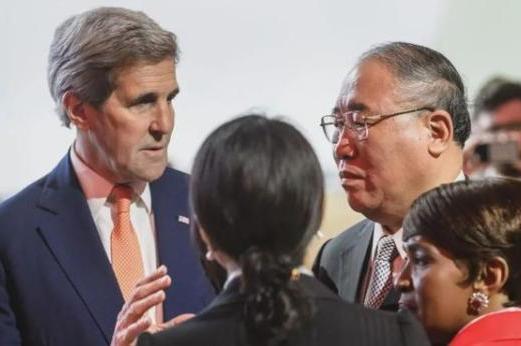
Han Liqun, Researcher, China Institutes of Contemporary International Relations
May 28, 2021
China and the United States should proceed from easier topics to more difficult ones, seeking new paradigms of interaction under new circumstances. Success in climate cooperation, if achieved, may serve as a demonstration of feasibility for other areas.

Andrew Sheng, Distinguished Fellow at the Asia Global Institute at the University of Hong Kong
Xiao Geng, Director of Institute of Policy and Practice at Shenzhen Finance Institute, Chinese University of Hong Kong
May 08, 2021
Last week, the world marked the 51st Earth Day. This year’s theme – “Restore Our Earth” – was apt. As the COVID-19 pandemic has reminded us, the effects of human activity on the planet do not respect borders. The Earth is a single living, self-regulating system, and it demands a single, shared system of accounting that balances at the global level. We need a one-Earth balance sheet.
Apr 27, 2021
Xi was the first national leader to speak after Biden, emphasizing the need to advance global environmental governance.
Mikaila Smith, J.D. Candidate at the University of Chicago Law School
Feb 08, 2021
China’s lack of environmental regulations has been fingered as a culprit in accelerating the climate crisis, but by digging into the nation’s opaque legal process, changes have been made quietly and consistently towards accountability in pollution and waste.
Andrew Sheng, Distinguished Fellow at the Asia Global Institute at the University of Hong Kong
Xiao Geng, Director of Institute of Policy and Practice at Shenzhen Finance Institute, Chinese University of Hong Kong
Jan 06, 2021
As the United States prepares for a radical course-correction on climate change, China is raising its game. Climate action has become yet another front in the competition between the world’s two largest economies. Who will cross the net-zero-emissions finish line first?
Shang-Jin Wei, Professor, Finance and Economics at Columbia University
Dec 23, 2020
China’s pledge in September to pursue carbon neutrality by 2060 was followed by a similar pledge from Japan a month later. With these commitments being made at a time when the US has withdrawn from the Paris climate accord, it is easy to interpret them as part of the ongoing geopolitical competition for global leadership. But managing climate change is not a zero-sum game. Here, national competition to strengthen ambitions and policies benefits everyone.
Back to Top

- China-US Focus builds trust and understanding between the U.S. and China through open dialogue among thought leaders.