
The U.S.-Israel strike on Iran lacks a clear legal basis or credible justification and represents a high-risk gamble by the Trump administration. Despite early military success, the operation faces uncertain prospects, including limited chances of regime change and the risk of prolonged conflict.
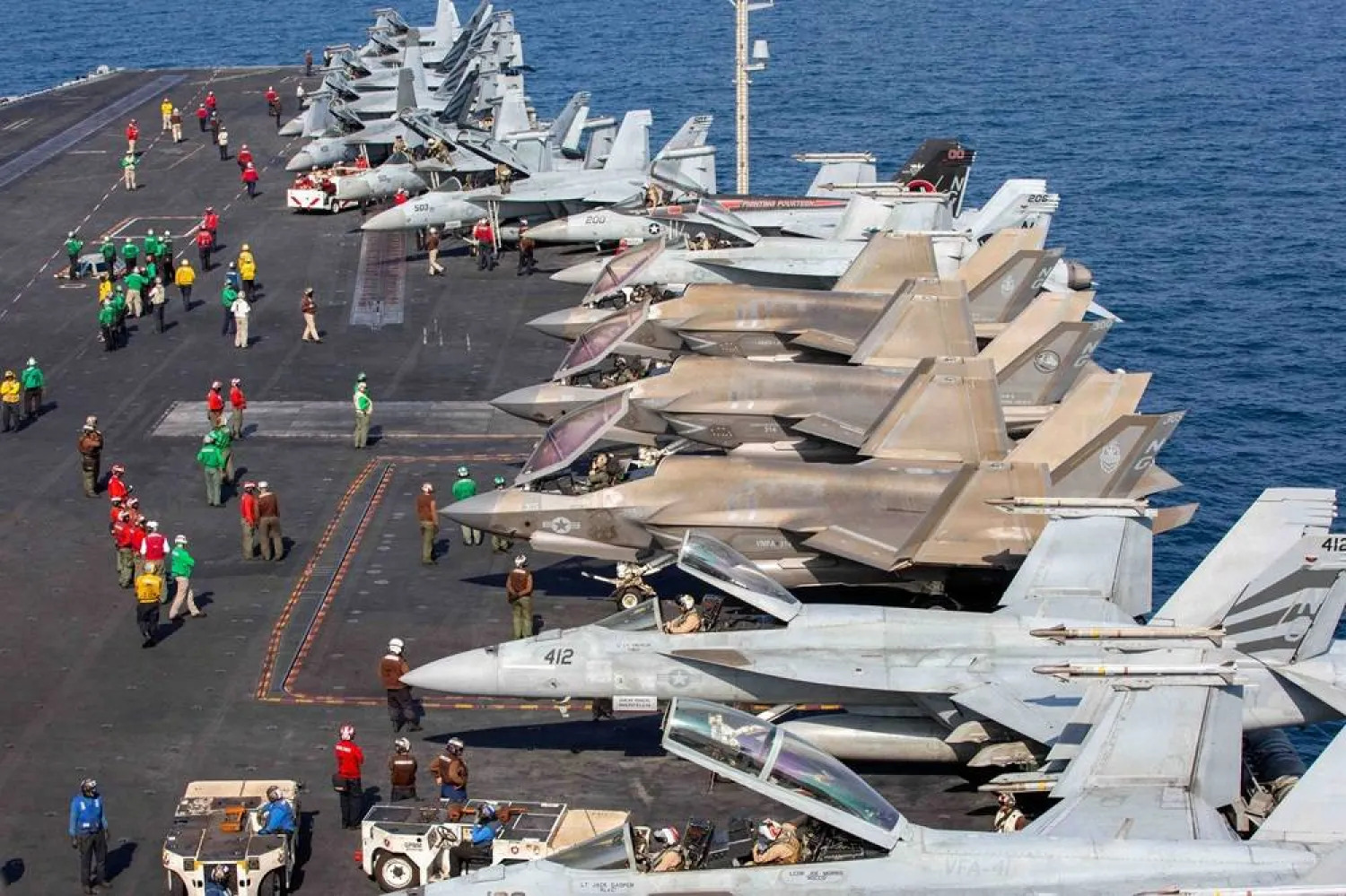
Aircraft attached to Carrier Air Wing (CVW) 9 sit on the flight deck of the U.S. Navy Nimitz-class aircraft carrier USS Abraham Lincoln in support of the Operation Epic Fury attack on Iran, February 28, 2026. (Photo: U.S. Navy)
On February 28th, the United States and Israel launched a military strike against Iran. Subsequent reports confirmed that several top Iranian leaders, including Khamenei, had been killed in the attack. This scene bears a striking resemblance to the U.S. kidnapping of Venezuelan President Maduro in early January, leading many to view it as another "Maduro incident" or an "updated version of the Maduro incident," ignoring the three core questions behind it. For anyone concerned about this conflict, we need to know the answers to these three questions: What is the legal basis for Trump's war? Is the U.S.'s justification for war against Iran valid? And what is the prospect of this war? In my view, the answer to all three core questions is "no," making Trump's military operation more of a high-stakes gamble with an uncertain future.
The first "no" is that Trump's legal basis for going to war with Iran is nonexistent. As Harvard professor Matthew Bunn has pointed out, a U.S. military attack on Iran, also a UN member, completely violates the UN Charter. The UN Charter explicitly prohibits military action against a party that has not yet launched an attack or is about to launch one; Iran clearly does not fall into either of these categories.
At the domestic law level, regardless of whether Trump declares war, the scale of his military action against Iran is tantamount to a formal war, far exceeding the war powers granted to the U.S. president by the Constitution. According to the U.S. Constitution, the power to declare war belongs to Congress. Trump’s military action was neither discussed nor debated by Congress and therefore did not receive congressional approval. Historically, while there have been instances of presidents using force abroad without a declaration of war, these have usually involved some debate in Congress to gain full support. The U.S. military action against Iran this time appears to have been conducted without formal discussion in Congress. A victory on the battlefield might help resolve congressional divisions on the Iran issue; however, if the battlefield turns against him, it will leave Trump in a difficult position.
The second "no" is that Trump's pretext for going to war with Iran is not so credible either. Trump has yet to provide a convincing reason for war, which makes the so-called "Iranian threat" seem like a complete fabrication. At present, Iran is arguably at one of its weakest points in decades, and likely cannot pose a greater threat than before. Following the U.S.-Israel airstrikes last year, Iran did not quickly resume its uranium enrichment program. According to the IAEA's assessment, it would take Iran several months to partially restore its uranium enrichment capabilities, which is fundamentally different from a genuine nuclear weapons program. Regarding the ballistic missiles, Iran's missile capabilities are insufficient to pose a real threat to the United States, as Iran does not possess the capability to launch intercontinental ballistic missiles. Without reliable security guarantees, Trump's demand that Iran abandon its ballistic capabilities is equally unrealistic. It is difficult to imagine that Iran has any other military means of self-defense besides its limited ballistic missiles.
Equally exaggerated are the accusations that Iran supports terrorism and proxies. It is well known that Iran's allies in the Middle East have been severely weakened in recent years. In Syria, the Bashar al-Assad regime, a staunch ally of Iran, collapsed in late2024; in Lebanon, Hezbollah crumbled after the assassination of its leadership and the loss of its strategic access to Syria; in the Gaza Strip, Hamas suffered heavy losses under Israel's bloody and brutal repression, leaving only an image of unyielding resistance; and the Houthi rebels in Yemen, with their civil war underpinnings, have been repeatedly bombed and their influence confined to a limited area. More importantly, there is no indication that Iran has recently increased its substantial support for these regional allies, or that these threats are imminent and urgently need to be addressed.
The third "no" is that the prospects Trump envisions in Iran are not so certain. Although the U.S. and Israel succeeded in their initial attacks on Iran, these successful military strikes are only the beginning, far from the end of the war. So far, the Trump administration has not provided the public with a clear objective for the war. This inevitably raises doubts about where the war will end and whether the U.S. is willing to pay the corresponding price.
First, regarding Iran's nuclear or missile programs, many experts believe that U.S. military action seems unnecessary. Iran's missile and nuclear programs do not pose an imminent threat. Even if the U.S. can continue to severely damage Iranian missile bases or remaining nuclear facilities, it cannot deprive Iran of the relevant knowledge and technology. Given time, Iran can still gradually rebuild them.
Second, regarding changing Iran's policy towards the U.S., although Khamenei and others have died in military operations, the regime change that the U.S. and Israel are hoping for may not materialize. As some U.S. media have stated, "This is not Venezuela, there won't be a deputy Ayatollah succeeding the supreme leader." On the one hand, neither the U.S. nor Israel is likely to invest significant resources in supporting a new pro-American regime; on the other hand, even if the U.S. and Israel intended to support a new regime, they may not be able to find a suitable proxy within Iran. Perhaps some exiled Iranian groups hope to seize power, but they may not possess the domestic political and organizational foundation that Khomeini had in the 1970s. The future of Iran may be weaker, but if Iran descends into internal strife due to a failed power transition, the emergence of more radical anti-American forces cannot be ruled out. This, too, may not be the outcome Trump desires.
Last but not least, Iran's retaliation could incur unexpected costs for the United States. Despite the significant military disparity between Iran and the U.S., a determined Iranian counterattack could still inflict unforeseen damage on the U.S. It should be noted that Iran is a country more populous than Afghanistan, with more resources, territory, and national ambitions. Iran's retaliation may not be a powerful military deterrent with thousands of missiles launched simultaneously, but rather a demonstration of unwavering will and determination through sustained counterattacks. If this is the case, it would be the quagmire of war that Trump least wants to see.
